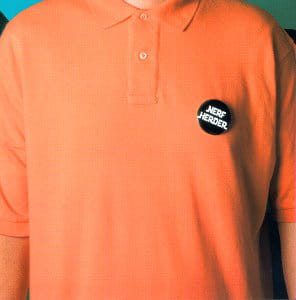
The landscape for 1990s punk rock in Southern California was vast and diverse. Coming up in a time with fast guitars and double bass pedals, Nerf Herder carved out a niche that teeters on a lot of different lines. Yet, Parry Gripp and crew have endured for over thirty years playing a brand of punk rock that is musically and lyrically their own. With songs teeming with great hooks and more nerd references than you can shake a stick at, Nerf Herder was able to stand out in a sea of sometimes carbon-copied punk rock bands.
In between Nerf Herder’s active times, lead singer, Parry Gripp has made a career out of making the same types of silly songs for a younger audience, but also jingles for brands like Wawa Food Markets and Hallmark Cards. Gripp has written themes and songs for a number of TV shows including The Super Hero Squad Show, Ben 10: Omniverse, and StoryBots Super Songs. In 2017, he won a Daytime Emmy for the song “I’m not Very Nice” from the Disney TV show the 7D based on Snow White and the Seven Dwarfs.
This year Nerf Herder celebrates thirty years of their self-titled LP. We talked to Parry about the record that started it all, its legacy and how it is still finding new fans three decades later.
(Edited for clarity)
Parry Gripp: Sorry it took so long for us to finally talk, but here we are.
Dying Scene (Forrest Gaddis): No worries, man. Thank you for doing this. I’ve met you a couple of times at shows and you’re always so fun and cool to talk to.
That’s very flattering. Thank you. What town do you live in?
I’m in Orange County. I saw you at Chain Reaction years ago. You guys played with Peelander Z.
OK, that’s going way back. That was 2006, I think.
Then we saw you about ten years ago at Slide Bar.
Oh, right. OK, yeah. Yeah, right. I remember that.
I do have to say my daughter was really excited that we are talking because she liked the StoryBots when she was younger. I played a little bit of Nerf Herder. She’s a teenager now, and getting into punk rock, I told her you wrote “Walk Like A Camel.”
I think “Walk Like A Camel” is my favorite song I’ve ever written. So I’m glad you referenced that.
It was funny because she was watching the show, and I’m like, “Are they ripping Parry from Nerf Herder off?” And then I look, and I’m like, “Oh, it’s Parry from Nerf Herder.”
That’s so funny.
How did Nerf Herder initially come together?
We’re from Santa Barbara, which is a small town, and at the time, it was the mid to late 90s. Every person you knew was in a band. There was no Googling or anything like that. You just had to do something. And what do you do? Oh, you’re in a band. That’s kind of what everyone was doing. Steve and I went to the same high school; we had known each other for a while. Charlie was just a guy in other bands from around town. We just started playing together.
It’s a natural thing. Really, it’s unbelievable we’re still playing because at the time it was just a way to hang out with other people in bands. I don’t know if you’ve ever been in a band. It’s just a way to have a social life. We were just excited to be playing at the Mexican restaurant with all the other bands around town. We weren’t super serious about it. I was really hoping that my girlfriend would be impressed and not dump me. So, that was a big motivator, too.
Who were the bigger bands in Santa Barbara at the time?
Lagwagon was from Santa Barbara, and they had been somewhat bigger at that point. There were touring bands. Toad the Wet Sprocket earlier was a huge band from Santa Barbara. Other bands that came out of that scene, like Summer Camp, who we’re playing with at this 30th-anniversary show in Santa Barbara, they got signed. Dishwalla was a big band that came out of that scene. They were just guys we all knew. It was kind of a small town, and still kind of a small town. It just was something to do. Everyone was in a band.
Was there ever a weird bill or a strange lineup that you were on in those early days that didn’t make sense, or was it just those bands essentially rotating out?
Because it was a small town, you ended up playing with just whoever was standing around. So, there were all kinds. I mean, I think the 90s was just this weird experimenting time for bands. There were grunge bands, punk bands, there were still metal bands, and there were folk rock bands. I think that you would play with weirdos all the time, but you didn’t really think about it.
What do you remember about the early shows?
Yeah, I mean, they were chaotic, and we just wanted to play. I think we had like six songs when we played our first show. It wasn’t like a full set. We basically just wanted to have enough songs to be able to get on stage for a little bit.
One thing I remember, we had been playing for a few months, and after a while, we came up with a cassette tape that had “Sorry” on it, and the local radio station played it. I remember at that point we were playing at Alex’s Cantina, which is a Mexican restaurant downtown. There were high school kids who couldn’t get in because it was a bar, standing outside and watching us through the window. I remember thinking, “Oh, that’s kind of neat that these kids had heard it on the radio.” Here they were, going downtown to watch us through the window at the Mexican restaurant.
Was there a moment you realized the band was working better than you thought?
Yeah, I guess when Joey Cape from Lagwagon had us record our debut record, I mean, that seemed like a big step. We thought maybe it would be like playing L.A. and San Francisco and stuff like that. It happened really fast. We were signed to Arista, this big label, and we had a video on MTV. That was like, wow, this is it, it just seems insane. It’s still crazy to me. You sort of assume anything can happen at that point.
What was the time between you guys starting the band and you guys signing and getting on MTV?
I think it was a couple of years. It seemed fast. I mean, we were just having fun, playing different things, and then doing the record with Joey. That was really exciting. We didn’t know it would happen. Then “Van Halen,” our song, which is really dumb and goofy, was picked up by radio, and that just seems unbelievable. We just wrote that song to be funny for the people that were at the Mexican restaurant. We didn’t ever think that Sammy Hagar, Van Halen, or anyone like that would hear the song. That just seems crazy. It still seems crazy.
I know Sammy Hagar wasn’t initially enthused about the song. Has he ever said anything about it since then, or have you run into him?
I can imagine if someone sang that song about me, I would be really mad and bummed, too. So I totally understand that. The point of a lot of Nerf Herder songs is that the guy singing the song is kind of crazy. I call it a relatable idiot type person. I mean, I don’t really dislike Sammy Hagar, but the character singing the song does. He’s really mad about it. I don’t know, but I still don’t want to meet Sammy Hagar.
Although Sammy Hagar was on this PBS show, Finding Your Roots, I don’t know if you’ve ever seen the show, but he was on that show and my wife watched it. She’s like, “Oh, you’ve got to watch this show about Sammy Hagar. You will love him after you watch it. Your heart will go out to him.” He had kind of a crazy life and a hard upbringing. I might have written a different song if it came out before we wrote Van Halen. I still think it’s a funny song.
Do you feel any different about any of the songs that you wrote outside of “Van Halen” since that time?
Not really, no. I mean, they’re all kind of satirical. They were kind of ridiculous when we wrote them. I still feel that way about them. It’s weird looking back at something you wrote thirty years ago. It’s sort of like you’re thinking about a different person, but I still like them. I think they’re funny. I think they’re silly.
I know you write a lot more kid-friendly stuff now. Have any of those kids become Nerf Herder fans?
It’s funny. People bring their little kids to Nerf Herder shows. When I can, I explain, “Hey, Nerf Herder is different.” They’re always like, “We know.” The parents know they shouldn’t bring their kid to this thing. Recently, we’ve had a lot of younger people, like high school kids, coming to see Nerf Herder. I think it’s because they found How To Meet Girls. It’s weird to me. I’ve even asked them, “What are you doing here? You’re in high school.” They really like “Feeling Bad” and “Pervert.” They love the song “Pervert.” I can’t really advocate for that. It’s kind of strange, but I’m glad people are there.
I feel like everyone looks at things superficially and sometimes doesn’t get satirical references.
It’s really different the way people take things, but I feel like these people get it. I think people understand satire. Maybe they think it’s something new. The 90s were sort of an “anything goes” kind of era with what you could say. It was understood that it was satirical or you were kind of making fun of a certain culture or something like that, but now it hasn’t been like that. So, I don’t know. What can you do?
When you write a song, especially thirty years ago, you didn’t think about how things would change. It’s just out there. What can you do? You can’t change that.
Are there any tracks you don’t play anymore for any reason, whether content-wise or because it’s not your favorite song in general?
I try not to play any songs that are difficult. We came out with this album, Rockingham. The song, “The Girl Who Listened to Rush,” is just hard to play. I try to avoid playing that. Those other guys, Linus, Ben, and Steve, they’ll want to play it. I try to veto that, but sometimes we do anything that’s difficult to play or difficult to sing.
Is there anything you felt was a personal song off this album?
“Golfshirt” is kind of personal. I think a lot of the songs I would write from a personal perspective, and then I would change the lyrics. They were kind of more ridiculous. Like “Sorry,” it’s really over the top. If you toned it down, it would be like a guy really whining. So you bump it up and then it’s sort of funny. I think that they all have kind of personal elements to them.
Do you feel “Golfshirt” is an outlier on this record compared to some of the other songs?
It’s a little more serious, but it’s also ridiculous. The sound of it is a little different, right? I guess there isn’t a song quite like that on there.
Have you changed any of the lyrics over the years to keep the pop culture references up to date, or do you keep them as they are?
We use the same references. Until recently, it was kind of the same people coming to see us. They would all get the reference.
What song from the album has surprised you the most that people love the most off that album?
Probably, “Nosering Girl,” just because it was really like a toss-off thing, with kind of ad-libbed lyrics, but people love that song; we always play it.
Were there any songs from these sessions that didn’t make the album but found a home later?
We had a song called “Hospital,” but I don’t think we recorded it that session.
How do you think the album fits into the larger pop-punk or nerd rock landscape in general?
I don’t know. I think it was sort of an earlier pop-punk record, but it has Weezer-y influences. We were really listening to NOFX, but we couldn’t play that fast. I think it fits in with the Fat Mike, NOFX-type stuff, the Weezer-type stuff, but a lot of it just has a Ramones thing. I don’t know how it fits. I hope it fits in; I don’t really know.
What’s the most unexpectedly cool thing that happened because of this album?
Oh, well, of course, having Mark Hamill in the video for “Sorry” was huge, but our whole having a record deal and getting to tour. I don’t think that would have happened without this record kind of starting it all for us. It’s weird to be thirty years later and still playing it; you just never imagine that you’ll be doing that.
How was it having Mark Hamill for the video for “Sorry”?
Oh, it was amazing. Oh, my God. It was great. That’s still like a high point in all of our lives. We were all such Star Wars fans, and to have Mark Hamill and Miguel Ferrer, he was amazing. I wish that we could have just hung out with Mark Hamill for the rest of our lives. I still can’t believe it. I look at the video. I’m like, I can’t believe Mark Hamill’s there yelling at us.
Did you figure this record would lead to a music career in general?
I don’t know, with a career in music, a lot of luck is involved in that. I think the whole time I was thinking, “Oh, this is going to stop and I’ll end up doing something else.” It’s been really lucky and strange.
My friends and I love For Those About The Shop…
I’m glad you got that.
We listened to that a lot.
Oh, I’m glad someone did.
Was that just you trying to show that you could do a bunch of different types of music?
I was just goofing around. Nerf Herder had kind of stopped, and it was just something to do for fun, the way you might take up woodworking or something. I was just like, “Oh, I’m going to write these songs.” When I had 50 of them, I thought, “I’ll see if someone will put this out.” “Do You Like Waffles?” is still a popular kids’ song. I don’t know how that happened, but it’s still getting played.
Was “Buffy the Vampire Slayer” your first musical work for TV? Like your first TV theme?
It was just a random thing. Some of the actors on the show liked our band, and they had us come up with something. They asked a bunch of bands, actually, and they liked what we came up with. It was again, sort of a luck kind of thing.
How long into Nerf Herder did that come out?
It was right when our record was being made and we were getting signed. Our first tour was with Weezer. We have a song about that. People back home were like, “Hey, we’re watching this TV show. You guys did the theme song.” It wasn’t like now where you just bring up YouTube or watch it online. There was none of that. You kind of relied on someone calling you on their landline.
Are there any elements from old material that you find yourself returning to in music now?
All of it. I mean, we try to regain that. The first record was so organic, and there was no real thought put into it. You try to mine that stuff again because it seemed like magic at the time. I think a lot of that, if you listen to Nerf Herder records, you’re like, “Whoa, these all sound kind of similar.”
Especially when you added the keyboard, was it the second or third record?
Yes, that’s the second record we did. We couldn’t play the keyboard too well.
You’re doing an anniversary show in Santa Barbara, a European tour, and an acoustic version of the album.
There’s some debate about whether it’s acoustic or not. All the guitars are acoustic, but the drums… I guess drums are normally acoustic. It’s kind of the same energy as the first record, just done with acoustic guitars. There are a few surprises in there, but I don’t know. It’s interesting. The initial idea was just for it to be like one microphone and us playing around the microphone. It’s turned into a produced version of the first record with acoustic guitars. You wouldn’t mistake one for the other.
Is it, for lack of a better term, like a Violent Femmes version of the first album?
Yeah, it’s kind of like a Violent Femmes version. Maybe not as out of control as that, but that was sort of the idea. Ben Pringle is playing his acoustic bass. Linus and I both play acoustic guitars. It was really fun to do. It’s fun to work on a record where you already have these songs so you don’t have to worry about messing with them, though we did mess with them a little bit. I’m excited to hear it when it comes out.
It’s coming out on Fat Wreck Chords. When we first started, Fat distributed the record. They were kind of there from the beginning. We’ve always been friends with them. It’s very exciting. The guy who kind of masterminded that was our drummer, Steve Sherlock. It was really his idea. He took it to Fat and they were like, “We’ll put this out.” I didn’t really think that would happen, but now that it’s happening, it’s great.
Are you guys incorporating these versions into the set?
We don’t really know. We’re going to get together at some point and figure out what we’re doing for these shows. We’re definitely playing the whole first record. I can’t imagine we would do some of it acoustically; we’ll see.
Are you guys working on any new music, or just focusing on the first record right now?
We’re really focusing on the first record. We have a lot of half-written songs where the bands played all the backing tracks, and they just need words and stuff like that. There are definitely things being worked on, slowly though.
Discover more from Dying Scene
Subscribe to get the latest posts sent to your email.