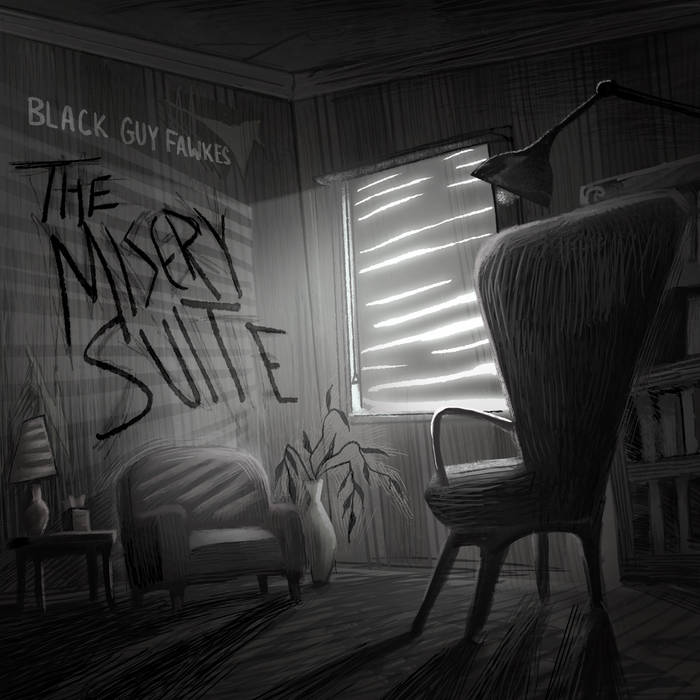
Ian Robinson – the artist better known as Black Guy Fawkes – is back with a brand new record, The Misery Suite. Due out next Friday (September 19th) on Asbestos Records, The Misery Suite marks Robinson’s latest full-length under the Black Guy Fawkes moniker. It’s chock-full of guest appearances by heavy hitting familiar names like Angelo Moore and Dave Hause and Linh Le and Kayleigh Goldsworthy and Ian “The Punk Cellist” Legge and many more. Most importantly, however, the album finds Robinson sharpening his claws to finer points than ever before, bringing his songwriting to new heights.
To hear Robinson tell it in the literature that accompanied early announcements of the album, The Misery Suite draws its name from the room that Robinson used as a space for both “brooding” and for engaging in therapy sessions. Engaging in therapy was a new endeavor for Robinson in early 2023, and it very much informs both the process that crafted the record, and the outcome of the record itself in ways that are hugely beneficial to both the art and the artist.
The Misery Suite begins with the tick-tocking of an analog clock. It’s a fitting introduction to album-opener “Beginning Of The End.” Based on the listener’s headspace, the clock plays as either warning that we’re running out of time, or as the predecessor to an alarm, a pending wake-up call that’s about to jolt you into action. Set over a simple four/four alternating chord pattern, the verses and the first of many anthemic choruses on “Beginning Of The End” have us wondering; has a lifestyle of bad choices and mistakes and missteps and transgressions has doomed us to oblivion? Or, perhaps, is there a point to all of this; a way to pull ourselves out of a tailspin with sights set on a redemptive arc. Therein lies the journey we’re about to embark on over the course of the next nine tracks.
This existential struggle is at the core of the album’s recurring theme. “Cause For Alarm” is full of the type of fear, doubt and insecurity that lead many people to a breaking point, or at least to a decision point. “I think I’m breaking down/Cuz I don’t know fucking how to make this lifestyle work” is the type of reflection that can push one to find help, or to make perhaps a more nefarious jump into the abyss of their choosing. “Fear Of Faith,” featuring the incomparable human dynamo that is Linh Le (Bad Cop Bad Cop), is the first big car-crash of a punk rock song. Set over a shuffling tempo, it finds Robinson – and Le – and really, all of us, asking the difficult questions about where exactly we’re supposed to turn for guidance and hope if there is no sign that traditional measures have worked in the past. “The rosary and all its beads// won’t help me get my wants and needs…there’s no sign that this cross will help me get back all I’ve lost” is a sign that maybe we’re not necessarily in this struggle alone, but that we’re going to have to search a little farther and wider for strength. It’s also chock-full of the kinds of brilliant and layered harmonies that have been one of Bad Cop’s calling cards for a decade now.
“Little Black Storm Clout” is a mid-tempo story of alienation and abandonment with a gigantic sing-along, where we all, sweaty arms linked in basement punk show camaraderie, shout along at the top of our collective lungs, wondering what we’ll have to do to be accepted for who – and how – we are. “Disposable” brings Side A of The Misery Suite to a close in tender, acoustic-driven fashion, and features our first of two back-to-back Punk Cellist appearances. It’s a somber track with an almost hypnotic recurring guitar melody, and it once again laments feeling like a castoff, like an outcast who’s been left behind by friends or family or society or all of the above.
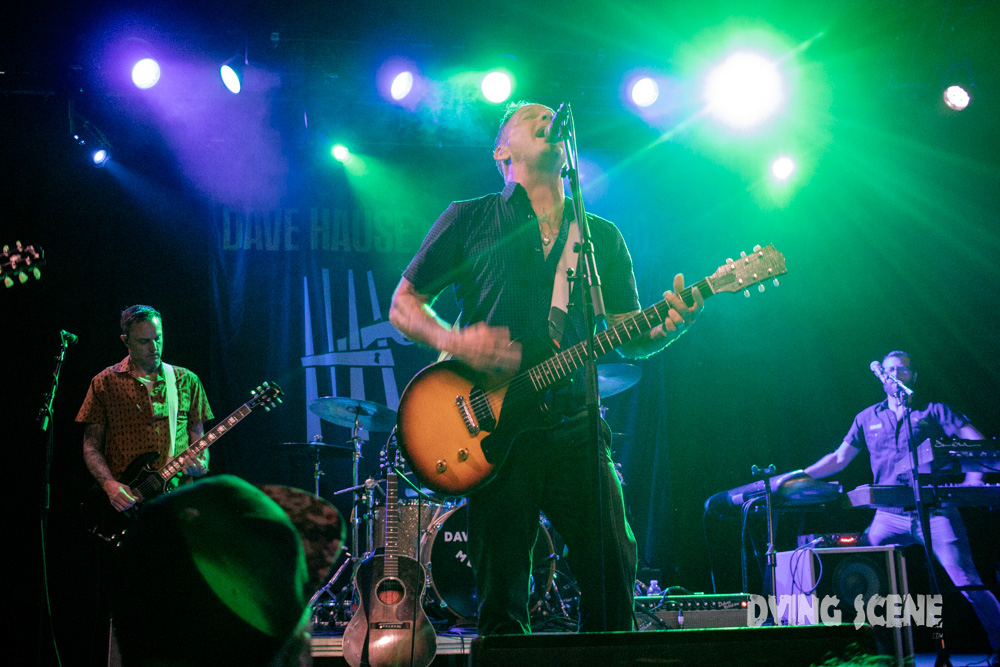
“Water & Wine” starts off Side B with a bit of hope. It’s the first real moment of change; the first real moment that the reflection and negative self-talk we might have engaged in in Side A has a counter-balance. “You’re not alone, you’re just misplaced…don’t forget, you’re unforgettable.” It’s got another big singalong outro, which creates the realization that those moments that we’ve spent together in those sweaty punk rock rooms are the thread, the something bigger that unites us, the collective that can help us realize we’re not alone. “Racial Battle Fatigue” is another car crash of a song with a giant, wailing guitar woven in and out, though it’s also the first track that probably qualifies as traditional “folk punk” in the truest sense of the term. It’s a razor-sharp dart aimed directly at the forces in this country that continue to treat minorities as other, as second-class citizens, and as needing to act or think or perform in a certain type of deferential way in order to be something close to accepted. “Glass Houses” might be the album’s high-water mark. Featuring writing – and soaring vocals – from Lauren Kashan (ex-Sharptooth) it’s a massive, stadium-filling rock track with super tight percussion, a slow, chunky breakdown, and Ian’s blood-curdling wail in the bridge. It makes this semi-reformed ex-nu-metal kid’s heart happy. “This Radio” is more of a traditional pop-inspired rock song, the perfect place to feature guest vocals by the great Dave Hause. Dedicated to “the punks, the freaks, the in-betweens,” it continues the redemptive arc in a manner that is so familiar to many a listener; finding solace in music. Finding inspiration to just keep going, to maybe not be perfect but to at least make progress in a way that buys you some time.
“Spotlight” brings the album to a close in a manner that…well, if “Glass Houses” isn’t the high-water mark it’s only because “Spotlight” is. It starts out solo and acoustic before kicking in a massive, Midwest emo riff-inspired verse. Lyrically, it’s a bit of a tale of the struggle that is therapy. “It’s so hard to hold a spotlight on things that keep you up at night.” The album and the process and the journey are not for the faint of heart. The work is hard and it’s messy but it’s cathartic and ultimately freeing. The kind of narrative that only comes when we’re razor sharp in our focus and not afraid to call out bullshit, even when that bullshit comes from elsewhere in the scene or, as is especially the case on The Misery Suite, from the reflections when we look in the mirror.
Discover more from Dying Scene
Subscribe to get the latest posts sent to your email.