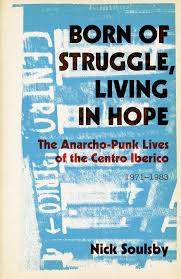
At one time, anarchy and punk rock went hand in hand, taking the side that we should be a society without rulers, government, or established authority. While a good number of punk rock bands still believe in these principles, somewhere along the line, the idea of no government got put to the wayside. Yet, the roots of these beliefs started in London in the early 1970s at the Centro Ibérico. This has been documented in Nick Soulsby’s new book, Born of Struggle, Living in Hope: The Anarcho-Punk Lives of the Centro Ibérico 1971-1983, reminding us that anarchy wasn’t just an aesthetic, but had a physical presence.
Started by anarchist Spanish writer Miguel García García, the Centro Ibérico began with his printing of the Anarchist Black Cross Federation’s newsletter, Black Flag. Soulsby documents some of García’s past which included fighting Nazis in World War II and later being exiled from Spain. These details give us the spirit and intention of García’s vision for the Centro Ibérico. The center he founded served as a place for anarchists to meet and discuss ideas, and morphed into a venue for bands to play for a portion of the center’s twelve-year history.
Nick Soulsby’s writing is very accessible. His retelling of the anarchy movement paints a different picture than previously reported. The text is broken up by pages of pictures and newspaper clippings from Black Flag or other publications. Sometimes he provides the full articles to give context rather than break up the narrative.
The book is very well researched and features interviews with a good number of people telling the history and personal histories of the Centro Ibérico, but it’s not overrun with interviews. They are actually more sparse than expected. There were sentiments that some of the true anarchists were upset at punks’ co-option of anarchy, mostly aimed at the Sex Pistols who seemed to be commercializing their ideas.
Soulsby’s book doesn’t just beguile us with politics. The anarcho-punk bands of the late 1970s and early 1980s have their roots intertwined with the center’s history. He also traces how the anarcho-punk scene emerged in regards to the center. For you Crass and Poison Girls fans, part of this book is a bit of an extended footnote on their histories, with both bands playing the Autonomy Centre, a meeting place and music venue put together by like-minded anarchists. Eagle-eyed fans would remember the mention of it in the liner notes of Crass’s Christ The Album. Even Wattie from The Exploited gets a mention in a somewhat funny exchange.
What is clear is that a scene was being built and funded by the bands and the people who wanted it to flourish. The Centro Ibérico may not have been as long-lasting as some of the venues, but it is still poignant in the ways communities grow. We’ve reached the point in punk rock history books where authors can fully flesh out aspects that were once footnotes in earlier pieces of work. I think it’s a good place to be, and Nick Soulsby’s book is a great read if you are into the scene’s history rather than just the music.
Pick it up here from PM Press.
Discover more from Dying Scene
Subscribe to get the latest posts sent to your email.