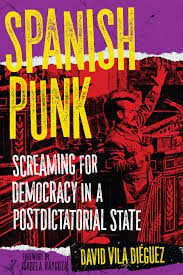
While the history of punk rock scenes in places like the United States and the United Kingdom is well documented, it would be ignorant to assume these are the only places where punk rock made an impact. Throughout punk rock’s existence, it seeped into other countries and established scenes similar to our own. David Vila Diéguez‘s book, Spanish Punk: Screaming For Democracy in a Postdictatorial State, is a history of Spain’s punk rock scene after the death of Francisco Franco in 1975.
The information presented in the book seems to be an overlooked part of not only punk rock’s broader history but Spain’s own cultural history as well. It’s broken up into five chapters, covering aspects such as Spain’s interpretation of punk rock, comparing it with Movida Madrileña, and its anti-transition, anti-capitalist, and anti-neoliberal stance. The book, for me, really shines when it covers the aspect of Spain’s scene and its interpretation of punk rock.
Focusing on life, attitude, fashion, style, and music, this first chapter does a good job of presenting a Venn diagram of these aspects compared to other scenes. It highlights some of the bigger bands and movements within. Spain’s equivalents of zine and straight edge culture aren’t surprising, but the similarities and differences between them and America’s are still interesting.
Punk rock emerged from Spain’s transition from dictatorship to democracy, protesting the amnesty law of 1977. Similar to punk rock movements in other countries, it wasn’t welcomed by the press or the public in general. Diéguez contrasts the difference between punk rock, which “went for the throat,” and Movida Madrileña, which celebrated the country’s new freedom in more poppy and happier ways. It was interesting how these two movements were related to the country’s ascent out of dictatorship after Franco had passed away.
The book also touches on broader academic perspectives, including a brief bit about the Punk Scholar Network, which examines punk on many different levels and is referred to as Punkademia. There are places where the book is bogged down by dense writing, but that is expected in an academic-type book. Given that this is a book about Spain, paragraphs are sprinkled with phrases and lyrics from the Spanish punk rock scene’s songs, but they are translated in the footnotes when needed from the many different languages spoken in Spain including: Basque, Galician-Portuguese, and Catalan. These footnotes actually help break up some of these dense passages.
David Vila Diéguez’s book is extremely well researched, and in comparison to some of the other academic books I’ve read, this one seems to be edited much better. It is unfortunate that it took this long for this book to come out. While there are a handful of documentaries on the Spanish Punk scene, this seems to be the first book to examine it as a whole. PM Press continues to release poignant books that make even the smallest niche feel essential.
Discover more from Dying Scene
Subscribe to get the latest posts sent to your email.