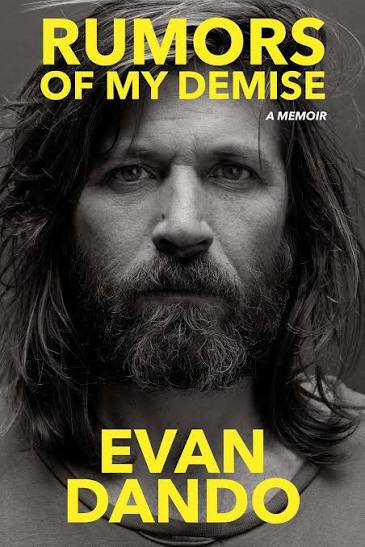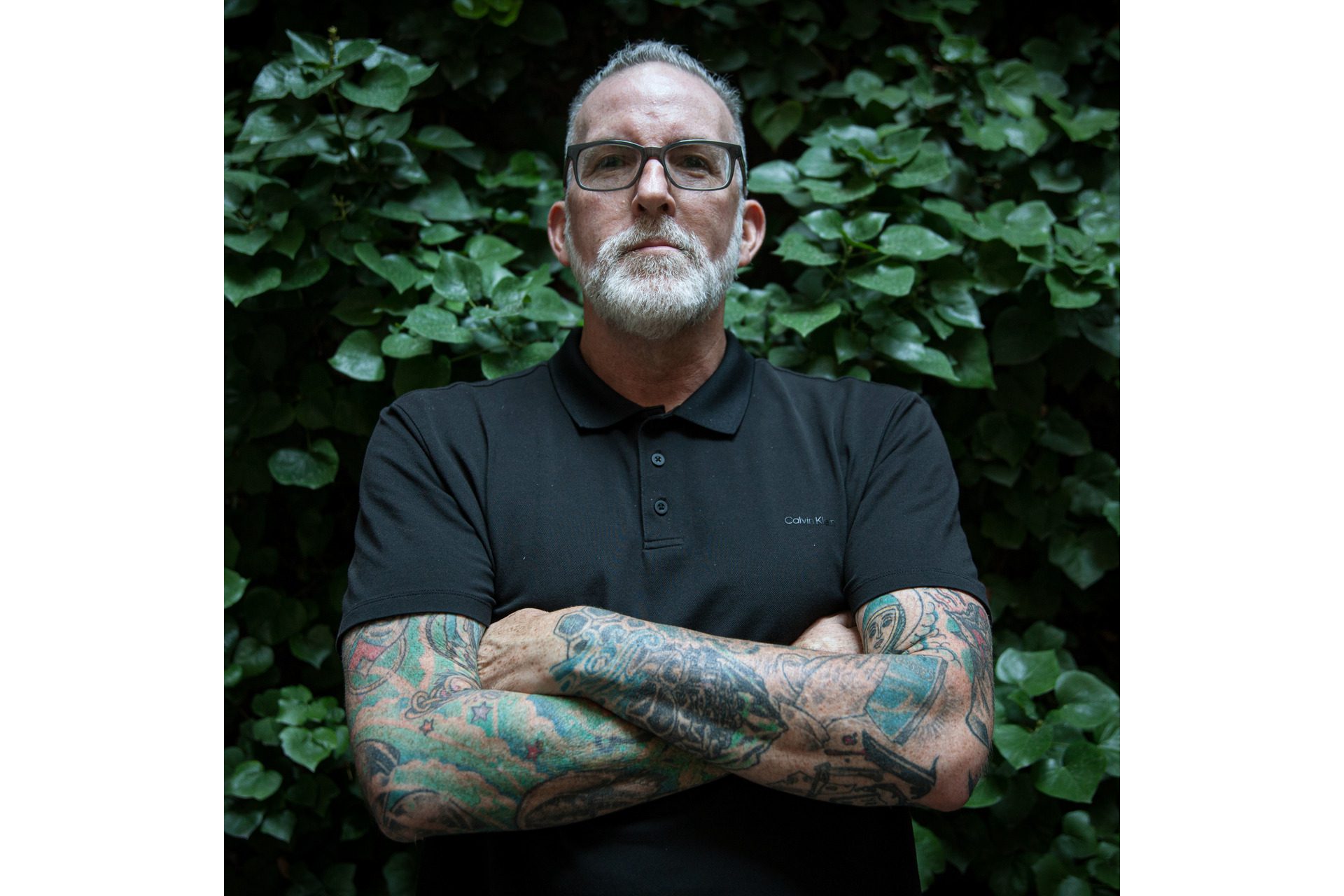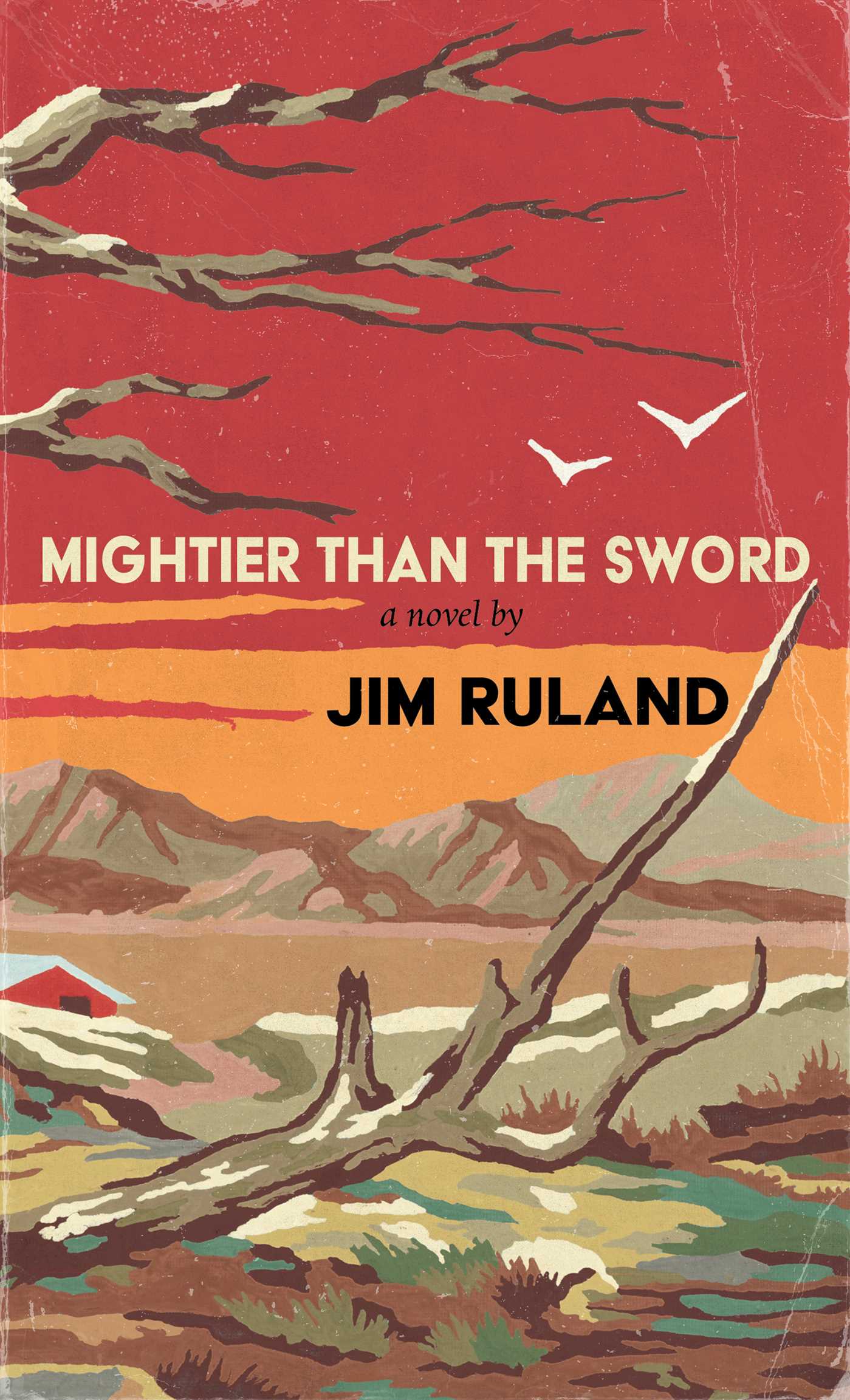
Author Jim Ruland has an interesting body of work. From his (punk) rock collaborative biographies about Keith Morris (My Damage), Evan Dando (Rumors of My Demise), and Bad Religion (Do What You Want) to his fiction novels Forest of Fortune and Make It Stop, his books are always interesting and well done. For his latest novel, Ruland went back to a specific time in his life: his time as a grad student in Flagstaff, Arizona.
Mightier Than the Sword is the story of four English professors at different stages in life’s struggles who decide to rob a college textbook store to throw money at the problems plaguing them. While there are differences from Ruland’s previous novel, Make It Stop, Ruland’s newest novel speaks to the deterioration of society and the disillusionment with the American Dream. Below, Jim talks about where this idea came from and how he executed it.
Dying Scene (Forrest Gaddis): Where did you come up with this idea for a heist story involving college professors?
Jim Ruland: When I was a graduate student in Flagstaff, Arizona, in 1993, I was in a situation that’s very similar to the teachers in Mightier Than the Sword. There were four of us crammed into an office, we were always bumping into each other, and in each other’s business and trying not to interrupt our conversations with students. One of my colleagues knew that I was a big fan of crime novels, and one day he said, “Hey, let’s go rob a bank. Who would suspect us? We’re English teachers.” That idea kind of rattled around in my head for thirty years and eventually took the shape of this novel.
Dying Scene: As it’s rattling around in there, did it go through different iterations before you committed it to paper?
Jim Ruland: I love heist stories. I love stories where people find a bunch of money or people who are unlikely detectives. Whenever I see one of these types of movies, I’m always thinking about I might do with the format. That idea just had been there for a while. Not too long after I finished the final edits of my previous novel (Make It Stop), I started this one.
Dying Scene: When you were thinking of the heist, what heist stories or movies came to mind?
Jim Ruland: The Killing was one; obviously, that’s referenced in Mightier Than The Sword. That’s a classic that I always go back to. One thing that Mightier Than the Sword has in common with Make It Stop is these kinds of ensemble casts. There’s a large group of people who come together to do this very irregular thing. In the previous novel, it was addicts who come together to fight back against the corporate healthcare system; kind of healthcare vigilantes. It’s English teachers who decided to rob a bookstore. A movie that kind of got me thinking about it a lot was Bullet Train.
I think that was the movie that lit the spark. It’s not a heist movie by any stretch, but it does take a group of people in a claustrophobic space and puts them all together. Then sees, “What’s going to happen when you put these personalities together?” I like stuff like that regardless of what the format is.
Dying Scene: The four characters are Colt, the frustrated writer; DJ, the poet; Mallory, the punk; and Max, the gambler. Do you create characters as a reflection of what you see around you or what you’ve seen yourself?
Jim Ruland: I think probably both. I don’t want to say too much about which characters are based on people I knew and which aren’t; other than that, they’re mostly composites. The house where Colt lives is the house where I lived when I was in one of the houses where I lived in Flagstaff, but I also lived with several people there. I didn’t just live there by myself.
There’s a lot of stuff that I draw from. My own experience of being that age. I set this in 1993, I think, maybe as a reaction to the previous novel, which was in the near future. I wrote a near-future novel and took so long to write it that the present kept catching up with the future that I was imagining. By setting it in the past, I had a little bit more control over the events and the time. There’s not gonna be some new technology invented that I now have to contend with.
Dying Scene: How did you differentiate the motivations of the characters so the crime feels more character-driven than plot-driven?
Jim Ruland: I think back to when I was a graduate student, and I have a lot of memories of friendships and experiences I had, but my situation was I was always broke. I was always short on money and always having to work at least one job. I knew that part of it was that because I’d already been in the Navy, so of course I’m going to work. I wasn’t afraid to work, but I just didn’t want to take out loans. I wanted everything to be paid for. I didn’t want to go deeper into debt. I think that there were times when I was like, “Well, shit.”
I was still a young person, still irresponsible in ways. I would make my rent and then be like, “Wow, how am I going to pay for food?” or “I don’t have gas for the next few days for a car.” Whatever it is just always having to do without in a way that was borderline desperate. The main character, Colt, grows up with a single mom. He didn’t really realize that other people have it different. He just thinks that “From time to time, people sell their things to make money, or they raid the coin jar to turn it into groceries, or they turn over their record collection in order to buy clothes or buy shoes. It’s something that you need.
That kind of thing becomes normal because when you’re a starving student, you’re working jobs. All the people around you are that way too. I remember towards the end of my undergraduate, which again, I did after I had been in the Navy, I had this job where I was a midnight cook, and I kept getting fired and rehired. A very toxic job and toxic bosses. I wasn’t always the most subservient employee, to put it nicely, but I was also sober. I wasn’t drinking or partying. A lot of my coworkers couldn’t always say that.
I remember at the end of my senior year, just kind of working at this restaurant, working from 10pm until the sun goes up. I just kind of stopped hanging out with people that I knew from school, and I was hanging out with the people that I worked with. It just kind of flipped the way that I saw things. People working at a Hardee’s fast food restaurant became the more dominant reality than going to college, which always felt like a fake reality. I really liked that idea of someone who is caught in between realities.
Dying Scene: The story is set in 1993. Why was that the right year for the story? Was there a moment in higher education or American culture that shaped that?
Jim Ruland: It was the year that I went to grad school; that was a big part of it. I knew exactly where I was; I could pinpoint everything. I also think it was kind of near the beginning of that kind of exploitation of graduate students. I still think that the school I went to was fairly generous and that they completely waived out-of-state tuition and paid people, but the pay was not nearly enough. Granted, we were part-timers, but when you’re going to grad school, you don’t have a lot of extra time anyway.
It kind of defined our reality to be going to school and teaching and then just scraping by on this little bit of money. I would then see that became the dominant way of higher education, using this underclass of contract employees and to do the bulk of the teaching.
Dying Scene: Why was it important to speak about the deterioration of education and the drastic lengths these professors go to?
Jim Ruland: I think they’re desperate. Not everybody will find themselves short of money and be like, “I know I’ll rob a bookstore or rob a bank,” but some people will. If there’s enough of you and you’re desperate enough, then you will. That’s why I picked these different people. Each has their different circumstances. One guy’s a gambler and finds himself in over his head with his debts. Another guy is going through a divorce and now suddenly has to come up with money for a lawyer, that kind of thing. In very unique situations where you gotta come up with some money, here’s a supposedly easy way out, right? I mean, these are not professional criminals, but they are professional students of narrative.
Dying Scene: Was there a play on the sentiment of the professors robbing a store that supplies their students with tools that help pass their class?
Jim Ruland: When I’m writing these fantastic stories, I may be overly concerned with the similitude; like, could this really happen? In the case of bookstores, textbooks are such a scam that I just felt like it was an easy target. Like, no one’s going to feel bad for the textbook companies being ripped off or a privately owned bookstore that exploits the students.
Dying Scene: What do you feel like fiction allowed you to say about academia that nonfiction couldn’t?
Jim Ruland: It’s funny cause I didn’t set out to write a takedown of academia. In the sense of Make It Stop, I didn’t set out to write a takedown of healthcare. It did dawn on me as I was getting deeper into this novel that it’s about class, right? That these universities, they dangle a carrot: “Hey, come to our school. We’ll waive your tuition, and you can get a free education. You just got to teach a little bit.” That’s going to be appealing to a certain kind of person. That’s someone who is willing to take risks and take chances, but it also comes from a place of financial insecurity. To me, it became pretty obvious that this was a book about class. I don’t want to say anything about the ending, but that rings all the way through the novel.
I also want to say that crime is one of the few places where we do talk about class. I mean, there are so many novels that you read where you never really find out how these characters get their money. They have a job, or they have a place, but where do they come from? Was there ever any insecurity? How do they achieve this stuff? I think that when you grow up with that insecurity or have lived with it, that becomes a really defining feature of the experience. I think you see that in crime more than you’ll see that in other genres, which I appreciate.
Dying Scene: It seems, in general, Make It Stop and Mightier Than The Sword comment on how institutions, whether academic or government, just erode trust eventually.
Jim Ruland: I think that erosion of trust is definitely there. I went to grad school. It was not an MFA program. It was just a master’s program in English. You could either have an emphasis on literature or creative writing. I actually started in literature and finished in creative writing, but at the end of the day, you’ve got a master’s in English. It was not a terminal degree. It was kind of like a stepping stone if you wanted to get a PhD.
I was using it as a stepping stone to somewhere else, but I didn’t really know where. I moved to California to go to grad school and follow that path, but then I realized how competitive it was and how ill-prepared I was both financially and in terms of my academic rigor. I went into the Navy after high school for a reason, and I went into the only school that took me for a reason. I was not exactly a desirable candidate for the life of a scholar. So I made adjustments, and this was one of them. During that process is when I was like, “This may not be all that it’s cracked up to be.”
Once you begin to suspect things, you look at things through a different lens. You see the cracks. You have to buy into it in order to make it work for you, and if you’re not willing to do that, then you see where the problems are.
Dying Scene: What inspired Colt’s father’s golden pen?
Jim Ruland: That’s harder to say; that was very organic. It kind of started out as a little bit of a MacGuffin that kind of traveled around. It was just a way to kind of highlight different characters. If you read a lot of crime fiction and genre fiction and you realize that there are no rules, you can do whatever you want. If you want to introduce a new character, two hundred pages in, you can. Genre fiction does that all the time. I thought that the pen kind of did that a little bit in terms of the lore around it; that’s what I was really attracted to.
The thing I love about genre is the lore. When I’m watching a samurai movie, I’m totally invested in all of the dynamics of the court, the army, and the disgrace of this samurai and his revenge against this person who dishonored. If I’m watching like a Chinese gangster movie or something with a Yakuza, I am in it. That guy betrayed this person, and now they’re getting their revenge, but they’re doing it by falling in love with this person’s daughter; it’s not really his son. That’s the literary element in the story. Colt’s father is this pulp cowboy novelist who’s disappeared. There’s this legacy of these forgotten fictions that kind of hangs over everything that I was really enamored with.
Dying Scene: What was the hardest part of keeping the humor, danger, and absurdity in balance?
Jim Ruland: There were no hard parts. I wrote this novel’s first draft in about six months. When I wasn’t doing other things. I always could not wait to get back to it. I remember being at a conference, and as soon as a speaker was done, I whooped out my notebook and was taking notes on something I had thought about during the conversation. It was just so much fun to write and very heartening for me. The two previous novels I’d written were pretty big and started out big and ambitious. Then I kind of had to pull them in because they weren’t working to the extent that I wanted them to, and made them a little bit less ambitious. Something that I could wrap my head around and actually write successfully. This just felt, everything I learned from that previous novel, I was able to directly apply to that one.
I had a really great editor at Rare Bird named Guy Intachi. He edited both of these novels. The edits were outstanding in the sense of helping me understand what I was doing in a new way to make it more dynamic. I think when I finished Make It Stop, with Guy’s help with that final edit that went into the book, I was so jazzed that I went on a writing tear after that. It was just fun to do this work again. It was just really exciting.
Dying Scene: Both books move really well. It very much feels like an old crime pulp novel, just set in the nineties.
Jim Ruland: There’s elements of Richard Stark’s Parker novels in there. There’s elements of these over the top neo-noirs. Many of those were adaptations of pulp novels from the thirties, forties, fifties, and sixties. In the nineties, I was reading all of those and then seeing them kind of be brought to life in a different form. That was a very exciting time for me in the nineties in terms of all my interests aligning in terms of fiction and the film. Then it kind of went away. After 9/11, there was like a seriousness to things. I just kind of felt I’d outgrown it until ten years ago; maybe a little bit more. I just started rediscovering all those old stories and things like that again.
I remember being a kid and reading Louie Lamour novels that my dad had laying around. He was a big fan of Westerns, but he was in the Navy, too. You need these books to pass the time. They’re great for that. They’re great characters; They take you into another world. A world very different from where you are, and where there’s a structure and order to it. I think there was something to that in play in this book.
Dying Scene: You’ve said that there’s a connection between Melanie in Make It Stop and Mallory.
Jim Ruland: Melanie is Mallory’s niece. It’s not mentioned by name. It’s just that you would have to know that Melanie and Mallory have the same last name. I think it’s only mentioned in Make It Stop once, that her last name is Marsh, and it’s only mentioned once in Mightier Than The Sword. It’s just something that’s entertaining to me. There’s just certain things I like to have in these stories. One is a bad Irish bar. Maybe because I’m sober and they’re all bad to me now. I mean, not really, but they’re still a great place to get a good meal and have an non-alcoholic beverage or watch a game. I just like having a really seedy Irish bar in my books, and luckily they’re all over the country.
Dying Scene: Your fiction usually deals with a lot of punks, outsiders, and underdogs. How do you feel Mightier Than the Sword extends or challenges those themes?
Jim Ruland: There are outlaws. Which goes back to the Raising Arizona quote, right at the very beginning. There’s just an idea of what makes someone an outlaw and what makes someone an outsiderSometimes it’s race. Sometimes it’s religion. Sometimes it’s class. Sometimes it’s all three of those things. Sometimes it’s sexual orientation. Sometimes it’s being in a room full of brutes and being the smart one there. I feel like we’ve read plenty of stories like that, right? Where really bright people who end up becoming writers write about their traumatic childhoods at boarding schools and things like that. I’m thinking of, like, James Joyce. I mean, it’s hard, kind of hard to imagine James Joyce running down a soccer pitch and kind of kicking ass. Right.
I just remember feeling very much like an outsider for the whole time I was an adolescent just cause I just did not fit in that feeling of that. I think that, more than anything, it makes one predisposed to punk rock. I went to Catholic school. I was raised in a Navy family. My mom was a nurse. It was a lot of structure and rules. I was the oldest of four kids, and I wanted to follow the rules. I wanted to fit in. I wanted approval. I wanted all that validation that comes with it, but I didn’t get it.
There comes a time when you’re like, “fuck that.” If you don’t want me, then I’m just going to reject you first. Then you find this genre of music that is all about that. Like, “Goddamn, I am home.” If you’re lucky, you meet some really dangerous people who expand what’s possible in your life, and now you’re a punk rocker.
Dying Scene: Rare Bird published both books. What makes them the right home for your work?
Jim Ruland: I think there’s a shared sensibility. That’s a better question for Rare Bird. They publish a lot of books about music, not just limited to punk rock. The singer of the Dwarves published some novels with them. Plenty of people who have done memoir projects with them. All kinds of extreme music. The publisher, Tyson Cornell, loves extreme music. I think he likes that sensibility, but also that I write other kinds of books.
There’s an understanding that there are limits to what an independent press can do or be for a writer in 2026. It definitely feels like, as books have a diminished place in pop culture and the written word in general, you have to do these things because you love it, not because you can see dollar signs or mainstream success at the end of every project. Sometimes a project is just worth doing. It doesn’t really need to be. You hope for the best, but I think we kind of share that sensibility.
Dying Scene: I know you’ve got a book about the movie Repo Man (The Repo Code) coming out next year in June. What’s the status on that?
Jim Ruland: We’re finishing it up right now. It’s going to have some amazing images that no one’s ever seen before. I talked to as many people as I could, from (director) Alex Cox, of course, all the way down. A lot of those people have passed on, but there’s also quite a few people who Repo Man was their first movie and went on to have long careers. So it was really great to talk to some of those people. Some are retired, some have had great success, some are still doing amazing stuff. It’s really cool. The whole book is an examination of the movie, but also the soundtrack.
Jim Ruland’s Mightier Than The Sword is available through Rare Bird. For Jim’s other works check out his website.
Discover more from Dying Scene
Subscribe to get the latest posts sent to your email.