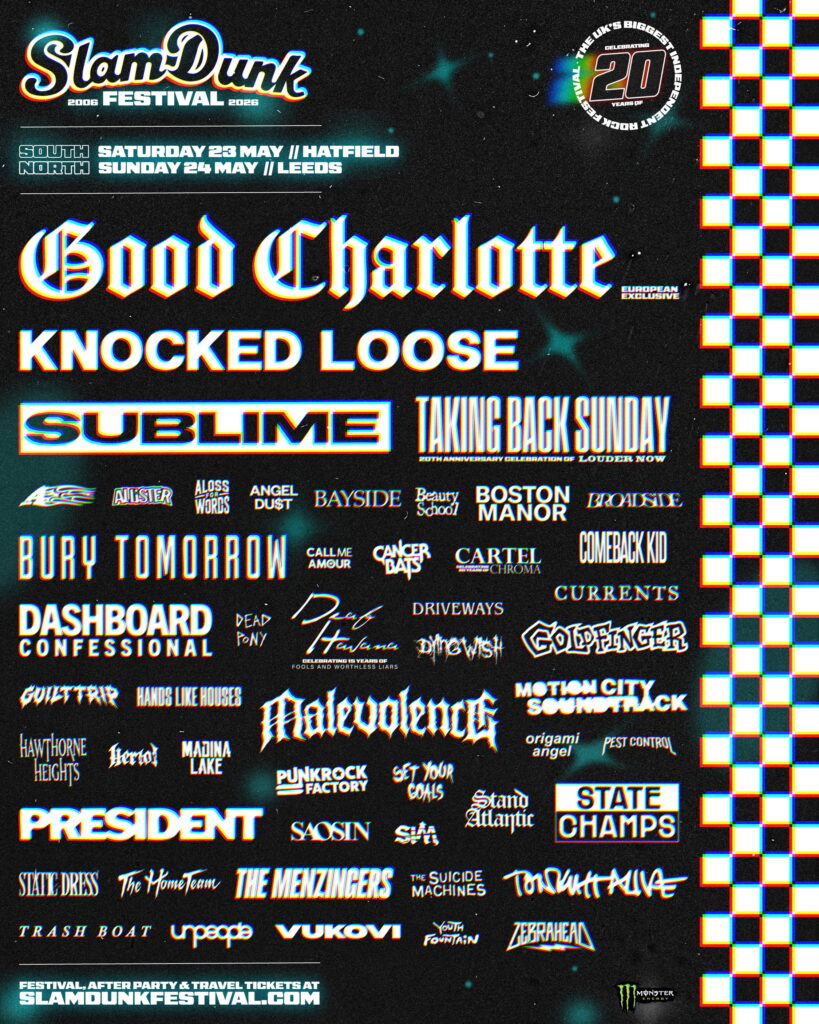
Twenty years ago, Slam Dunk was a single-stage festival in Leeds, headlined by Fall Out Boy. In the years since, it has grown into one of the UK’s biggest celebrations of alternative music, welcoming everyone from pop-punk icons and emo veterans to the next generation of hardcore, metalcore, ska bands, and punk bands.
A lot has changed since Slam Dunk’s first edition in 2006, at Leeds Millennium Square. The stages are bigger, the crowds are bigger, and the lineup now stretches across almost every corner of alternative music. What hasn’t changed is the feeling of arriving and immediately seeing thousands of people who clearly wouldn’t want to spend their Saturday anywhere else.
The first thing I noticed after arriving by train wasn’t the stages or which band was about to play. It was the people. Friends reuniting with one another outside the gates, groups comparing schedules and talking about where they should meet up since our telephone signal was lost upon entrance, I hope they fix that next year, and despite the heatwave and the sizes of the different crowd sizes, the atmosphere felt warm, welcoming, and excited. For all the growth Slam Dunk has experienced over the past two decades, it still feels like a festival built by and for the community that helped it survive.
OF COURSE, some parts of the experience were impossible to ignore. The heat was relentless. Bar queues became a running joke throughout the day. Every patch of shade was occupied by somebody trying to recover before the next set, by chugging water like there was no tomorrow. And as someone bouncing between stages, interviews, and the press area, I quickly learned that seeing everything on my schedule was never going to happen. Somewhere between standing in a queue for a drink and racing across the site, I even managed to miss half of State Champs’ set. Sorry!!!
Twenty years on, Slam Dunk still feels like a festival where everyone is trying to do the same thing: fit an entire weekend’s worth of bands into a single day.
Angel Du$t – Main Stage East Left
While there were a few anniversary shows, the focus wasn’t quite there. Angel Du$t felt like a reminder that the festival wasn’t built on nostalgia. But on new innovations.
By the time the band took the stage, the crowd was more than ready to jump into a pit. The heat wasn’t exactly merciful, but the crowd worked with what they got as the band went through their set.
But what made Angel Du$t interesting is that they don’t just fit into the hardcore genre. There’s so much more to them, soundwise, something weirder and more fun happening underneath it all. And everyone was there for it!
Boston Manor – Monster Energy Stage Right
Boston Manor could have easily spent their Slam Dunk set leaning into nostalgia. A lot of bands were doing that, and rightfully so. But instead, the Blackpool band used their time on stage to showcase just how they’ve evolved over the last decade.
Boston Manor’s set felt a bit like a tour through their entire career. One minute they were playing newer songs like “Floodlights on the Square” and “Passenger,” the next they were throwing the crowd back to tracks like “Laika” and “Stop Trying, Be Nothing.”
That balance paid off throughout the set. Older songs sparked memories that flooded back, while the newer material drew some of the loudest sing-alongs. Rather than looking backward, the band used their set as a celebration of everything they have become since they first started appearing.
Dashboard Confessional – Main Stage West
I only caught part of Dashboard Confessional’s set. Like most people at Slam Dunk, I was already checking the time and trying to figure out how long I could stay before needing to head somewhere else.
Even so, it didn’t take long to understand why so many people had made them a priority. Within minutes, the crowd had largely taken over singing duties. Chris Carrabba would start a line, and thousands of people would happily finish it for him.
Sadly, like many people at Slam Dunk, I found myself watching one band while keeping an eye on the time for the next, with The Menzingers waiting across the site. I eventually had to make a run for it before Dashboard’s set was over.
But from what I did catch, it was enough to understand why so many people had made them a priority. Even after all these years, the songs still connect in a way that few bands can catch.
The Menzingers – Monster Energy Stage Right
Twenty minutes before The Menzingers took the stage, I was sitting with Greg Barnett and Eric Keen talking about growing older.
Not in the dramatic, rock-and-roll sense. Just life. Families. Kids. The strange reality of somehow being twenty years into a career that started because a group of friends wanted to play punk rock.
Twenty years in, The Menzingers still don’t seem entirely convinced they’re supposed to be here. When I asked what had kept the band together for so long, Greg’s first response was a joke about fame and fortune before both he and Eric settled on a much simpler answer: people kept showing up.
An hour later, standing in front of the stage, it was hard not to see exactly what they meant.
Opening with “I Don’t Wanna Be an Asshole Anymore,” The Menzingers were greeted by a crowd that barely needed warming up. If anything, it felt like people had been waiting for this set all day. Everywhere you looked, someone was singing. Not just the big choruses either. Entire verses disappeared beneath the audience as songs like “The Obituaries,” “Good Things,” and “After the Party” rolled through the set.
Earlier in the day, Barnett had told me that one of the best parts about The Menzingers is that their fans have grown alongside the band. “They’re seeing their stories in the same way that we are existing,” he explained.
Looking around the crowd, it felt less like an interview answer and more like a statement of fact.
The people who first connected with these songs aren’t the same people anymore. Some have children. Some have gone through divorces. Some have moved countries, changed careers, lost people, found people, and somehow ended up here on a Saturday afternoon in Hatfield singing along to a band that has soundtracked a large part of their lives.
That’s what made The Menzingers’ set feel different from many of the anniversary celebrations happening elsewhere across the festival. There was no need to revisit a classic album or recreate a specific moment in time. The connection was already there.
That same mindset has shaped the band’s upcoming album. Rather than looking backward, Barnett described the new record as an attempt to document the present. “It felt like we don’t really need to be looking towards the future or the past,” he told me. “It just feels like we need to kind of document what’s happening right now.”
In many ways, that idea also explains why The Menzingers continue to matter.
While plenty of bands spend years chasing the version of themselves that people fell in love with, The Menzingers have allowed themselves to grow up in public. The songs have changed. The people listening have changed. Yet somehow the connection remains exactly the same.
Earlier in the day, Greg had told me that The Menzingers’ fans had grown alongside the band. By the time “After the Party” rolled around, I didn’t really need the explanation anymore.
Taking Back Sunday – Main Stage West
Taking Back Sunday should have been one of the highlights of the day.
Celebrating twenty years of Louder Now at Slam Dunk feels like a perfect match on paper. Few records are as closely tied to the festival’s audience, and judging by the number of people packed in front of the stage, plenty of fans agreed.
Unfortunately, the sound had other ideas.
Whether it was where I was standing, issues with the mix, or just Adam himself, I spent more time trying to figure out what was happening than actually enjoying the set. Vocals regularly felt buried, and instead of being pulled into the performance, I found myself growing increasingly distracted by the technical side.
Maybe that’s unfair. Maybe somebody standing fifty meters away had an entirely different experience. That’s the reality of festival sets.
What I can say is that after spending most of the day running between stages, sitting through interviews, and standing in queues, Taking Back Sunday became one of the few bands I chose to walk away from.
Judging by the crowd that stayed behind, plenty of people were still having a great time. I just wasn’t one of them.
Motion City Soundtrack – Monster Energy Stage
Slam Dunk’s twentieth anniversary wasn’t the only anniversary I was celebrating that day.
Slam Dunk’s twentieth anniversary happened to coincide with my twentieth as a Motion City Soundtrack fan.
I wish I could tell you I handled that fact normally.
Earlier in the day, I had been standing with Jesse Johnson and Tony Thaxton. A few hours later, I was standing in a crowd watching Motion City Soundtrack tear through a setlist that felt suspiciously designed to target my teenage years.
Fortunately, they made it very easy to remember why.
From the opening notes of “Some Wear a Dark Heart,” the crowd was locked in. What followed felt less like a festival set and more like a greatest hits collection for everyone who had ever found comfort in Motion City Soundtrack’s particular brand of anxiety, self-deprecation, and perfectly written hooks.
“Capital H,” “L.G. FUAD,” “My Favorite Accident,” and “Her Words Destroyed My Planet” arrived one after another, and judging by the reaction around me, I wasn’t the only person having a moment.
What I noticed most wasn’t even the songs. It was the people. Everywhere I looked, somebody was dancing, screaming lyrics at their friends, or throwing an arm around the person next to them. For forty-five minutes, it felt like everyone had collectively decided to stop worrying about being cool.
At the center of it all was Justin Pierre, who somehow remains one of the most relatable frontmen in alternative music. Twenty years on, he still performs with the same nervous energy and sincerity that made so many people connect with these songs in the first place. Nothing about it felt forced. Nothing felt like a band trying to recreate a moment from the past.
That’s what surprised me most.
For a set built around songs that have been with many of us for decades, Motion City Soundtrack never felt stuck there. “Attractive Today,” “Everything Is Alright,” and “The Future Freaks Me Out” got some of the biggest reactions of the afternoon, but they didn’t feel like museum pieces being wheeled out for applause. They still felt alive.
Maybe that’s because the songs have aged alongside the people listening to them.
Or maybe it’s because Motion City Soundtrack has always understood something that many bands don’t: growing older doesn’t mean leaving those feelings behind. It just means understanding them a little better.
Whatever the reason, twenty years after discovering Motion City Soundtrack, I finally got to interview them and then watch them play one of the highlights of Slam Dunk.
Some things really are worth waiting for.
Good Charlotte – Main Stage West
Some bands remind you of where you’ve been. Good Charlotte reminds me of where I wanted to go.
Growing up, I always liked how open the Madden brothers were about their background. They never pretended they’d had an easy ride. As another poverty kid, that meant something. Maybe that’s why Good Charlotte always felt a little more personal than some of the other bands I grew up listening to.
Their first UK appearance since 2019 was always going to be one of the biggest moments of the weekend, and the crowd in front of the stage reflected that long before the band even appeared. People weren’t casually wandering over to see what was happening. They were already there, waiting.
And once the set started, they didn’t stop moving.
What I noticed most wasn’t necessarily the songs. It was the people. Friends with their arms around each other. Grown adults screaming lyrics they probably first heard as teenagers. People are climbing onto shoulders to get a better view. For an hour, it felt like everyone in front of that stage had somewhere else they’d rather be than adulthood.
Maybe that’s the real reason Good Charlotte still works.
The songs came from a very specific place, but they never stayed there. Twenty years later, people continue finding pieces of themselves in them. Some came because they grew up with the band. Others came later because they discovered them. Standing in that crowd, the difference didn’t really matter.
For a band that once sang about wanting more from life, it was hard not to smile watching thousands of people sing those songs back at them all these years later.
And that was how Slam Dunk 2026 ended. Did I get to see all the bands I wanted to? NO. But does that give me an excuse to do two days next year?
The Good
- Motion City Soundtrack
- The Menzingers
- Good Charlotte
- The atmosphere
- Improved toilets
- Friendly crowd
- Easy entry
The Bad
- Bar queues
- Missing bands because of queues
- Heat
- Schedule clashes
- Constant running between stages
The Ugly
- Taking Back Sunday’s sound
Discover more from Dying Scene
Subscribe to get the latest posts sent to your email.