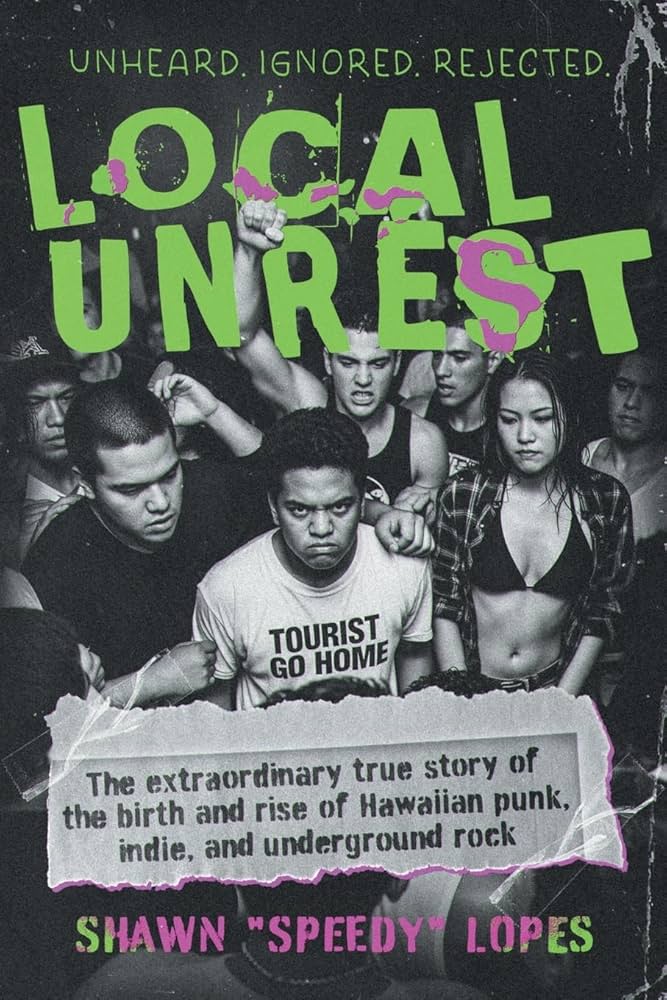
Looking back, it’s sometimes strange to call punk rock a phenomenon, but I think that’s a true statement for organic things. Rebellion and defiance have historically never gone out of style, but punk rock’s assault on the mainstream gave a voice to kids who didn’t have one before. Punk rock influence slowly started to build. First in New York, then in England, and outward from there. As scenes have been built, people tell their stories. A number of books and documentaries have been produced about these different scenes, nationally and abroad. While it adds more layers to punk rock’s narrative overall, these stories drip with local history. Hawaii is one of these regions with an untold punk rock past.
Shawn Lopes has written Local Unrest: The Extraordinary True Story of the Birth and Rise of Hawaiian Punk, Indie, and Underground Rock. An oral history of the underground music scene that was cultivated in the often ignored in fiftieth state. Sean’s book documents the roots from its beginning to around the year 2000. While it may be a surprising thing to learn that the development of Hawaii’s punk rock scene came together like a lot of the other that have been documented. The unsurprising part is that the music is just as good. Stick around after the interview to check out a playlist of some of these bands.
Dying Scene (Forrest Gaddis): My mom actually lived in Hawaii when she was a kid. She would tell me about concerts she went to out there. I think she left Hawaii like right as your book is starting.
Shawn Lopes: Oh, interesting. Okay. She probably went to the Crater Festivals at Diamond Head Crater.
I think she said her first show was the Rolling Stones. That would have been in 1973. A few years back, she went and saw Alice Cooper out here. She wanted to see when he was touring in the 1970s, but they wouldn’t let him into Hawaii because he had a snake in his show.
Wow. So she’s a big Alice Cooper fan.
She’s all over the place musically. She was into like the 1970s rock and stuff like that, but also was into new wave and ska, and some punk rock too. I kind of got that from her.
That must have been at the Blaisdell Arena, but at the time, they called it the HIC (Honolulu International Center.) It’s where Elvis had that big, gigantic concert that was broadcast live around the world at the same time. I remember because I was like a toddler when that happened.
One of my earliest memories is of my mom coming home from that concert. I was sleeping as she woke me up. Back in the day, they used to have tour programs of the act that you would see. I remember being like, maybe three years old, and she’d shown it to me. Then I kind of fell asleep, but it’s one of my earliest memories. Yeah, funny.
What drew you to document the punk rock and indie scene of Hawaii in Local Unrest?
I’m just a reader of music books, as I think you probably are, I had come across many, many books of different underground scenes from around the country. You know, I have books on the Minneapolis scene, the New York scene, the straight edge scene. A lot of these are done in that oral history format. I always thought that was a great format to be used in these books. I just thought, well, will someone ever write one about the scene that I grew up in? I knew in the back of my mind, the answer was probably no. I went ahead and started calling people, right? I’m contacting people on the internet, as well. Just to find out for myself, what were the origins of my scene?
Did you find that the entry point into the punk or indie scene was unconventional at all?
I think everybody has a different story about how they got into the scene. I kind of get into it on a personal basis, I think it was Chapter 14. I talk about how I got into the scene and got interested in it. I think everybody has a different take on how they get into it. In terms of people from Hawaii, I think it’s pretty fascinating and commendable how we’re here in the middle of the Pacific and remarkably on top of what was going on elsewhere in a time that preceded the internet.
We got our cues, like everybody else: magazines, TV, newspaper articles, records, and word of mouth like everyone else at the time. Looking back on it, I think it’s pretty remarkable how we were able to really stay on top of what was going on elsewhere. Despite the geographical hassle of being isolated thousands of miles away from everyone else.
It seems like the Hawaiian scene had the same timeline as Mainland Punk, but it was such a much more condensed space. What do you think caused that compression?
All of the above, pretty much. I think there’s always an element or a segment of society that is not satisfied with mainstream culture, or the status quo. People who are especially artistic will gravitate towards the unusual or anything that goes beyond the conventions of mainstream culture, right?
I think a lot of people are attracted to the punk scene and just oddball music in general, have that type of personality, and that sense of adventure. You have to have a sort of bold streak to embrace this music and be different from the people around you. You have to have that sense of investment. You kind of need a certain streak in your personality that seeks out things that are different or go beyond conventional culture.
Did you feel like the scene had erasor was it fluid because of the island environment?
As far as the book goes, I tried to do everything chronologically, or as close as possible. It starts out before punk rock happens. It starts with how rock and roll itself enters the islands, right in the 1950s. I do talk a little bit about the surf rock and garage rock that was going on in the 60s. That sort of leads into rock and roll in the 70s, and punk rock. There’s a timeline that I tried to keep. This book actually takes place for the most part between the 1970s, and maybe the year 2000. These are sort of the decades that I can recall in some parts as an elementary school kid in the 70s, and also as an active participant in the 80s and 90s.
Were there any, did any of the early like proto-punk or pre-punk influences ever make it to Hawaii? Did The Stooges or MC5 ever make it out there?
Those bands never made it out. Although there is a picture of one band from Japan called Gedo, that played at a music festival. And they do have some music that’s actually pretty heavy rock and you could consider proto-punk. You may not call them a proto-punk band because some of their music is pretty straight-ahead rock and roll. They did have some proto-punk tendencies.
How did the local identity intersect with the DIY and anti-establishment ethos?
I think living in Hawaii is in itself unique. We have our own culture, we have our own slang words, we have our own food, we have our own way of life, basically. As far as punk rock goes, I think a lot of kids who got into it early on sort of understood that we’re out in the middle of the Pacific and we won’t get a lot of concerts early on. So, a lot of kids in the early part of hardcore had no choice but to simply start bands of their own if they wanted to enjoy this music with their friends. We didn’t get a hardcore band in Hawaii until Agent Orange in maybe ‘82 or’ 83.
That’s a little bit late. Although, Talking Heads and B-52s might be counted in that conversation because they did come here in the late 70s. I understand that some people don’t consider them, quote unquote, punk rock so much as new wave. I think the perception of the term “punk rock” has changed over the years, particularly in the post-hardcore era. So, getting back to what I was talking about. I think a lot of local kids realized that there weren’t going to be a lot of hardcore punk bands coming to the islands early on in the early 80s. That was a big reason why a lot of kids just started their own bands was, “Hey, if bands aren’t going to come here, we’re going to start our own bands and we’re going to put on our own shows.” It’s that whole DIY sort of ethos that really set the stage for the scene in those days.
When mainland bands came through, were there any bands that left a big mark on the island?
I think kids were generally appreciative of any band that came through, so I would put, Agent Orange, Circle Jerks, Youth Brigade, and the Vandals in a special class as being the first hardcore bands to play in Hawaii. I think they were sort of pioneers in that way. I think they did have an influence on the kids that were forming bands in their bedrooms or garages. I would have to give them credit, for sure.
Was there a need for mainland bands to come through, or do you feel that the local ecosystem was pretty self-sustaining with what the scene was doing?
I think it would have been fine if none of those bands came through, but it sort of gives your scene a sense of legitimacy if you do have bands coming through your city. I think kids were excited to see hardcore bands and metal bands that were in the record collection come to town. It creates an extra sort of excitement around this music. You’re actually energized as a kid to see these bands live and up close, and it inspires you further to start your own band. I think in that sense, it was a huge thing to have these bands come through Honolulu.
Was there any type of apprehension or were you guys appreciative that they’re able to make it out?
I think the kids were absolutely stoked that a band that they knew from their record collection would actually appear live in Honolulu. I think it seemed like a godsend to them at the time. Agent Orange, Circle Jerks, what have you. Actually, I think if anything, the kids here just sort of felt almost embarrassed that they, in their minds, were kind of behind the times in the early 80s.
Mike Palm from Agent Orange had once stated in a local magazine that Honolulu was actually not behind the times at the time. I kind of mentioned this in the book. This club that they were playing at, 3-D Ballroom, was the first punk rock club in Hawaii. He said, this club could be in the middle of LA. If the kids go out to LA, they’ll see that their scene is just as legit as any other scene.
Why do you think there was that assumption that the Hawaiian scene was behind LA and New York and other cities on the mainland?
I think it’s just this sort of feeling that we have in the islands about being behind the times, especially pre-internet. We don’t get as many concerts because of our isolation. We don’t have as many bands coming through to play. All we got was what we could find in magazines or in books. I think that geographic isolation just sort of makes us feel like we’re not really a legitimate part of the U.S., a lot of times.
Was there a separation between rap and punk like there was on the mainland?
It depends on what era. I think by the time the 90s came around, I think everything was free-for-all. Everybody was into everything, but for sure in the early days, there were definitely different scenes.
I think that’s one thing you guys would be ahead on, everybody being just cool with everything in that way. I feel like in the last couple of generations, like the mid-2000s is when that came. Not including the rap-rock-Limp-Bizkit shit. I’m talking like listening to punk rock, rap, and a little bit of everything. Not trying to mash shit together.
Early on, there were definitely distinctly different scenes, not just in Hawaii, but elsewhere. The one thing I can say about the Hawaii scene is that it’s always been pretty inclusive. From the earliest days, you could have a ska band with a punk band with a folk band and nobody really cared. It was just exciting to hear music that was outside of the mainstream. Hawaii’s always kind of embraced that from its earliest days.
There’s no real elitism with regard to the music scenes here. I think everybody’s pretty welcoming to other styles of music and pretty accepting of new ideas. I think part of that is due to the fact that we’re very multicultural in Hawaii, as well. You have a huge American influence, you have a huge Asian influence, and you have Polynesian and Native Hawaiian aspects to our culture here. I think we’ve always been very much open to new ideas, to new people, to new cultures and sometimes even subcultures, you know?
There was never like this debate about the authenticity of who’s punk, who’s not. It was just everybody’s punk.
I think maybe early on, maybe in the early 80s. I think you had to really prove yourself. Am I fully metal? Am I fully punk? It wasn’t until maybe the mid 80s when the whole punk metal crossover happened that I think kids were starting to get open to the idea of music crossing over to different genres.
Were there bands that you tried to include or track down that you couldn’t or is it that small of a community that you were able to get most of the people from the scene?
By the time the 90s had rolled around, the scene had really exploded with the number of bands and venues. There were just so many bands that I never got to mention from specifically the 1990s. When you talk about the bands from the 70s and 80s, you could name several dozen bands. I pretty much got most of them or at least most of the ones that are spoken of to this day as the important bands. When the scene gets to about the 1990s, the mid 90s or so, there were just so many more bands that I was not able to contact all of them or speak to enough scenesters. I feel to really accurately represent that decade because I feel like the 90s itself could have been its own book.
Oh wow, it was that big.
By the time the 90s came around, what was underground at one time was not underground anymore. In the 80s, Metallica was sort of like a cult band. You never heard them on the radio, but they had great record sales and would just never be represented in the mainstream. When the 90s came around, I think record labels finally realized there were lots of indie bands that they can make money off of. I think that’s when music just sort of exploded. A lot of these bands that used to be quote-unquote underground bands were now almost part of the mainstream. The prevailing youth culture was one of an anti-mainstream sort of belief, you know?
Are any of the clubs mentioned in the book still open, or were there buildings repurposed for newer venues?
Most if not all of them are gone by this point. 3-D Ballroom, which was the first punk rock club, closed in 1984. Wave Waikiki, which opened just a month or two after 3-D, had a long life, and it was probably one of the most popular nightclubs in Hawaii, if not the most popular and well-known of the nightclubs in Hawaii. In the 90s, there were big venues like After Dark and Pink’s Garage, Those nightclubs are gone as well.
Were there any venues that you would consider anchor venues, like CBGBs or Gilman in Hawaii?
3-D and Wave Waikiki were sort of the main venues. Then in the 90s, After Dark would be a huge one, Pink’s Garage would be another one. They were much larger and could bring in headlining acts like Pearl Jam or Alice in Chains, bands of that caliber. Wave Waikiki was still around as well. They lasted up until the 2000s or so. Yeah, those would be probably the four main venues of the 80s and 90s, for sure.
Were there ever any burnout cycles where the scene almost died out?
Every scene has its ebbs and flows. It depends on who you talk to. I think some kids have felt disconnected from the scene at certain times, depending on different factors. Some of them will go away and then come back, and the scene will have changed. All the kids are gone that they knew, and it’s a whole bunch of new kids. Sometimes there are a bunch of bands and a bunch of venues. Other times, especially when the venues go out of business or close, the scene takes a big blow.
Did anybody’s interview reshape your understanding of the scene in ways you didn’t expect or maybe didn’t pick up on before?
Yeah, what really took me aback was just the amount of violence that would happen every once in a while. There were certain murders and shootings that would happen in the nightclub scene. You know the old saying is, “nothing good happens after midnight.” But I think anytime you mix alcohol with young people, you’re going to have issues. You’re going to have these incidents of violence, but I was really surprised with the amount of violence that actually occurred within our scene. I think chapter four speaks about how one nightclub owner was found bound and bludgeoned. There were a couple of accounts of shootings that happened or people who were murdered in front of nightclubs. That sort of thing really took me by surprise.
Is there a through line between the earlier punk bands and the musicians today in Hawaii?
No, I think I’ve always had this sort of belief that about every five years a new generation is spawned within the scene. A whole bunch of new kids come through and by the end of the five years or so, they’ve already gone off to college, they’ve gotten regular jobs, they’ve gotten married, or maybe gone to the military. Certain parts of certain eras of the scene seem foreign to the kids who come later.
There’s a little bit of crossover. You may know the guys who were in the scene two, three, or four years before you, but the people that were there like five, ten, or fifteen years before, you have almost no clue of. That’s just how it goes, especially when you’re young. You don’t really have that sense of history unless you’ve really looked for it.
Are there any misconceptions that people still have about Hawaii’s underground music culture?
I just don’t think people realize people just haven’t heard of the bands that have come out of Hawaii, and I don’t think people realize that there are bands that have made it even to the major label status.
You mentioned a couple of those in the book. I didn’t pick up that Lance Hahn was the same guy from J. Church until it’s mentioned in the book.
I think there are a lot of connections with people in Hawaii who go elsewhere and find success, but very few record labels were willing to take a chance on bands from out of Hawaii that were not willing to relocate and I think a lot of it has to do with the fact that pre-internet. It was a lot harder to keep track and keep tabs on bands who were out in the middle of the Pacific. They were sort of gun-shy about signing bands from Hawaii, but make no mistake, there were lots of bands that were talented enough to make it to either indie labels or major labels, but they weren’t willing to relocate to the Mainland. The examples of the bands that did make it to major labels, like Poi Dog Pondering and the Dambuilders, for example, they had to actually move to gain any kind of traction and that’s a theme that reappears in the book over and over.
If someone wanted to explore the scene now, where would they start?
Oh, the internet’s a great place. We didn’t have the internet back in the day, but I think there are several groups on Facebook or even Instagram that would help you find the venues, the record stores, the bands. I think Instagram’s a good tool, Facebook’s a good tool, and there are a bunch of bands and venues that I think people would enjoy here in Hawaii.
Do you think punk rock still serves the same purpose for young people in Hawaii today as it did before?
I hope so, right? I don’t know what it’s like to be 17, 18, or 19 today, but I would hope that it gives them the same sort of excitement that I got when I was that age. Just the sense that you’re discovering something that is outside the mainstream; something that’s underground and you can call your own. A scene that you could say helps establish your identity as an individual. Those are the things that I’ve carried with me throughout my life, so I would hope that those things ring true for young people today.
Do you think the next wave of punk in Hawaii will look more global, local, or somewhere in between?
I have no idea. I would hope that the kids who are making bands now find that same sort of enjoyment that I did when I was younger. With the advent of the internet, I understand that there are all types of influences out there.
Did documenting the scene change your relationship with Hawaii at all?
No, Hawaii’s always going to be my home. Part of the reason I wrote this book is so I can sort of tell the world or show the world that we exist, and we have music that’s worth listening to. We have a history that’s just as exciting and interesting and engaging as what I’ve read in some of the books that are out there on different scenes around the country and the world.
The one thing that really surprised me is how similar all these stories are from the different scenes from around the world. It starts with one or two bands, then a nightclub opens up or a venue opens up that allows these bands to play. The scene grows and then they sort of merge with other scenes. I saw a documentary on Chicago’s punk scene, and I’m like, wait, just in a different setting.
Were there any unconventional places that the bands played… backyard parties? I mean, I don’t think there are many basements in Hawaii.
I remember there was a state park here in the late 80s. It’s mainly a place for tourists, but there’d be metal bands, punk bands, and crossover bands in the late 80s that would play there, and it was a thing for a while. That was pretty cool because you kind of have a whole state park to yourself. Just you and a bunch of your wild teenage peers.
It’s kind of a Warped Tour.
In Chapter Two, I do talk about the Diamondhead Crater festivals that happened there before my time. We’re talking like the 1970s, but if you ever see pictures of Oahu or Waikiki Beach in the background, you’ll see Diamondhead Crater. It’s basically the most famous natural landmark on Oahu.
There used to be tons of bands that would play there every year, like major rock bands. I always thought that was such a fascinating place to hold a concert in this ancient crater that used to be an active volcano. It’s pretty cool that young people in the 1970s were able to enjoy that location as a venue.
Sean’s book, Local Unrest: The Extraordinary True Story of The Birth and Rise of Hawaiian Punk, Indie, and Underground Rock is available to purchase, here. Below you can find ten tracks from ten bands featured in Local Unrest to whet your appetite.
Discover more from Dying Scene
Subscribe to get the latest posts sent to your email.
Hawaii fan
Screeching Weasel plays in Hawaii for the very first time in their long career this weekend. If any reader is here on vacation get tickets from 808shows.com
Rolan Dongon
Mahalo Shawn Lopes for the interview and reading Local Unrest truly brought back some great memories and there’s so many stories.
Kudos to the bands that I’ve gotten to see and perform with. Not in any order:
Broken Man
M.U.G. (Mean Ugly Guys)
Tarrasque
Luau Guys
B.Y.K.
Optimum Fury
Social Ignorance
If Any
Last Chance
Pimp Brutality (Grain)
Ira Hayes
Tantra Monsters
Red Sessions
Freakhunt
Tweaked
Grapefruit
Hell Yeah Bowlers
Unit 101
Generic <— now relocated in Portland Oregon
Knumbskulls
Bangstick (Cooperstown)
Spurn
Mister Meaner
The Catalogs
Friend of the Family
Extra Stout
Omnicide
The Pugilist
Potluck
And many more bands I can’t think of at this moment.