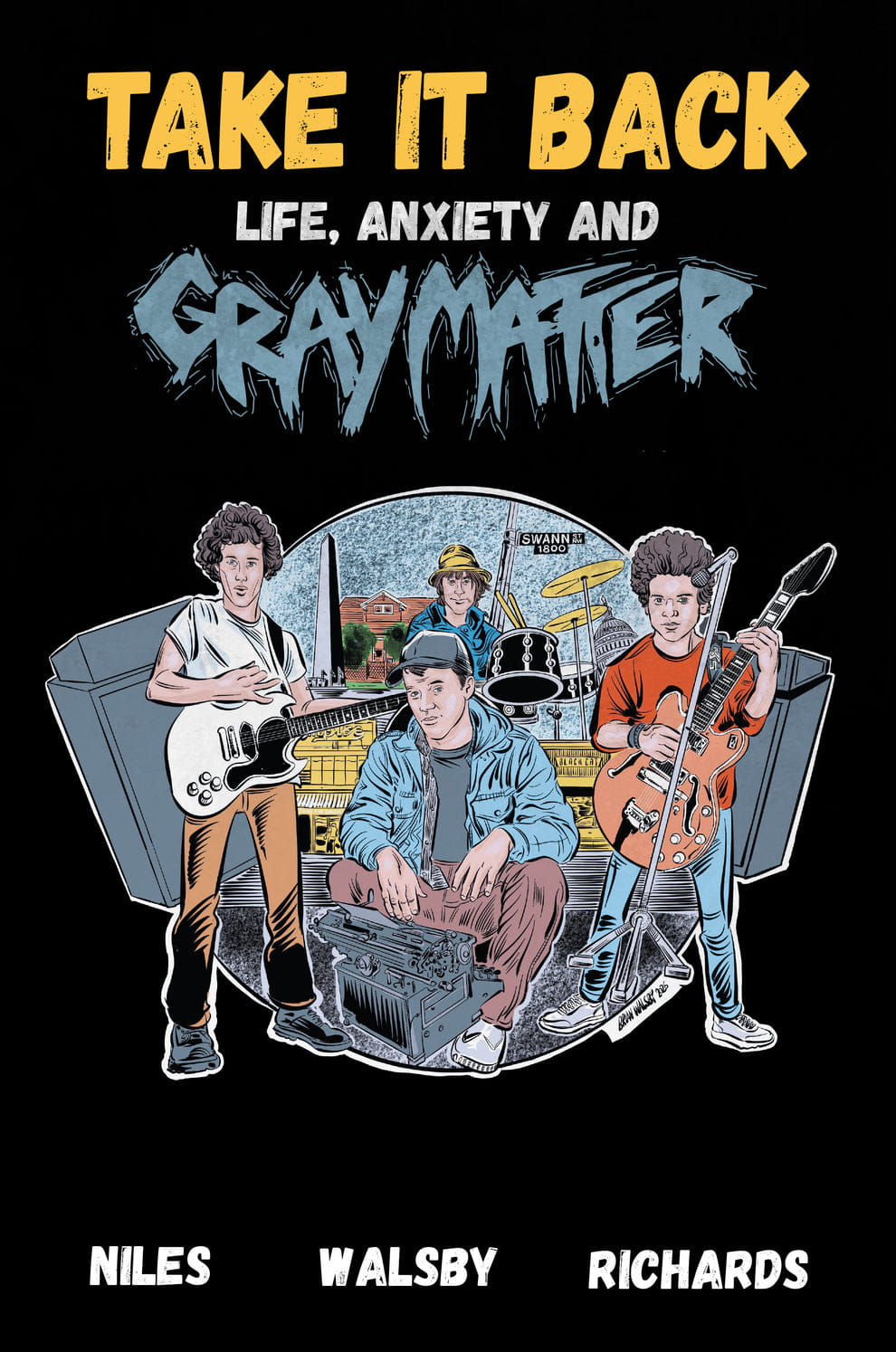
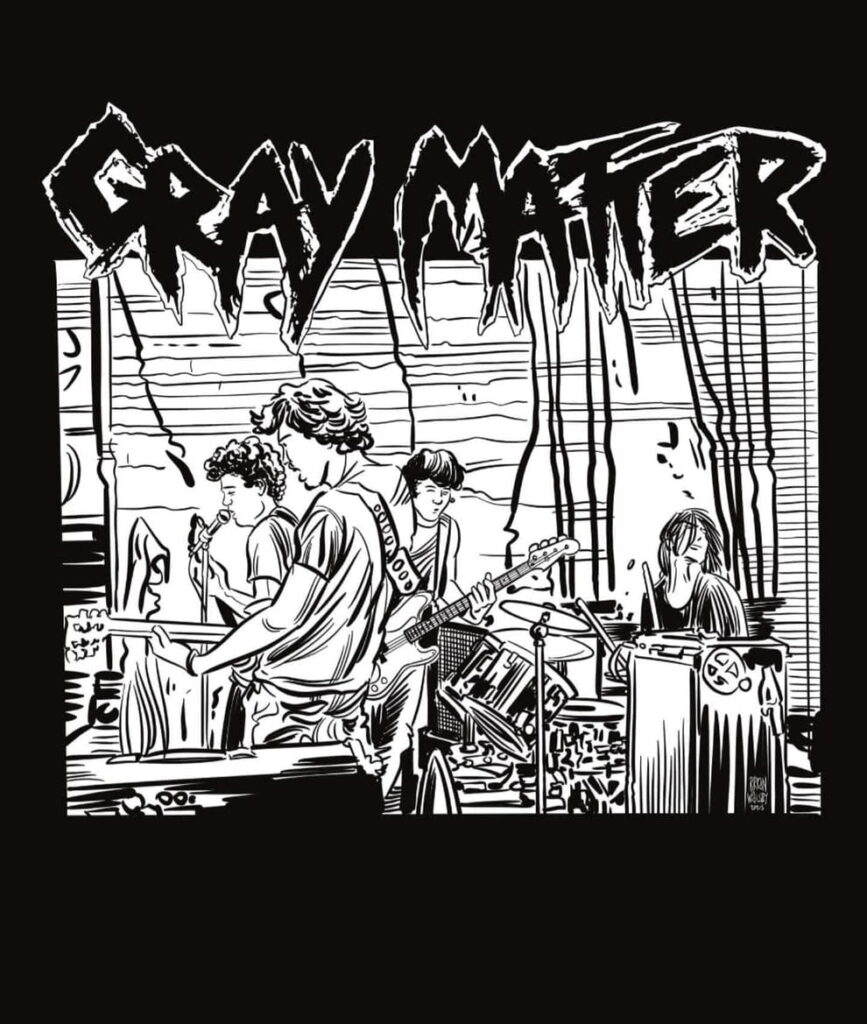
Horror writer Steve Niles has made a career for himself by writing about things that go bump in the night for over thirty-five years. However, very few know that before this, Niles played in a punk rock band, Gray Matter. The band was a part of the well established Washington D.C. punk scene and even released records on Ian MacKaye’s Dischord Records throughout the 1980s and early 1990s. Gray Matter has reunited several times since their disbandment, typically to celebrate the anniversary of the legendary rock club The Black Cat, owned by Gray Matter drummer Dante Ferrando.
For a while now, Steve Niles has had the itch to tell the story about his time in Gray Matter and the D.C. punk scene, along with some of the struggles he faced growing up. With his latest comic, Take it Back: Life, Anxiety, and Gray Matter, Niles chronicles these occasionally tumultuous times in his life. Illustrated by Brian Walsby, Steve’s journey through punk rock, comics, and mental health is a must-read. Below, Steve and Brian talk about what it was like to reconstruct Steve’s punk rock past into a graphic novel.
When you think about the D.C. scene, what made it feel like it was your scene?
STEVE NILES: You know, it was a really welcoming scene. I actually lived in the suburbs and would come into the city to visit my dad. I would go to Georgetown where all the punks hung out, and I was accepted pretty quickly. That’s one of my prevalent memories of being in the D.C. scene: how welcoming it was, which is, I think, uncommon. There’s a lot of gatekeeping that goes on in various scenes. I thought it was really exceptional that everybody was so nice. Everybody in the scene, like Ian (MacKaye) and all these guys, really early on, were always really cool.
Brian, what scene did you come from?
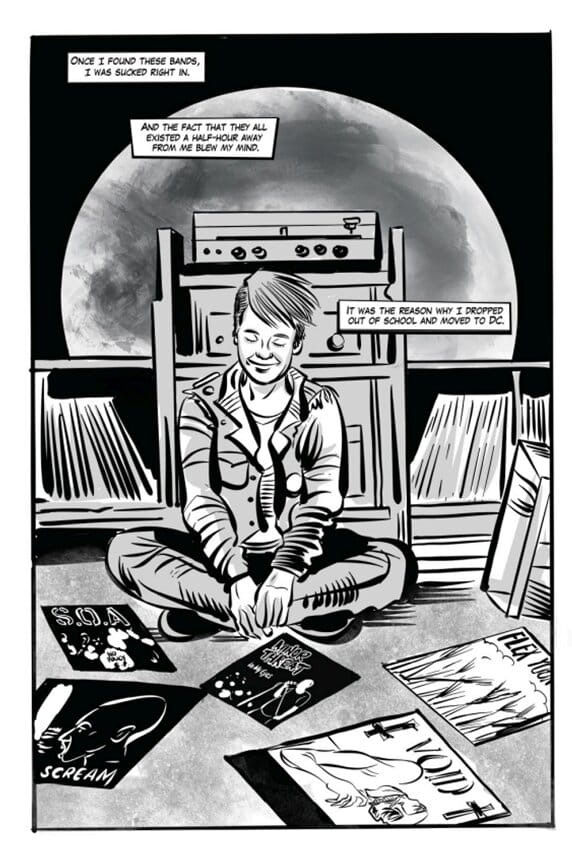
BRIAN WALSBY: It came primarily from the early to mid-1980s, a sort of letter-writing underground. The reason why I wouldn’t say solely punk is because there was a heavy metal underground that pretty much used almost the same tactics that the punk underground did. They had their own fanzines, and they had their own bands and demo tapes and that kind of stuff. They operated pretty much the same way that the “punk rock hardcore” underground operated during that time period, where you had to write letters and you had to sort of get involved. Obviously, it’s a lot different than what’s going on now. That’s definitely the world that I came out of, basically.
I saw what was going on with a few fanzines. I was blown away. I felt like I was sort of not… I guess out of step with what was going on, basically, in my peer group. I really resonated with discovering all this really cool music from both worlds: the punk underground and the heavy metal underground. It was pretty exciting. I guess because it was kind of small and it was something that you had to stumble into. It’s like the difference between loving the Beatles as a 10-year-old but knowing that the Beatles were always around. They’re just omnipresent. They’re great, but it’s something that you discover. I think that’s the difference. It felt like when you were discovering punk rock, it seemed easier to access because all you had to do was pay attention to it and write letters and read stuff.
It just seemed very natural to gravitate toward it because it really felt like it was your little thing that you discovered, your special little secret. I’m not trying to sound like a gatekeeper, but it was such a small thing back then that when you did see people out in the street wearing a Black Flag pin, that marked you. It’s okay to talk to that guy. He has something in common with me. Of course, these days it’s for the young people doing that now, that’s the same thing, but now you’ll see a person in a Black Flag shirt and you’ll go, I wonder if I have anything in common with that guy. It doesn’t have the same meaning, I guess.
Was there a moment that made you feel like you were part of the scene rather than just watching it?
STEVE NILES: I think probably the first time that I played in the band when the people that I grew up admiring were in the audience. That was really cool, I just remember that being a big moment where I really felt that I was part of something.
BRIAN WALSBY: I guess just being able to participate in it more. Maybe the first letter I got back from somebody was probably from someone that actually wrote me back and didn’t know how uncool I was, and it was okay. It was this guy named Drew Bernstein. He’s dead now. He started out being a hardcore punk kid. He was in a band called America’s Hardcore. They were huge letter writers, and they were very into all people that supported each other and wrote to each other and spread the word of America’s Hardcore, apparently. So I was pretty excited to get a letter back from somebody. I was like, oh, this is easy.
You just write to people, and if they’re interested, that’s all it took. Somebody wants to know about what I’m doing, so let me send back a bunch of stickers and write a little letter.He did that and it was like, “oh, wow, that’s really cool.” Okay, great. I had to wait until the end of 1983 to be able to go to a show because I couldn’t drive. I refused to drive, which was unusual for someone growing up in Southern California. You might as well cut off both your legs. You can’t really get around Los Angeles without a car.
What part of California are you from?
BRIAN WALSBY: I was born in Encino, and then my parents moved us to Ventura County when I was seven or whatever. So I spent 10 years there, and that’s it.
What came first for you: punk rock or comics?
STEVE NILES: Comics came into my life when I was a very little kid. I started with Creepy and Eerie and basically moved on to Marvel. I was a big Marvel kid. My peak was 1974, 1975. I was really into the Silver Age Marvel stuff. Punk rock came along pretty young. I was probably thirteen or fourteen. I have a sister who’s eight years older than me and was very into the punk rock scene. She turned me on to stuff like Buzzcocks, Ramones, all of those bands. Then I discovered the D.C. punk scene on my own and was very impressed with it.
BRIAN WALSBY: The way it went was I liked rock music. There was FM radio. There was this show called Dr. Demento. They liked rock music. They’re small kids. They discover the Dr. Demento show and for whatever reason, it leads into punk rock. I was really into Mad Magazine and I liked Charles Schultz’s Peanuts a lot and things like that. I never actually read comics until I was probably eighteen years old because my little brother started collecting them on his own.
I started reading things like X-Men during that time period, Chris Claremont, early ’80s kind of stuff, and I liked some of it. From Mad Magazine and Dr. Demento to punk rock, like when you hear the Ramones for the first time back then, and you’re like, “This is really different. It seems like a joke. It’s really funny. That seemed to be the order of appearance for all that stuff. Punk rock came slightly later.
Do you feel your time in Gray Matter fed your creative identity as a storyteller?
STEVE NILES: Oh yeah, if you’re a storyteller, I feel like anything does, any life experience feeds it. My band members were my only audience when I first started writing. I had Cal McDonald stories and other things that I’ve done since, but I was writing them back then, and band members were my readers, especially Mark. He read so much of my stuff. That was a really cool thing.
Brian, what drew you to Grey Matter’s story?
BRIAN WALSBY: I didn’t know what the story would be, to tell you the truth. I think when DiWulf got in contact with me, I hadn’t read it yet. I just thought it would be a really good opportunity. I always liked Grey Matter and grew up really liking the Washington D.C. scene and all the stuff that Dischord Records was putting out. The whole D.C. scene was very inspiring. I live in Raleigh, North Carolina, so it was kind of like the next serious epicenter of the whole punk rock scene. I liked Grey Matter very much, and I liked a lot of their peers: Scream, Minor Threat, Marginal Man. Pretty much almost everything that came out of there was really good. Faith/Void album, and then later Shudder to Think, stuff like that. I really liked everything that came out of Washington D.C.
Have either of you done any non-fiction before this?
STEVE NILES: Not really. I’ve done some shorts here and there, one-pagers, and some stuff for anthologies. Nothing that really sticks in mind. This was the first autobiographical nonfiction thing that I’ve written. It had been brewing for years. I had friends like Rick Remender and Eric Stephenson, who were really urging me to do it. They knew I had this history. My whole thing was I could never figure out a way in.
I could never figure out how to tell this story. Do I just go in and tell the story of Gray Matter? Then I came up with this idea that I did with Take It Back. It’s my life and it’s Gray Matter. I keep going back and forth between the two as everything converges. I thought it just made it more interesting than just a straightforward, in-order biography.
BRIAN WALSBY: There was that band, Die Kreuzen. They reissued one of their first records called Cows and Beer, which is a legendary seven-inch record. They wanted me to draw a little miniature comic book. It was like this six-page mini comic book that went with this reissue, but going from four pages or six pages to what ended up being a 100-page project. I mean, it’s kind of daunting.
How did you land on Brian as the artist?
STEVE NILES: I knew Brian from his T-shirt work. He had actually done a Gray Matter shirt that he sent us. We have a deal with a company called Shirt Killer, so we weren’t able to do it, but Brian stuck in my head. I had looked at three or four other artists, and the biggest problem I kept coming up with was that they were kind of superhero artists. It just didn’t work for me, but it was also, “Did they know the scene?”
Did they know the subtleties of the scene? A lot of times if you bring up punk rock with people, all of a sudden everybody’s got mohawks. DC was very relaxed that way. Finding somebody that knew the scene, and that was a good artist was a really tough thing to find. When we stumbled on Brian, it happened so fast we hired him right away.
BRIAN WALSBY: When I got the opportunity, I just signed on immediately because I just thought this is exactly the kind of thing I should be doing for sure. Luckily, they thought of me. I guess I was on a pretty short list apparently, so that’s also very flattering. At first, I was like, “I don’t know if I’m going to be able to do this,” but they made an offer that allowed me to go, “Okay, well I can do this for sure.” I just thought whatever they had to say would be good. Plus, I had a little bit of experience.
Did you pitch to DiWulf first, or did you consider releasing it independently?
STEVE NILES: I tried to do it through Comix, and there really was no interest. They just didn’t seem to really get it. My wife, Monica, found DiWulf. I contacted Steven (DiLodovico). I didn’t even realize I had met him a year before and actually talked about doing a Gray Matter book and completely blanked on it. I just wrote to him and was like, “Are you interested in reading this script?” He read it and came back. It was an immediate, “Yes.”
They got it. They got the whole idea of it. For comics, they don’t really know the scene. They don’t know the music. It was a tough sell. I’m hoping now that DiWulf is doing it, I’ll be able to sneak some copies into the comic industry. We’ll see how that works out.
I love them. They definitely know the scene.
STEVE NILES: This is their first comic. They were really excited about it, and they’ve just been great to work with.
Were there people from the D.C. scene that you felt obligated to consult, or were you nervous to show this to?
STEVE NILES: I’m nervous to show it to everybody. You know, I’ve always hidden behind vampires and monsters and things like that. This is the first one… I was like, this is my life, and I’m putting it all out there. I checked in with all the guys in the band, made sure they’re all cool. I’ve been keeping them up to date on it. The only other person I checked in with was Ian McKaye. I checked in with him just because I’m like, “Look, I’m putting you in the book.” I think all the scenes he’s in show really how funny and charming he is. He was cool with it. Aside from that, I didn’t really have to ask anybody.
BRIAN WALSBY: It turned out that Steve had a pretty good story, for sure. His misadventures and issues, and putting it all out there along with the actual story of the band, that’s pretty brave. You’re kind of exposing yourself to people. It’s a good story, him going through what he went through, sorting out his head, going through therapy. I mean, that’s also something I’ve been doing recently, which has been really beneficial. There are a couple of panels of him talking to a psychiatrist or a therapist or whatever. I kind of like that angle of it. It’s something I can also relate to: trying to dig down and figure out what your deal is or your issues or that kind of thing.
Was there a way you handled the gap between how people remember the scene and how it actually was?
STEVE NILES: Well, that’s really tough because I only have how I remember it. My memory is pretty scattered at this point. I mean, this was thirty, forty years ago. Luckily, Dante, the drummer, who also owns the Black Cat, has a photographic memory. With his help, I put together a complete timeline. I was able to work my own life around that. He knew everything down to the month.
Wow. That’s insane.
STEVE NILES: Yeah. It really is because I’m like, “Really, did we do that?”
Did you find a way to balance nostalgia with honesty when depicting a scene that people feel protective of?
STEVE NILES: I think I did. If anything, I laid my own personal stuff on the line. I wasn’t too judgmental about the scene. I tried to just tell the story from my perspective of being there: the subtle changes in the scene and what was happening with the bands. I think I handled it well. I’m very curious to see how people respond to it.
Was there anything you chose not to include?
STEVE NILES: I tried to get everything I could in the scene. This is about the sixth draft that you’re reading right now. It used to have a lot more personal stuff in it, and then my life was sort of taking over the story, just talking about every relationship I’ve been in, this and that. I looked at it and I was like, “You know what? I’m squeezing the band out.” So I did a major cut in about the fourth or fifth version. I really pulled back on my own life and pushed the band stuff forward.
What was your workflow?
STEVE NILES: I have never worked with anybody who works as fast as Brian. It was literally like I was getting two or three pages a day. He works on a tablet, so he moves really fast on stuff. He was great and took notes really well. There were a few drastic changes to the artwork he was fine with. He would just redo it and send it right back. We were in almost constant, daily communication, but again, going back to what I was saying about somebody who knows the scene, Brian was a big fan and knows the scene.
The one thing I had to show him was architecture. He didn’t really know what DC looks like, and it has a very unique look to it. I’d supply him with some visuals, but other than that, he did great. He already knew everybody in the scene, so I would just write, “Rites of Spring was playing,” and then boom, I’d get a Rites of Spring live shot.
Brian, do you have any visual rules you set for yourself when you’re drawing a story rooted with real people in places?
BRIAN WALSBY: I don’t have a process. I just try to do a good job. It’s easier to do that these days. I’ve been drawing on a tablet with Procreate. That’s really different from what I would have done ten years ago, because I would have been on paper. I haven’t done that in a long time. I just tried to capture the vibe of the story. I tried to do what actual comic book illustrators do. I don’t have any training or anything like that. I just kind of visualize it like I’m sure a lot of those guys do. Then, I just looked at pictures for reference, because that’s a great tool. Not everybody can draw an old-fashioned telephone from the 80s. Stuff that nobody ever has to use anymore.
Which is weird, because when I hear “old-fashioned telephone,” I think of the one with the small earpiece you listen from and then talk into the receiver on the wall.
BRIAN WALSBY: It feels like a million fucking years ago.
Was there something Steve did creatively that surprised you?
BRIAN WALSBY: I don’t know Steve from his career after being a bass player. I’ve heard about the movie, 30 Days of Night. I don’t seem to see a lot of movies. I knew it came from a comic series that he wrote? I just know him from his young adult bass playing. I even saw Grey Matter once. They put out the double seven-inch when they got back together after they broke up the first time. I think that was like toward the end of the ’80s or early ’90s when that came out. That record surprised me. A lot of those bands that break up in D.C., they never really reform. It seemed like they were one of a pretty small amount of bands that did. I saw them in San Francisco and they just blew the socks off the place.
It was some bar somewhere. They played seven-inch records and songs from the first two albums. It was just fucking great. I don’t know if they surprised me, but I was just surprised that they were actually back together and pretty happy about how good they were, and they were just great live. I almost think that that double seven-inch is my favorite Grey Matter record, because I just wasn’t expecting them to get back together again.
What was the hardest part of shaping the real history into a narrative arc?
STEVE NILES: The hardest part, especially because I decided to tell the story out of order, was finding the right rhythm. The one thing I didn’t want it to be was confusing because it’s constantly shifting times and dates. I think the toughest part was just organizing, making sure that the story flowed. I wanted some kind of arc. The example I give is my relationship with my wife, Monica. I’ve known her since I was seventeen. The book ends with us married and living out in the country, but organizing it was the toughest part.
Named the comic after one of the albums from Grey Matter, Take It Back. Did the music shape the tone or the structure of the comic at all?
STEVE NILES: I really wanted to make sure the book had a lot of lyrics in it. I’m really trying to get across what the band was about by showing Geoff’s lyrics and the songs. I didn’t take too much from the music itself. The original title was going to be “Swann Street,” which is one of our songs, but it’s actually from when I was in another band called Three. It was Grey Matter with a different drummer. It was a Three song; Grey Matter ended up playing it, but it wasn’t really a Grey Matter song; that’s why I went with “Take It Back.” I thought that was a better title.
What do you think your scenes taught you that still shows up in your work?
STEVE NILES: It’s simple: do it yourself. Don’t sit around waiting for permission from people. If you want to put out music, or put on a show, or put out a comic book, there are ways to do it. You don’t have to solicit DC Comics or Marvel Comics to put out a comic. You can just do it yourself, and that was one of the biggest impressions of the D.C. scene that changed me so much. These were kids, and they were putting on their own shows, you know, putting out albums and singles, organizing tours, doing all this stuff completely on their own outside the system. I’m a big admirer of that, and I’ve tried to carry that with me into comics.
BRIAN WALSBY: Pretty much everything. I’ve always really liked the aspect of trying to be creative. I kind of feel like finding punk rock and hardcore and heavy metal and those underground scenes was the catalyst for my own creativity. So when I think of punk rock and “do it yourself,” I think of DIY a lot more these days. I think when you say DIY, that sort of references the attributes of punk rock without really calling it punk rock. I do associate punk rock with just doing stuff yourself because no one’s going to do it for you.
Trying to stay busy and build something. That’s what it was all about for people in the 80s: building up your own scene, trying to get people who want to be a part of it and believe in it, and becoming their friend. I knew people who used to drive around and pick up kids from other parts of town and bring them to the shows they were putting on, just so these kids could see them. There was this fervor of, “Have you heard this? Check this out.”
Then when you get love back from people, you’re surprised. I was always surprised that everybody didn’t just immediately love Black Flag or something like that. Like, “Oh, you don’t like this? I guess it’s weird.” It seemed like it was a huge affront to a lot of people back then. It scared them or whatever. It was always really exciting.
Has making this book pushed you towards any other non-fiction ideas?
STEVE NILES: Not yet. This one really took it out of me. Like I said, I want to see how people react. It’s very odd to put yourself out there personally. I kind of want to see what the reaction is, but I did have fun doing it. It was very fun and kind of liberating.
Do you think punk as a subculture still has the same power to form identity for young people today?
STEVE NILES: If they discover it, it sure does. I think it’s a great time for it. I’m sure stuff’s going on out there. We just don’t know about it. That’s the coolest thing about this stuff: I’m a sixty-year-old man now. I’m cut off. I don’t get the newsletter anymore.
BRIAN WALSBY: It’s hard to say because I’m not a young person today. I don’t know what their entry point would be. I think the basic motivation has to be the same. I guess it’s just surrounded by a different culture. It’s pretty obvious that discovering things in the world before social media and the internet happened is a little different than what’s going on now. It’s hard not to sound like you’re a million years old when you say that. I’m a million years old, what can I say? It’s going to be different.
It’s going to seem different to me, looking at how kids get into underground. I don’t know if you can even call it really “underground” because punk rock is so… I don’t want to say mainstream. It’s just been accepted and woven into the fabric of American society. It’s no longer this little cool treehouse that you get to climb where there’s nobody else in there, barely, except for a few people. All of a sudden now, it’s like everybody’s in the treehouse. You’ve got to make your own treehouse or whatever.
What would your younger punk self think of this book?
STEVE NILES: Oh, he’d be thrilled. I’ve been trying to put out comics since I was fourteen or fifteen. I’ve been, in one way or another, making little fanzines or short story collections or something like that. So I think I’d be pretty blown away that there was a comic out. I think I’d be pretty psyched.
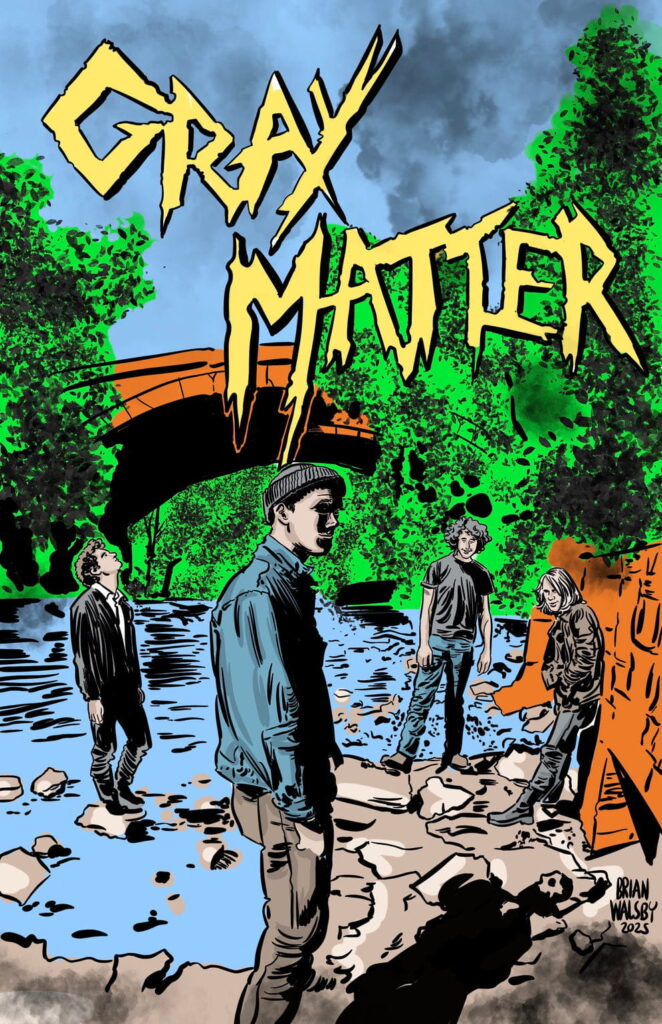
Take It Back: Life, Anxiety, and Gray Matter written by Steve Niles and drawn by Brian Walsby is available for pre-order at DiWulf’s website. Check it out and the other punk rock books they publish.
Discover more from Dying Scene
Subscribe to get the latest posts sent to your email.