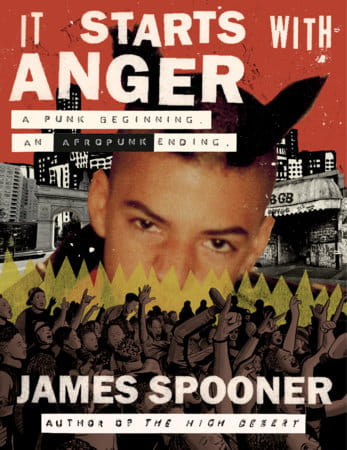
I’ve always been attracted to biographies, whether it’s someone I’m familiar with or not. A few years back, I read James Spooner’s High Desert and fell in love with a story about finding punk rock that felt similar to mine yet completely different. Disappointed that it was cut short before his move to New York City, I hoped that it wasn’t the end of Spooner sharing his punk rock past. Thankfully, it’s not, with the release of his comic and prose hybrid, It Starts With Anger: A Punk Beginning and Afropunk Ending. Here, Spooner takes us on the journey of what punk means to him and how this definition evolved his ethos in regard to his identity, politics, and DIY approach to art and community-building.
It Starts With Anger… is broken up into two parts. Spooner starts by jumping straight into his punk rock past by giving a quick summary of his slice-of-life punk rock comic, The High Desert. It’s been a minute since I’ve read it, so I don’t remember if it’s a summary or a story that may have been left out, but it links these pieces of work together well. Eventually Spooner makes it to a pre-Giuliani New York City. It’s here that he is accepted into the LaGuardia School of the Arts and starts to navigate the punk rock shows he had gotten a taste of during summer visits to his dad’s place.
What I like most about this story is that Spooner’s experiences in punk rock are easily relatable. He presents the punk rock he experienced in his youth for all to see, legitimizing the attempts a punk rock kid made. While there are moments that feel like crash courses on punk rock that he weaves seamlessly to enhance the story. Along with moments of honesty about the shitty behavior and hypocritical stances that came with punk, even when the bad behavior is his own. It’s not necessarily a baptism by fire, but looking back, it’s not hard to figure out how to do the right thing even if you have a mohawk, especially when it comes to racism, sexism, and homophobia.
Spooner reconciles some of the problematic issues of early punk bands, such as lyrics written by favorite bands he was a fan of when he first got into punk rock. His contextualizing of lyrics for songs like the Ramones “Loud Mouth”, The Descendents “Sour Grapes”, and Minor Threat’s “Guilty of Being White” doesn’t excuse the bands, but highlights that these exist. It’s one of the many cracks that Spooner points out in punk rock. The crux of It Starts With Anger: A Punk Beginning and Afropunk Ending is Spooner processing what it means to be a POC in the local punk rock scene. Sadly, many people believe that punk rock is solely white music, which is definitely far from true. Most of these beliefs are shaped by Spooner’s experience in the NY hardcore scene and love for bands who should have been able to play with more of the prominent bands of the era, but didn’t due to the color of their skin.
Part two pivots to Spooner’s sort of post-punk era after being disillusioned with the genre. He travels the country in some sort of punk rock odyssey for a few years until he settles into the NYC club and art scene doing DJ sets at dance parties. Yet, he becomes disillusioned when he is portrayed based on his race and how people would exploit him as being a “safe black.” A black individual who is perceived as non-threatening by non-Black peers. A term he uses critically and not self-descriptively. This continued disappointment sends Spooner on a quest to start documenting other black punks around the country who may feel like him. The baby steps to making the Afro-Punk documentary and then using the lessons of punk rock to get it shown to people, but even that comes with a headache when he accepts an offer to grow Afropunk as a brand.
James Spooner’s It Starts With Anger: A Punk Beginning and An Afropunk Ending is one of my favorite books in a year where I’ve read a ton of really good books about punk rock and dissecting the scene itself. Spooner’s not the first person to hybridize comics and prose, but his panels-and-paragraphs approach to an autobiography is well done, but does lean heavier in prose. I like hearing a good story about a person finding their thing, and it gets double points for crossing over with my interests (punk). While parts of his story didn’t turn out the way he wanted, it seems that Spooner has made the best of his situation and came out a better person for it. It’s relatable, gives perspective, and overall tells a compelling story that is still being written.
Discover more from Dying Scene
Subscribe to get the latest posts sent to your email.