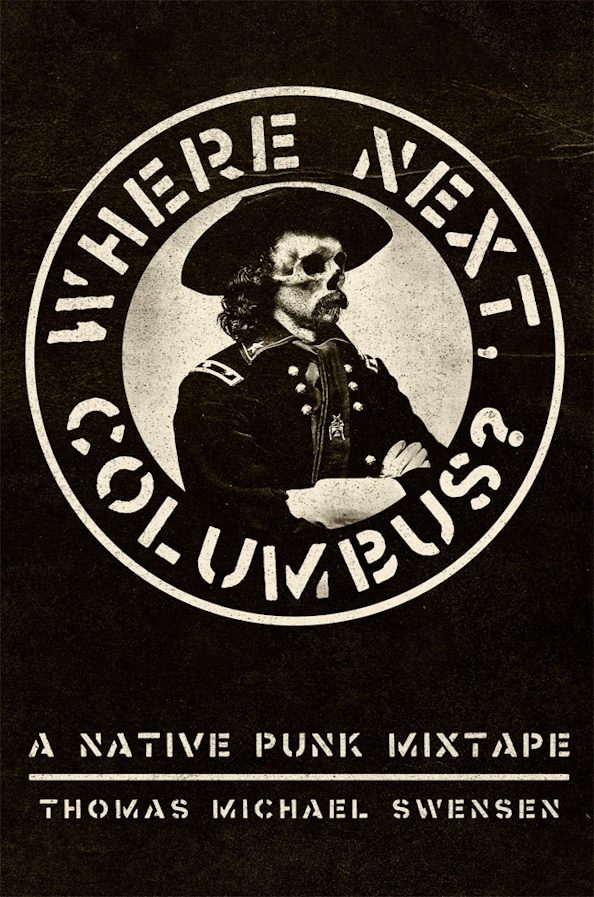
Recently, it seems you can throw a rock and hit a book about an overlooked punk rock scene. While punk rock has affected a good portion of the planet, each scene has its traits. While a lot of these traits can be traced back to either the New York or London scene, what’s evident is that a lot of the sentiments from the regionally cultivated scenes are universal. Thomas Michael Swenson’s book, Where’s Next, Columbus?: A Native Punk Mixtape, explores punk rock through a Native American lens. Pulling its title from not only a Crass song but also a Smithsonian Museum Exhibit that celebrated the incorrectly praised explorer, “Where’s Next, Columbus?” questions common assumptions about Native Americans, but it is not the focus. It doesn’t just re-contextualize punk as a whole as it relates to Native Americans, but also how it relates to sub-genres like hardcore, Oi!, and pop punk.
Born into Alutiiq culture in Kodiak, Alaska, Thomas Michael Swenson gives us his bona fides on how he got into punk rock, starting with a box of records procured by his mom in exchange for controlled substances. In this collection of records, he found the Ramones’ album Rocket to Russia, along with a George Carlin record and lots of rock from the ’60s and ’70s. This, combined with repeated viewings of the punk rock film Ladies and Gentlemen, The Fabulous Stains, a film that featured members of the Clash and the Sex Pistols would provide Swenson’s punk rock foundation. While his mom was working, He would make mixtapes with tracks off these records. Something he continues to do at the beginning of each chapter, resulting in a playlist that makes reference to punk bands like The Germs and OFF!, but also makes room for Native American punk bands and their relation to punk rock as a whole whether they sound traditionally punk or not.
Swenson goes over what sets his region’s punk rock scene apart from others, such as James Cook’s monument, the colonial history, and their looming presence over the Native Americans who live in Alaska. A show from Canadian Hardcore band DOA kind of set the scene on its path. It’s relatable as each region has that show or band that lit the powder keg, whether it be the Ramones first playing England or the Stooges playing for the first wave of punks. His arguments for punk rock are simple: punk is definitely political, and being born native is to be born into politics given the government’s treatment of Native Americans and the shrinking sovereignty they are experiencing.
Each chapter’s connective tissue is a little too transparent, but serves as a decent preview for what’s to come and even if each section’s thesis is stated too bluntly. Whether this is on purpose or not, it feels a little clunky mechanically, but works as a bit of a highlighter rather than a deterrent. While the text may be dense, as is par for the course on a lot of academic books, this keeps a reader from getting overloaded. In general, the actual mixtapes from each chapter are pretty cool. A good portion of these chapters center around a non-native setup, then provide their arguments using examples from Native American punk scenes across the country. Swenson shouts out a good number of bands, from old-school hardcore punks Skate Death, who played with DOA at that fateful show in Alaska, to Sub Pop artist Ya Tseen, and pop-punkers Friends of Cesar Romero.
While there have been a few academic books that seem to stretch their material, Where’s Next, Columbus?: A Native Punk Mixtape is not one of them. Each point is argued thoroughly without overdoing or repeating itself too much. Swenson’s experience and assertions regarding punk rock are more than valid and should translate well into other aspects of life and art, much like punk rock in general. If you are one of those people who feel like punk doesn’t have much to say, then you’re looking in the wrong places. Swenson’s book is a good place to start. Where’s Next, Columbus?: A Native Punk Mixtape by Thomas Michael Swenson is available through The University of Oklahoma Press.
Discover more from Dying Scene
Subscribe to get the latest posts sent to your email.