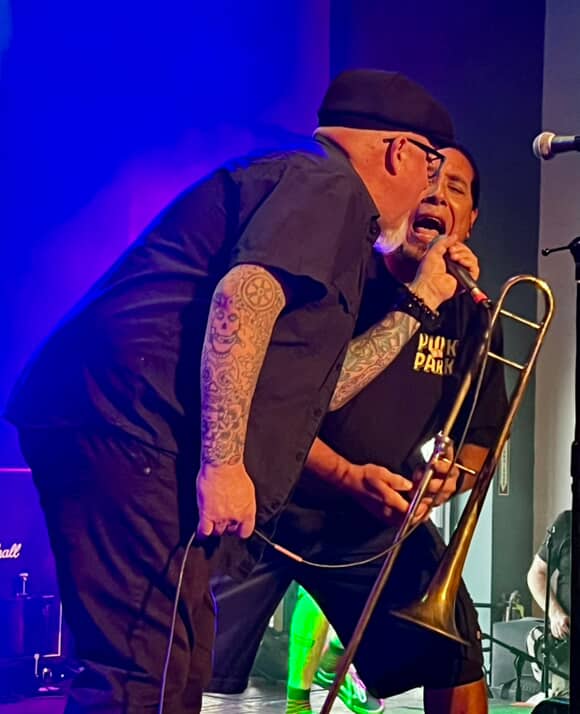
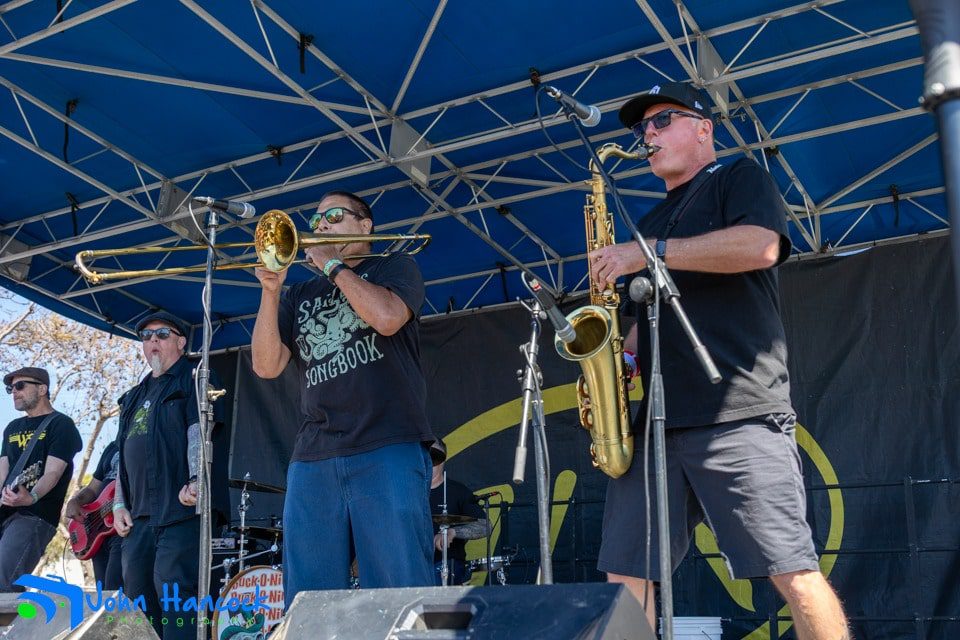
For over thirty years, Buck-O-Nine has been delivering ska punk anthems on their own terms. Starting up in 1991 in San Diego, CA, they have been a constant member of the ska-punk scene, blending ska with a plethora of other genres. If you’ve never seen Buck-O-Nine play live, you’re missing out. Playing a great mix of their catalog and a few covers, you’re sure to be dancing by the end of their set.
This year, Buck-O-Nine released their twelfth LP, Cut Out The Noise; fourteen songs written during the COVID-19 pandemic and sees the band pivot to a more serious tone, but still keeping the positivity that makes their records a joy to listen to. Craig and Jonas were kind enough to give us some time to speak about the new record and how the band functions these days.
Dying Scene (Forrest Gaddis): I was listening to it a lot the last couple of weeks. I really dig it. It seemed a little more serious than the other albums.
Jonas: I think we broach some different topic matters. Pebs (Jon Pebsworth), our singer, wrote all the lyrics, and he was influenced by the events of what was going on at the time. If you rewind five years ago, in the depths of the Covid lockdown, we had passed back and forth MP3s or WAV files. We’d come up with these ideas whether it was guitar riffs, horn lines, or whatever. Then Pebs would take that and just loop it over and over again and write lyrics. Being up in the COVID lockdown in Los Angeles, there was a lot of stuff going on, plus dealing with you know, personal demons. I think all of that leaked its way into the lyrics. Although I think some of the songs have really positive, uplifting messages, there’s definitely a darker tinge to it.
I noticed that you guys are on Cleopatra. Are they not the goth label anymore? I remember being in high school, and they were releasing like Christian Death and all those types of bands.
Jonas: Cleopatra they put out all kinds of different genres, hip-hop, punk. Lots of different styles.
Craig: They’re just kind of acquiring things here and there. It looks like they’ve done a lot of legacy stuff.
Jonas: There’s like blues records and live records. It’s interesting, they’re releasing stuff all the time, just all different genres. Some of it is catalogs that are being reissued, and others are just new artists. We had the opportunity to work with them, and it’s cool. They’re really good people.
Did it just take long to get into the studio to record, or did you record it in pieces?
Jonas: We had written over twenty songs. I want to say like twenty-three or twenty-four songs and then we went through this process of weeding down the best. We all voted on which ones we wanted to go through and record. We started doing that. We had some technical difficulties the first time we recorded it. We actually re-recorded the whole thing. That’s one of the things that happened which made it drag out a little longer. I mean the fact that we hadn’t been in the same room in a couple of years. After that, just trying to figure out how we want to move forward on this, and the process of recording it twice was very time-consuming, but we persevered. We just kept at it.
What’s the bands writing process?
Jonas: A lot of the stuff on this record just started as like guitar riffs that I would write and with loose arrangements, so I would have a guitar riff or a chord progression or both.Then maybe some secondary guitar stuff to enhance the line. I wanted to put together a strong enough idea that someone could riff off of; I would send that around. Then Craig would grab the track and pull it into his, you know, digital workstation at his house and work on the horn lines. Simultaneously Pebs would work on lyrics and Vocal melodies. We just kept sending stuff together until we had good arrangements and parts until we thought, “This is the sound we’re looking for.”
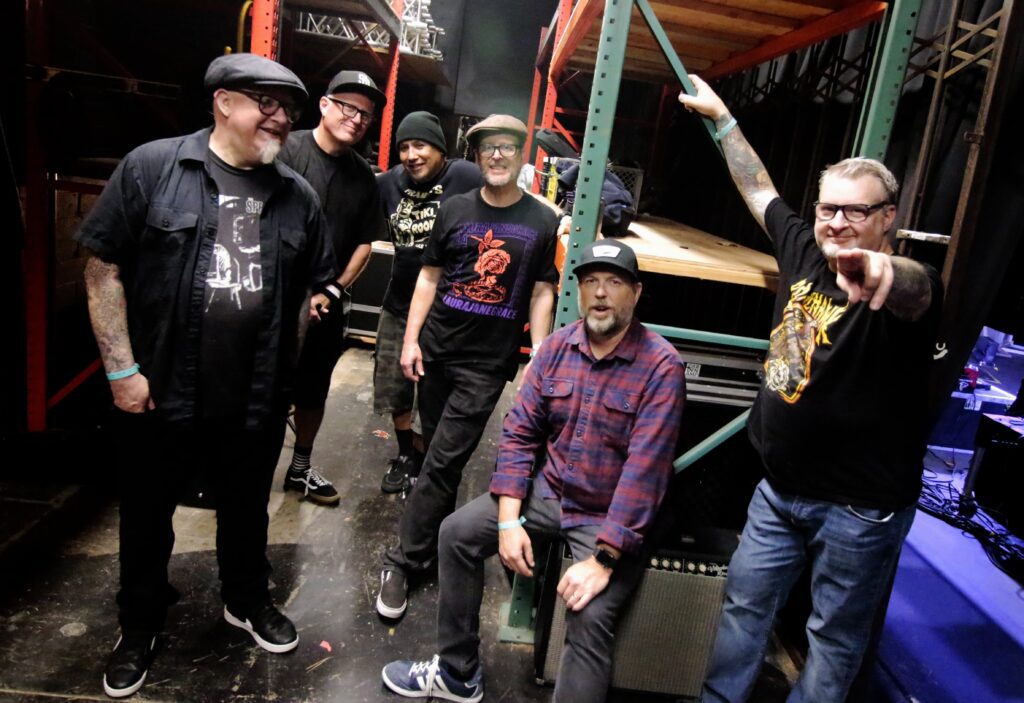
photo by Laura Streppone
Has that always been in your process?
Jonas: A lot of the times, but we did this one where we wrote everything apart. We never jammed the songs in a room because we couldn’t. There was not that opportunity, but a lot of the time, what we like to do is we’ll come up with parts in real time, work on it. Pretty much all our other records with the exception of Fundaymental, the one before this.
We’d come up with song ideas whether it was like guitar riffs, guitar chord progressions, or whatever. Whether it was me or Pebs, we would come in with something, or the horn players would come in with ideas straight out of the gate. We don’t have one formula, which is great. Once we start fleshing out the songs we’re all open to feedback. Everyone listens to music differently and it makes people feel different. Part of our process is just talking about some ways that we can really sync this all together. It doesn’t necessarily start with any one particular person. It’s like let’s get ideas in the air like a juggler and then just start going for it and figuring out what works and what doesn’t.
Where do you guys draw inspiration from either musically or lyrically?
Craig: Lyrically, it’s a lot of real-life stuff, personal introspection, and observation. Musically, it’s a broad spectrum of ska, reggae, and punk influences and things in between, depending on what the song calls for, I suppose. That’s kind of been our main three-pronged approach. It’s a good chemistry set.
Jonas: With Buck-o-Nine, you’re cognizant of what kinds of song ideas tend to work the best for us or what kinds of musical ideas provoke or entice other ideas from the rest of the players. As opposed to a singer-songwriter kind of approach, where someone would come in with the entire song, lyrics, melody, and chord progressions, and very specific ideas of what has to happen. We’re not that kind of band. It’s not one person and a cast of backing characters. I think the cool thing I love about this album is that if you listen to the lyrics, it’s like Pebs kind of wrote a story. The first song, “Preface” talks about how he’s getting out of LA.
At the time, he was living in Los Angeles, and he touches upon personal things that affected him while living up there, and then with each song, unravels more and more to the onion, so to speak. “I’m Alive,” the second song, is a celebration of life and how he persevered through dark times. The next song, “Done With You” is very dark lyrically and even in the feel of it and the riffs of it.
It talks about his battling depression and anxiety. Each song has a really strong story in it. It’s super interesting, his approach to lyrics. I think John is probably the most prolific songwriter that I know personally. He writes so many songs and I think he’s really hit his stride here because we’re really pushing each other with a feedback loop. He went and rewrote things over and over again. I went back and we did guitar parts. Craig and Dan went back and did horn line stuff. I think we really fell into a good thing here with how the lyrics and the energy of the music kind of clicked together. I’m super excited about how it came out.
There’s definitely a shift in the lyrics and the type of songs, even from the last album. I like the contrast.
Jonas: Yeah, it’s interesting because as a band that releases records, we put so much effort into this. When we release it into the world, we’ll never know how other people hear it. It’s just impossible. I was talking to a friend who’s an elementary school teacher, and I said, “You’ll never realize the impact you have because everyone feels it differently and not everyone can articulate what they feel.” It’s cool to hear from people who’ve listened to it and want to tell us their thoughts, like I think it’s super rad.
It wasn’t the album I was expecting and I like that. I always like being surprised. It’s poppy, but it’s still got a little bit of darkness in it.
Jonas: I think musically we try to challenge ourselves because we’ll experiment with different rhythms and things that you might not hear in other bands. I always remember this paraphrase from Angelo Moore from Fishbone, like years ago, when he was on the radio, and he was saying that ska is a type of music. It should be mixed with other styles. I was like well, wait a minute, because I liked just ska on its own, like traditional ska and whatnot. I see what he’s saying because it lends itself, and you can find new musical space if you mix it up. Instead of just doing the same straight up chord progressions or the same thing over and over. I think we get bored doing that. You take a bit of a risk that you might alienate some people, but then again, you just never know what people are gonna like.
I remember when Twenty-Eight Teeth came out and “My Town” hit the radio. I was in junior high, and as soon as something hit the radio, “Oh, they sold out.” Holier than thou punk rock attitude. I don’t hear that coming from kids now. Do you think because radio isn’t as prominent as it was, that attitude has kind of gone away?
Craig: Probably yeah, I mean the landscape’s so different now. People can just self-publish on, you know, the various platforms. My son is nineteen, and my daughter is seventeen, and they listen to everything. There’s not as much, “Oh, you’re a punk rocker. You’re this, you’re that.” I think people like what they like and don’t worry about the labels. Plus, everything’s out there now. There’s no underground. You don’t have to go find a zine or mail order something to find out what’s going on, or go find a flyer to find out where the show is. Everyone’s got equal access for the most part.
Yeah, that’s what I that’s i’m always amazed that you can just find anything. You can just type it and find all those bootlegs. You can just go on YouTube and they’re all there.
Craig: I think it’s bands like us who were around in the 90s. I think every single band was accused of being a sellout. I don’t even really know what it means. Other than like people are assuming, “Oh, yeah, you’re you’re involved in greasing the wheels.” I have my own idea of what payola was; pay-to-play kind of stuff, but for radio. It’s almost like a catchphrase of putting down a band that might have had a little bit of luck
Jonas: Yeah, I agree with Craig, with the sellout thing. It’s not the way people listen to music now. It’s different like Craig was saying. Kids are still into the Rolling Stones, David Bowie, and The Who. My daughter’s a drummer into speed metal and all kinds of crazy stuff. My daughter doesn’t have a particular label for the scene, whatever she’s involved with, it’s kind of different. It’s interesting to be able to release music in the year 2025. It blows my mind because you’re saying, “People can find anything.”
Craig: Yeah, I think back in our generation, there was the sellout thing. If there was a band like Green Day. Many of us were listening to Green Day before Dookie came out. The first two albums were more accessible and they were playing small venues. You felt like maybe it was an exclusive kind of club. They belong to us. Then they’re out there to the rest of the world like Nirvana and maybe that’s where it comes from. It’s not as a exclusive of a club anymore because now the jocks are listening to it. Maybe that was part of it, but I always just thought if you’re not selling out your music or your artistic integrity, then you can’t fault someone for trying to make a living. Some bands did sell out. I remember there were punk bands that went metal in the eighties and then you’re seeing them on Headbanger’s Ball on MTV.
Are you guys mostly part-time? How often are you guys playing right now?
Jonas: I think we have four shows booked right now. We have three shows at the end of this month. Then we have a festival we’re going to play in Mexico in October. It’s not like a touring machine like we used to be. It’s more like now we all have careers or families. Just other responsibilities. It’s like whenever we can find a bit of time, we’ll book like a short little run, and it’s been a lot better for us that way, treating this as a hobby, because trying to make a living at something like being a musician, you gotta do so much. So, by not having it as our main gig, we can pick and choose what we want to do and no one gets bummed out for having to play like some show?
If we’re trying to pay rent, we’re gonna take this three-hour private event, playing covers to people who don’t even care. We’re just background music. That’s the reality of being a musician for a living. You gotta teach. You gotta sell merchandise all this stuff. For us, we’re just at a point in our lives where this just works better as a hobby. We’re not dependent on it for financial survival, but we could still make money out. It’s kind of like going golfing with your buddies on the weekend. It’s like a guy’s trip. We’ll just do a tour for a week. It’s like the seven of us in a van and it pays for itself. Our favorite thing is playing live. You get to hang out with your buddies. We’ve been friends for so long is kind of what makes it a different experience for us.
Personally, like other bands, it’s like “Oh, the guitar player can’t do it. I’m going to call blah blah blah” or you know, “the horns can’t make it so i’m going to call this dude and that dude” We’ve never really been that kind of band. It’s something that I think affects us in that there’s this trust and bond that we have because we know we’re not going to replace anyone in the band for any reason. We feel closer to each other. We trust each other with song ideas or taking risks on stage. It’s just a looser, but funner feel for us. If we can, on stage have a great time and people see that they’re gonna have a great time, too
Buck-O-Nine’s Cut Out The Noise is available wherever you get music. They have some shows coming up for more info and tickets, click here.
Discover more from Dying Scene
Subscribe to get the latest posts sent to your email.