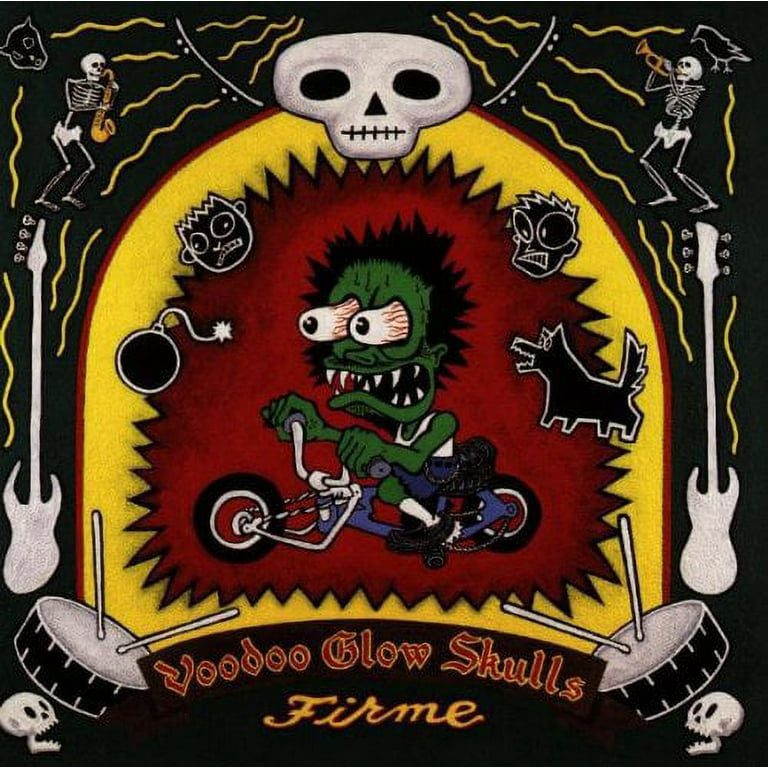
This week marks thirty years of the Voodoo Glow Skulls album, Firme. Released on October 10th, 1995, an instant ska punk classic that blended breakneck horns, grit, and high energy. The album cemented the fanbase the band had been cultivating since their inception seven years earlier. If their first album, Who Is This Is?, lit the fuse, then Firme was the exploding keg of gunpowder that got the band noticed.
We spoke to Frank about this milestone for Firme and the band’s experiences making the record and how it helped solidify the band’s legacy in the scene.
Dying Scene (Forrest Gaddis): When you guys were making Firme, did you guys have any idea that it would be a cornerstone ska punk album?
Frank Casillas: We did not. I mean, we knew that things were happening for us at the time. I guess it was a lot of perfect timing for us. That whole third wave of ska was on the verge of happening. I would like to think that we were a few steps ahead of that. I guess you could say that’s the first chapter of the Voodoo Glow Skulls book. We’ve got so many albums out now. It was just like a kickstart to the next level, to be honest with you..
How long had you guys been playing at that point?
I think it’d been like five or six years since we started the band. We’d already been touring and doing a lot of stuff on the really DIY level. We had put out a couple seven inches and Dr. Strange Records put out Who Is This Is? That gave us a lot of momentum.
Was there any hesitation to jump to Epitaph from Dr. Strange?
At first there was. Before we signed to Epitaph, there were a lot of major labels that were interested in us. We didn’t really want anything to do with that. We were already a DIY band. We’ve always been, and still believe we are in a lot of ways. It just kind of happened naturally for us. It was kind of like the natural right decision. There were a lot of people that were working at Epitaph at the time that were fans of the band that were already seeing us play. They introduced us to Brett Gurewitz. So for us, it was just the right move. We, obviously, as a band at that time, wanted to get to the next level. We felt like with Epitaph, at that time, we were around a lot of good company.
Did signing with Epitaph shape the sound of the album at all or were they pretty open to what you wanted to do?
Well, as far as the sound goes, the producer Garth Richardson who worked with us had a lot to do with it. It was our first time actually working with a real record label budget and with a well-known producer. He did the Rage Against the Machine album, you know. He was a big-time producer. So for us, it was a new experience. I would say going to legitimate studios and working with a producer that already had success with other albums definitely helped shape the sound of the record.
The producer wanted to change a few things, and we were pretty lenient on some things. We didn’t really let anybody come in and change much of anything. Granted, during that time, Pro Tools was a new thing. We got to experience stuff like that. I would say, as far as the overall concept, the music, and the sound, it was one hundred percent us.
With Pro Tools, maybe it’s something from that era in general, is that how a lot of the movie clips get in there?
I wouldn’t say it was necessarily because of Pro Tools. We always have been influenced by comedy. We grew up listening to Richard Pryor and Eddie Murphy and Cheech and Chong movies, a lot of cult classic stuff, you know? We were just like, this is a part of us. It’s a big influence for us. We weren’t really accepted in the traditional ska scene, as there wasn’t really a ska punk scene yet.
There were like a handful of bands that were doing what we were doing, and we didn’t really exactly fit in with the punk scene. For us to throw those samples in kind of held people’s hands a little bit and led them to like our sound. A lot of people were like, what the hell is this? It’s not ska, it’s not punk, it’s not metal. I mean, during the early 90s, late 80s, it was new to a lot of people. Those samples, throwing them in there, we always had that in the back of our head. Like, hey, we got to throw these samples in there because it’s going to kind of narrate the music and the album.
For me, one of the first albums I got as a punk rock kid was Firme. That guitar tone has always been there for me. I don’t know ska or punk without it.
That’s a lot to be accredited to my brother, Eddie. First of all, before we got started, we were like heavy metal kids, you know? We grew up listening to Iron Maiden, Judas Priest, and Scorpions. We grew up listening to that type of music, and we got turned onto ska and punk when the glam scene started coming along. I’m the older brother. I was always like a few steps ahead of them musically.
I grew up listening to new wave music, heavy metal, and ska. I was way into the British two-tone stuff at that time. My brothers and I pretty much shared record collections, and that’s kind of what helped evolve our music. We were kind of musically confused as to what style we wanted to go into. That’s how you get Voodoo Glow Skulls, man. It’s just like a product of our environment and the music we were listening to at that time.
We didn’t really go, we’re gonna write this type of music and add horns. I mean, the first two or three years of our existence, we were just like a wannabe Red Hot Chili Peppers four-piece punk-funk band. And then we heard, believe it or not, Fishbone. Fishbone and Operation Ivy were the bands that pretty much influenced us to do what we’re doing now. We heard those two bands and we were like, this is new, groundbreaking, innovative music, and this is where we want to go. So that’s pretty much what kind of helped us mold our sound.
When you wrote the album, did you have both English and Spanish versions in mind?
It’s funny because when Firme came out, it was gaining a lot of momentum. We were having these meetings at a conference table at Epitaph with Brett Gurewitz and everybody involved. At that time, it was really going off at Epitaph. Stuff like that would happen all the time. I just mentioned it one day. I was like, “Hey, why don’t we do a Spanish version?” And Brett was like, “Okay, let’s go.” Next thing you know, we’re in the studio doing a Spanish version. It was just quick and simple. I mean, that’s how fun it was back then. There weren’t any formalities to it.
Do you have a vocal performance you prefer over the other?
Well, I mean, the original Firme captured us the most. When you try to duplicate something, no matter what you do, whether it’s English, Spanish, or a re-record, I never think it’s the same. Actually, surprisingly enough, it did very well. It’s still holding its own. I prefer the original. The energy and everything of the original Firme record, I think you can’t top it as far as Voodoo goes.
The English version is the one I’ve heard growing up. I was listening to the Spanish version in the last week; it’s been a minute since I’d heard it. I forgot how different it is. You’re a little more calm with it.
I consider it more like a novelty version. It helped us gain some coverage and some ground on MTV Latino. We actually got some plays out of that. The “Randy Gordo” video did very well on MTV Latino, which was something that we totally did not expect. It definitely opened up some doors for us in the Latin market. It was great that we were able to have that creative freedom.
It’s only because I’m a movie nerd that I know that this song’s in there. I know that “Shoot the Moon” is in Biodome. Was that something you guys had a say in, or was that done behind the scenes?
So, funny story. It was done behind the scenes because we have nothing to do with the publishing end of things, especially when you’re on a bigger label and stuff. We were actually on tour, and one of our horn players, his girlfriend at the time, called and was like, “Hey, I just saw this movie, Biodome, with Pauly Shore, and you guys are the first track on the whole movie.”
We had no idea. We called the record label, and they’re like, “Oh yeah, we got you guys on there.” That’s pretty much how that happens. The band is usually the last to know about stuff like that. It launched us in a lot of ways. A lot of people recognized us through that. It’s always cool to be able to get that. It helps sell records and get you out there and known, for sure.
We were on the Mr. and Mrs. Smith soundtrack. We were not in the movie, but the songs were on the soundtrack. That’s another one of those things where they’re like, “We got you on the soundtrack,” but the song didn’t make the movie, but you’re on the record. It gets you out there.
You had mentioned you had released EPs before, and some of the songs were on those EPs. How many new songs did you write for Firme when you guys started working on it?
There are very few songs that were on those seven inches that we put out before. I think a majority of the songs on Firme were unreleased previously. There were a few. Maybe a handful, two or three of the songs were released before, but we’ve always been pretty clear about not trying to re-release things twice. Even though obviously putting something from a seven-inch EP to a full-length album on a bigger label, obviously you’re gonna get more exposure. So a lot of the stuff we wrote for Firme, though, was all new stuff.
When you put the few that were on the previous EPs, did any of those songs change from the EPs to the full length?
The production changed, but we didn’t really change the music or anything like that. Everything that you hear on the Firme record is pretty much all organic stuff. I think what happened is after Who Is This Is?, we spent a lot of time developing our sound and practicing. We spent a lot of time writing and rehearsing the songs that were on Firme. We wanted to make sure that by the time we recorded the record, we actually were more of a put-together band. Who Is This Is? definitely gained a lot of momentum.
We were still trying to figure out our sound. By the time Firme came around, we were more of a seasoned band, and we had more experience not only playing live but also rehearsing and learning how to play our instruments. I think that’s why Firme came out the way it did. It was just the vibe. Everything we were throwing, the imagery, the album cover, all that stuff kind of came together and helped complete that whole package.
Who did that artwork?
So that was a local guy from Riverside, California, named Ken Stansbury, a very, very good artist. He was just a well-known local hometown artist who always hung around the band. At the time, he was hanging out with us a lot. We had a studio in an art space in Downtown Riverside where a lot of different artists would rent rooms out. So it was like a big community of different visual artists and musical artists.
He was around when we were writing a lot of these songs and grasped the whole concept of what we were trying to do. He was like, “Man, your sound is fierce, but at the same time you have this Mexican vibe and the Southern California vibe.” That’s what he translated the music into. The whole character, which is obviously a rip-off of Rat Fink. I don’t know if you’re familiar with Rat Fink and Ed “Big Daddy” Roth, but that’s Southern California culture and lifestyle, as well. Car culture is a big part of it. So, it kind of all came together.
I would like to say that Ken was like a part of the band. You know, he was always around, and he just kind of embraced what we were doing. We had a lot of good people around us who were visualizing what we were visualizing at the same time.
Did living in Riverside help develop your sound? Did you take anything from living in the area?
We were transplants from East Los Angeles. When we moved to Riverside, it was the late 70s. Suburbia was a thing, you know? People were moving from the big city to rural places like Riverside and Orange County. A lot of tract homes and stuff like that were happening in Southern California. A lot of people were moving there at the time from other different places. We kind of became a product of that environment. We were these confused Mexican-American kids that are kind of thrown into this Anglo-White suburbia type of place. We had to learn how to adapt.
Everything was very new to us. I mean, that’s how Voodoo Glow Skulls kind of came about. At that time, Riverside was kind of like Texas or something. It was very open and rural, with a lot of land and backyard parties. That kind of molded our whole attitude toward our music, our sound.
We just kind of became a product of our environment. That’s why a lot of our early songs were just really adolescent as far as the lyrical content goes and stuff, a lot of partying and stuff. That’s what people were doing at that time. If you were a teenager, you were going to backyard parties, keg parties, shows. Punk rock was still kind of very new. We were just living our life, and Firme was a way for us to express what we were going through and what we were living at the time.
How did you guys land on the Charlie Brown cover?
We grew up listening to oldies through our dad’s record collection. That was a big influence for us, as well. A lot of the stuff you hear nowadays, punk rock and rock and roll, stemmed from the early 1950s and 1960s rock and roll. You hear a lot of it, whether you notice it or not. If you’re into that old music, there’s a lot of stuff you can grasp from bands you hear now. That’s always been a big influence on us as well.
And the band, The Coasters, that played “Charlie Brown” and several other songs, we consider them to be like the 1950s and 1960s version of what we do; kind of funny, fast, manic music. I think The Coasters were ahead of their time. They really appealed to that. They happen to be a big influence on us as well.
Is there anything you’d go back and change on the album, or is there anything you’ve changed on stage?
I think we captured a good moment in our life and in our career with that album. There’s not really much I would change. The producer at the time didn’t think our horn players were good enough to play the music that he wanted to bring in the session, you know? He wanted to bring in session players and stuff like that. This is something we stand behind. Our guys play our music every day live and they rehearse; it’s Voodoo Glow Skulls. If you bring in some guy from an orchestra or something, it’s gonna be different. That’s the only hiccup or snag you could say we had during that whole process, but at the end of the day, we got our way.
How do you feel it holds up in today’s social and musical climate?
I’d say it holds up pretty good, man. Right now we are on a resurgence. I quit the band for seven years, and one of the main reasons I came back is not only because I missed doing what I do; I missed the music, I missed my brothers, I missed the fans, and everything that goes along with it. One thing I noticed was ska music that wasn’t happening back then is happening now more than ever. We’re busier now than we have been in a long time. That influenced me to come back.
I was watching my peers and all my comrades that are in other bands like Buck-O-Nine, Mustard Plug, all these bands that we grew up playing with. They’re out there killing it and shows are selling out. You’ve got these big festivals going on, and I thought it was time for me to come back. The band needs me. I think it’s bigger now than ever, man, honestly.
I saw you play in January at the Ska Smackdown and it was fucking great. That whole show was, but you guys put on an amazing set. I also saw you guys twenty years ago, play at the Anarchy Library and you guys were like two feet from the crowd. I don’t even think you guys could all fit on the stage.
I remember playing there. It’s definitely always been a high energy show for us. You know, obviously, the older you get, the more seasoned you get. You figure out your instruments and your sound and everything. I think right now, the lineup that we have and with what we’re going on with the band in general, I think it’s right now, it’s some of the best times to see our band. I mean, we all want this now. The music will continue.
Did the album teach you anything about songwriting or performing?
You learn a lot when you work with guys that are professionals that get paid a high dollar to record your music in a studio. You learn a lot that you didn’t know before. That was like our first introduction to Pro Tools. Pro Tools was like a new thing when we did the Firme record. Back then it was we’re going to bring in this specialist from France and he’s one of the only guys that knows how to use this program. We’re going to put him in this special room and he’s going to do all the edits and everything.
My brother Eddie, the guitar player, is now our producer. He’s got his studio at home in Riverside and he records a lot of the L.A. bands and a lot of these ska punk bands that are playing now. So we got a lot from working with professionals and paid attention and took notes.
That’s how we’re able to do what we do now is by paying attention to what those guys were doing, asking questions, just not being some band on a major label budget recording and not giving it two shits about our music and just doing what they tell us. We were always hands on from day one and we still are.
If you gave this album to a kid to listen to for the first time. What song would you tell them to start with?
I think “Shoot the Moon” is probably the staple. There’s a lot of cool songs on that record. I think Shoot the Moon kind of defines the record and it defines us the most just with the samples and everything. I just think it just comes out and just hits you in the face from the get go. You got the heavy guitars and it’s loud and you got the horns. People are just like, what the fuck is this? We hear that a lot from people that say, “I heard you guys from the first time that “Shoot the Moon” song, that kind of set the pace for that whole album.
I mean, we’re not for everybody, obviously, and no bands are really. For us, we’re just really abrasive. There’s nothing softer or gentle about us. We’ve always been that way. You got like these up front, you know, guttural monotone vocals and then, you know, you got the heavy horns and the loud guitars that are more like a metal tone. You got like the thumping bass. It’s kind of hard for people to grasp at first. Somehow we’ve managed to make it work and keep us going after all these years, man. So we’re stoked, you know?
Discover more from Dying Scene
Subscribe to get the latest posts sent to your email.