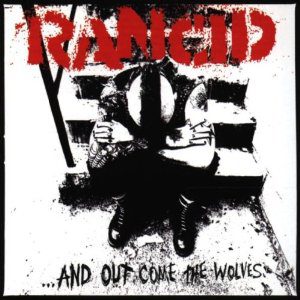
During the winter of 1995, I bought Rancid‘s …And Out Come the Wolves. It was one of the first punk rock albums I bought, but a funny thing happened at the record store. With Christmas money in hand, I went inside and immediately found it on an end cap. The rest of the world had also found Rancid, whose songs “Time Bomb” and “Ruby Soho” were getting radio play and airtime on MTV. When punk started trickling into MTV’s morning rotation, it piqued my interest. That’s not to say there weren’t other ways punk made its way through, but MTV was definitely one of the first.
I didn’t grow up in a necessarily religious household, but my mom was young enough to be sketchy about punk rock albums. Earlier, when I had bought Social Distortion’s Somewhere Between Heaven and Hell, I would write the lyrics to the second side track, “99 to Life,” in a notebook. They were concerned about the song’s content. To summarize the song: The narrator, in a fit of jealousy, had killed his wife with a knife, and the judge gave him 99 to life… in prison.
DId I want to kill anyone? No.
Had I already read worse things in Stephen King books? Yes.
Does this explain my love for noir films? Probably, but I digress.
I immediately recognized the homage to Minor Threat on the album’s cover, but I also read the track list of songs on the back of the album. I realized that there was no way my mom was going to let me keep this album. Even if there had been a Parental Advisory sticker on it, which there wasn’t. I had to find a decoy album that would take attention away from the album I actually wanted. I chose Alanis Morissette’s Jagged Little Pill, which did have a “Tipper Sticker” on it.
When I went to pay for my purchases, the clerk had to have been either confused at the spectrum of music I was buying or knew what was going on. The clerk was able to sell the Alanis Morissette album to me, as my mom had driven me to the record store. When I got home, I was told they would be keeping Jagged Little Pill, but I can keep …And Out Come The Wolves. I feigned protest, but eventually went and listened to the Rancid album in my room.
After Operation Ivy had called it quits in 1989, Tim and Matt started and then subsequently quit the Dance Hall Crashers for another ska punk band called Downfall with former OP IVY drummer Dave Mello, Pat Mello, and (fellow DHCer) Jason Hammon. Upon disbanding, Matt joined MDC with Tim as a roadie. As time went on and Tim was down and out with depression and alcohol problems, Matt suggested they start a band, and Rancid was formed in 1991. After releasing their self-titled record with Epitaph in 1993 to fantastic reviews, the band recruited Lars Frederiksen from the UK Subs to play guitar and released their next record, Let’s Go. The album contained the song “Salvation” and helped Rancid break through to radio airplay.
Released on August 22nd, 1995, …And Out Come the Wolves is Rancid’s third release in just as many years. If Let’s Go was able to benefit from the mid-1990s punk rock boom, …And Out Come The Wolves was able to capitalize on it. If “Salvation” was the primer for Rancid, the singles off of …And Out Come the Wolves are the band redlining the throttle. It’s with this album that the band caught its stride.
The first side of this album doesn’t miss a beat and opens with fan favorite, “Maxwell Murder.” Tim and Lars trade vocals back and forth, solidifying Rancid’s dynamic after testing the waters on their previous record. While there’s much debate about what the lyrics are about in this straightforward punk rock song, one thing that is clear on the track is Matt Freeman’s magnificent bass part. Matt Freeman’s bass lines stalk up and down the verses and choruses with ease throughout the whole album, but right out of the gate, this bass line is a one-man killing machine, slicing its way through an army. The term “peak” indicates a dip in quality, of which there has not been one throughout Rancid’s career. While the rest of the songs aren’t nearly as aggressive as “Maxwell Murder,” territory is clearly marked. This bass line throws down a gauntlet, setting a tone for the rest of the record.
This whole first side is just great song after great song. The album’s three singles, “Roots Radical,” “Time Bomb,” and “Ruby Soho” are great exercises in keeping your sound, but also making it more accessible for a mainstream audience. With the exception of “Maxwell Murder,” the rest of the album’s music sounds much more polished than the band’s previous outings, but lyrically keeps its edge. Whatever this world had presented Tim or Lars, it had taken them down some dark paths they had no qualms recounting. Yet, there was still room for a song with heart like “Ruby Soho.”
Whatever embargo Tim and Matt had on ska songs seems to have been lifted. Despite writing some of the greatest ska punk songs the genre had ever seen in Operation Ivy, Rancid’s first two albums leaned into punk rock and opted for a harder sound. Not that either Tim or Matt were slouches when it came to writing punk rock songs, either. The way their instruments melded together to create what they did continues to be this great thing. This is evident on the ska tracks from …And Out Come the Wolves: “Daly City Train,” “Old Friend,” and “Time Bomb.” “Time Bomb” brings everything we loved about Operation Ivy’s music with Tim Armstrong’s darker lyrics about the murder of a friend of the band (allegedly) by some members of the Hell’s Angels.
While “Time Bomb” would propel Rancid’s trajectory further, we’ve only scratched the surface of this album. One influence of this album is author, poet, and fellow punk rocker, Jim Carroll, and his book, The Basketball Diaries. I often feel that this book gets written off due to its association with the movie adaptation starring Leonardo DiCaprio, and myself being one of those people. Yet, after reading the book and its sequel, Forced Entries, you find the raw writings of someone adjacent to the New York punk rock scene. Carroll would go on to release albums under his own band, The Jim Carroll Band, which would have their own hit song, “People Who Died.” The first side of this album ends with “Daly City Train.” If that song isn’t about Jim Carroll, it’s very perpendicular to his struggles with addiction, which we can agree is definitely a theme on this album.
The back nine of this album isn’t chopped liver. We are again treated to another fantastic Matt Freeman bass line with the intro for “Journey to the End Of The East Bay,” Tim’s ode to Operation Ivy. It doesn’t seem like he had any doubt about the greatness of Operation Ivy, but it’s very clear there were some unresolved issues surrounding the band that really affected him. Whatever bitterness Tim held seems to be aired out in the song’s lyrics as he recounts the band’s rise and fall.
The last ska song on the album is “Old Friend,” a bouncier, poppier song that’s probably the lightest song on an album full of dark corners and shady characters, next to “Ruby Soho.” While this was a sound that Rancid would explore more on their next album, Life Won’t Wait, its inclusion here elevates an already great album. The song delves into Tim’s love of the road, but also the loneliness that sort of life brings. It’s wistful, but bittersweet chorus is one repeated line that recognizes how difficult it is to make a connection with someone.
The album title, …And Out Come The Wolves, is taken from a poem in Jim Carroll’s Basketball Diaries, which is recited during the breakdown in the song “Junkie Man.” To say the phrase has taken a life of its own would be an understatement. Parodies on its title have been used for everything from comics (Apollo City Comics’ …And Out Come The Comics) to Rancid tribute albums (…And Out Come The Lawsuits). It was recently announced that a movie taking place in the 1990s punk rock scene is using the title with Rancid’s blessing. Time will only tell if the movie will endure for as long as the album has.
…And Out Come The Wolves remains one of the best crossover punk rock albums of the 1990s. Rancid stayed true to their punk rock roots and it paid off for them. The album not only helped grow their fan base, but it also helped legitimize punk rock in the eyes and ears of many disbelievers. Despite its themes of murder, biker gangs, and junkies; its journey through addiction, recovery, and redemption hits much harder than a pop-rock album with a parental advisory sticker on it.
Discover more from Dying Scene
Subscribe to get the latest posts sent to your email.