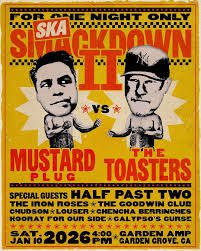
It happened again. GardenAmp in Garden Grove, CA hosted Ska Smackdown 2. Featuring some of the best names in ska, ten bands performed between the venue’s Main Stage and smaller-sized Locker Room, treating the crowd to a night of energy, angst, and dancing in the pit.
Behind the main stage sits the Locker Room, a smaller stage that feels like a dive bar, complete with a disco ball and bad decorations. This year’s lineup was so solid that the small space was always filled, and I only got to see the first band, Calypso’s Curse.
This eight-piece from Long Beach, CA, is led by two singers, Kimberly Sharon and Shane Reider. The amazing thing about ska is how many different variations of it there are; Calypso’s Curse was great at playing a good portion of them. Mixing ska, reggae, and rocksteady with a little bit of surf rock and indie, there was something for everybody. Sublime’s legacy left an indelible mark on the city of Long Beach, and the newer bands have done a great job carrying that torch.
It’s been a minute since I’ve seen the Goodwin Club, but it’s always a good time. Always the band to dress up in matching costumes, this year the theme was old ladies. Although they didn’t have as many horns joining them as last year, I believe they still had the largest horn section. Last year, lead singer Tami Demaree had caught a bad case of laryngitis right before the show, but she more than made up for it this year. I’ve never seen a bad set from the Goodwin Club, and tonight was no exception.
Next up was The Iron Roses, who had the most profound set of the night. They walked out to the song “The Day the Nazi Died,” like it was a national anthem to the scene; as it should be. With the crowd all fired up, co-lead vocalists Nat Gray and Becky Fontaine brought an explosive set full of angsty glory to Orange County, an area that could use it. Between class wars and chasing Nazis out of the scene, The Iron Roses should be a louder voice in the fight against… well, everything. Partway through the set, Becky gathered people who identified as women, queer, or trans to give a collective scream in a safe space. The Iron Roses closed out their set with “Screaming for a Change,” a song that more than applies to the current climate of our country.
This was my second time seeing Half Past Two this year, and it continues to not be a bad thing. Purple-haired singer Tara Hahn and crew played “Talk Is Killing Me,” “Curse the Universe,” and “Dominoes.” During “Dominoes,” Hahn brought out her daughter to help with the verses, and she did a fantastic job. In the middle of the set, they debuted a new song called “Nightmares of You.” It was a little darker than the other stuff I’ve heard them play, but it works and would be an interesting direction for them if they pursue it. Half Past Two ended the set as they did back in May when I saw them at Chain Reaction (R.I.P.) with a hardcore song. I said it then, and I’ll say it now: Tara Hahn could make a fantastic hardcore singer.
The main event for a lot of fans was this year’s inclusion of New York City’s the Toasters. Like most classic ska bands, the Toasters have had many members pass through, but are always led by guitarist and lead singer Robert Hingley. With a packed show comes short sets. Hingley and the Toasters were given forty minutes. They opened with “2Tone Army,” and the hits didn’t stop coming. Fishbone lead singer and sax player Angelo Moore came out appropriately for “Weekend in LA.” While not all of the bands acknowledged the state of our country, Hingley took it straight on by closing with Don’t Let the Bastards Grind You Down. A song that sadly still needs to be relevant nearly 30 years later.
Despite a long night for everyone, Mustard Plug showed up with a lot of energy. There wasn’t much change from the band’s set last year. They played most of their staples in a nearly identical set. However, their version of Fugazi’s “Waiting Room” is a cover that gets more and more fun each time I see it played live.8 The stage turned into absolute chaos in the best way as Mustard Plug brought all of the bands out to sing “Beer (Song)” and close the night.
It would do a disservice to the other bands that played in the Locker Room if I didn’t talk about them. I was to hear a few songs from the bands from outside the door if it was open, but in general, the small room was packed, and rightfully so. From the few songs I could hear and/or knew, if I was a previous fan of the band, the acts performing in the Locker Room deserved it. I would have liked to check out Hooray For Our Side, Chencha Berrinches, Louser, and Chudson, but another time.
I hoped for a second iteration of the Ska Smackdown, and I feel the same about a third. The ska scene out here right now is really in a great place. This is a great opportunity to check in with these bands, but also the friends I’ve made in the last couple of years. It’s a shame there aren’t many other venues that would entertain a show of this caliber. Given that the Locker Room was full for most of the show, its popularity only seems to be growing.