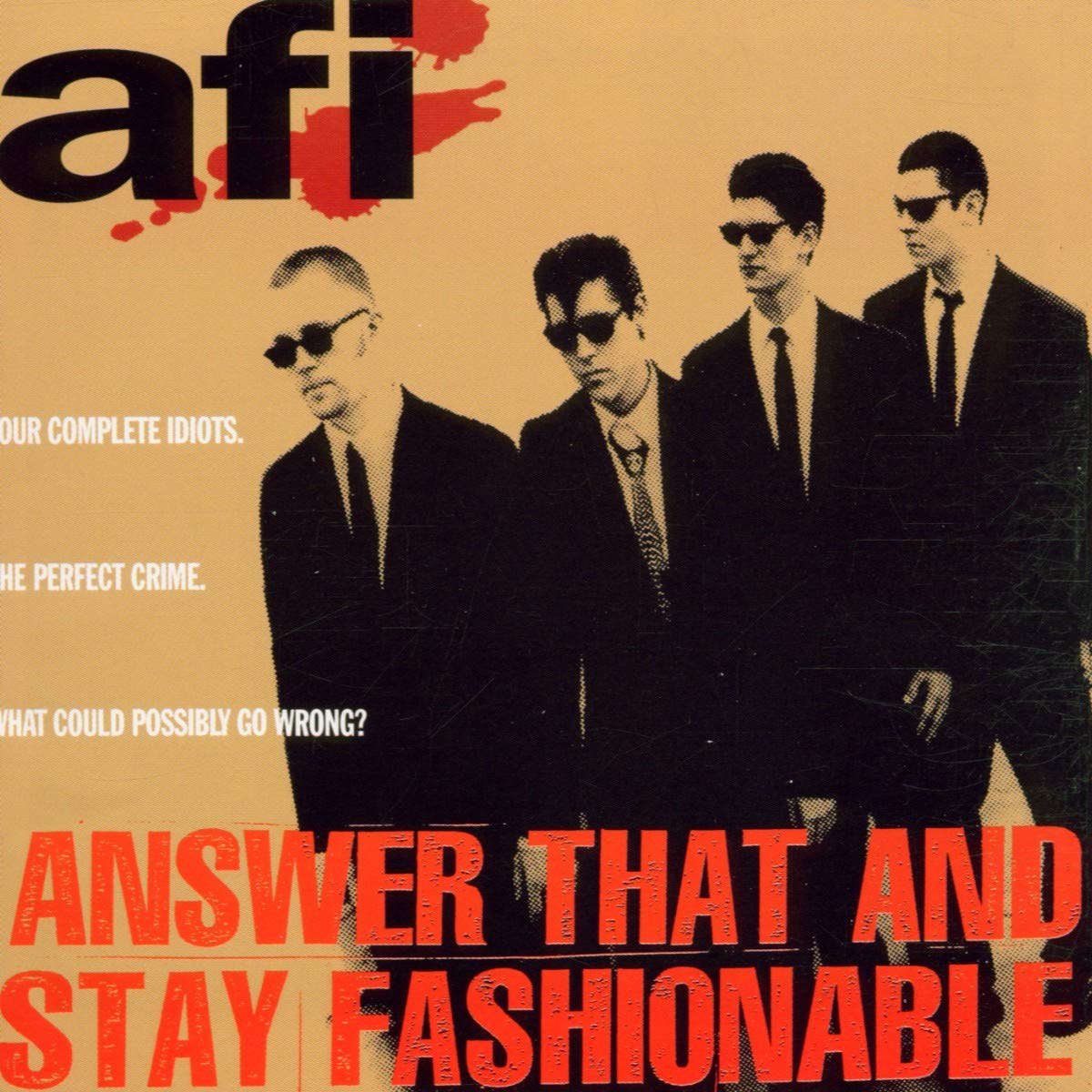
On July 4th, 1995, AFI’s Answer That And Stay Fashionable was released on Wingnut Records. The East Bay Hardcore band was no stranger to being in the studio, having released a handful of EPs previously. However, recording a full-length album was new ground for them, but the risk paid off. It launched AFI into a career trajectory that has mostly led to success despite the band’s distancing from it’s original sound.
The album itself is the amalgamation of four kids blending their own styles to create a unique-sounding record. While you can say that about many punk rock records, most have not had the lasting power of Answer That And Stay Fashionable. Is it the band’s rabid fanbase that keeps this album alive or the songs themselves? I’d like to think it’s the latter. We sat down with former AFI bass player Geoff Kresge, one of the architects of the album, to talk about the road to making the album and its recording.
Dying Scene (Forrest Gaddis): When did you join AFI?
Geoff Kresge: I want to say they started at the end of the summer of 1991, or maybe the early fall of 1991. Jade, AFI’s current guitar player, and I were in a band together before AFI. I was going to put out a seven-inch by them. They had done a couple of demos that were pretty different from whatever the latest album was that I’ve heard from them. It’s probably more than a few albums ago, but very, very different. At some point, they kind of had a little bit of a shift in sound, where they kind of started getting better at their instruments. I don’t think any of them actually played before they started the band. I think it was just like, “Hey, let’s start a band. Okay, well, I’m going to play this, etc., I’m going to play that, or whatever.”
The difference, however, is that the singer and I had been involved in a couple of jam sessions that a mutual friend had put together when we were in high school. We had a little bit of a history, and that was how I came to say, “Hey, I want to put out a record by you guys.” At some point, they were in the process of recording in the spring or summer of 1992. I happened to bump into one of them and was given a tape. It was a huge improvement on where they had come from before. I definitely wanted to put this record out. Before the end of that summer of 1992, I was asked to come and sit in with them, because they were thinking about changing bass players. So, the original incarnation lasted maybe just under a year, and then that’s when I came in.
Was the tape they gave you the Dork E.P.?
The songs from that were on the tape that I was given. I want to say that there were five or six songs on the tape. I did play on the record after the fact. It had been fully recorded. There was kind of a thing about, well, do you still want to put the record out if you’re in the band? I said, “I do, but since I’m in the band, I also want to re-record the bass tracks so that it’s representative of what we’re going to sound like.”
Halloween Day of 1992 is when I took the bass tracks that are on what has been released and mixed the songs. That was that. I did play on it, but I wasn’t a member of the band while they were recording the drums and guitar.
Your record label was Key Lime Pie Records, right?
They had a song called “Key Lime Pie” from one of their earlier demos that I liked a lot for its simplicity. They were kind of embarrassed by it, but I liked the song. It was my favorite song that they had up until I joined the band. I decided if you guys aren’t going to play the song with me, then I’m just going to use that as the name for the record label.
You guys recorded like four or five EPs before you recorded Answer That and Stay Fashionable, right?
Yeah, we did a handful of EPs. The first three I released on Key Lime Pie Records. I just had those pressed through a couple of different places I used. Then we did the Fly In The Ointment EP, which was on Wedge Records, which was Matt Wedgley’s (The Force, and Viva Hate) label. The way that relationship came together was fairly interesting as part of the story, too. That was how I learned to put out a record on my own.
Paul Thomas put out the Circus Tents seven-inch, Matt’s previous band. Inside the seven-inch, there was a little insert that had a breakdown of all the costs and contact information for different places; resources for pressing plants and for places to have the sleeves printed. It basically said, “Here’s how you do it. Get out there and do it yourself.” That’s what I did. I took that insert and took it to heart. It’s because of having picked up that record that it all happened. The relationship grew from there with Matt, and it led to him asking about putting out a seven-inch by the band. That’s where Fly in the Ointment comes from, before we actually went into Answer That and Stay Fashionable.
“Open Your Eyes,” was recorded for Fly in the Ointment. It was added later when I remixed Answer That and Stay Fashionable for the Nitro Records version. I don’t know how noticeable it is, but if you listen to the original Wingnut Records pressing of Answer That and Stay Fashionable, it’s a different mix than the one that came out on the edition that everybody knows that’s on streaming. I remixed “Open Your Eyes” for that edition also.
How long did it take to record the album?
I want to say that recording and mixing took ten days. It was probably less than that; it’s not coming to me off the top of my head, but it wasn’t terribly long. I want to say it was probably two days of drum tracks, two or three days of guitar and bass, overdubs and fixes, and then two days of lead vocals, maybe three. It was a pretty tight budget from what I recall. When it was probably all said and done, the recording and mixing was probably about a week. It was recorded at a studio called Art of Ears in Hayward, CA by Andy Ernst. Before that, Andy was in the punk rock scene or the underground music scene.
He had done several recordings for some bands on Lookout Records. I can’t remember if he had done a Green Day record, but he had done some really cool records. His recording techniques, I don’t know how they necessarily differed from some of the other studios in the area at the time, but there was just something about the records that he made. We really liked the sounds that he was capturing. He was a cool guy.
When we did the first session there (08/16/1994 – 08/17/1994), it was just a demo. I want to say two of the songs from that demo session, “Half Empty Bottle” and “Your Name Here” are actually on the finished album. We had quite a relationship with him for a couple of years. Everything that we recorded, we did with Andy. Art of Ears felt like a home away from home at some points. It was just a very comfortable environment. I’m sure he probably thought that we were a little crazy or goofballs, but we had a really great working relationship with him. I did a couple of other projects outside of AFI with him at the studio there, too.
Tim Armstrong and Brett Reed of Rancid are listed as producers on “Half Empty Bottle” and “Your Name Here.” Why only those two songs and what did they contribute?
Brett loaned us some drum equipment. They were supposed to produce the demo session; those particular songs on the album are from the demo tape. They were called away on business with their own band before the session actually began, however. We brought Tim back to do some backing vocals the following day. He did a few different takes during the middle section of “Love Is a Many Splendored Thing.” That song went to a compilation EP (This is Berkeley, Not West Bay) instead of Answer That and Stay Fashionable. It would have been another one that I wrote the words and music for. There’s another song from the demo session that Tim had a part on, but the lyrics were changed and the song was renamed “Kung-Fu Devil.”
It was a weird time in the Bay Area for punk rock because there was such a huge interest in bands from the East Bay. Green Day was newly mainstream. This was after Dookie was released. There was a big magnifying glass on the East Bay scene. We didn’t come from the East Bay, but we lived in the East Bay. We started in Ukiah and eventually made Berkeley and Oakland our home base. There were several other interested parties, but we didn’t have enough songs ready to make a full album. At least as far as the game plan that we had in mind, that was still quite a ways off. It wasn’t even really a thought to make a full album.
What happened is we basically had to kick it into high gear and get as many new songs fleshed out as we could. At that point, as far as the musical and lyrical aspects, I was contributing much more than some of the other people bringing in songs. I remember having a phone call with Mark, the guitar player at the time. I said, “Whatever you do, don’t stop writing. Just write as much as you can and let’s see what we can come up with.”
He and I both poured on the steam and tried to get as much new material out as we could. It was kind of like, well, this is on somebody else’s dime, let’s record. Even though in the long run it’s your own dime, it’s just that somebody else is paying for it up front. The thinking was, let’s just record all of this stuff too and see what we think is album-worthy or whatever.
As I say, it was basically everything we had and things that were being finished maybe a week before we went into the studio. It was primarily out of necessity for filling time to honor the contract. As far as I’m concerned, those songs were still worthy of being heard by people outside the four of us in the band at the time.
When torrents were a bigger thing, I had friends that had CDs they made full of the EPs. We loved “Who Said You Can Touch Me?” and “Rolling Balls.” They’re two songs we used to go back to a lot.
“Who Said You Can Touch Me?” was the first song that I brought to the band. Jade and I had played that in the band we had been in together previous to that, but I carried that over and just changed the words.
Was that Loose Change?
No, I did play in Loose Change. I was only in the band for a few months. Not the earliest lineup, maybe the second lineup of Loose Change. The band that we had been in, aside from Loose Change, was called Influence 13. I was in that band for about a year before and during my time in AFI. For Loose Change, I was there for maybe less than a handful of rehearsals. I think maybe there was a drummer change and I didn’t pick it back up when things got going again.
My favorite songs on the album are those kind of goofy ones, “I Wanna Get A Mohawk (But Mom Won’t Let Me Get One)”, “Cereal Wars”, and “NyQuil”. Did those survive the sets later? You mentioned they were a little embarrassed about “Key Lime Pie.” Did they start getting embarrassed about those songs too?
You kind of hit the nail on the head there. It was almost a sense of being embarrassed by those songs or those lyrics. Wanting to be taken more seriously and not be looked at as a novelty or whatever you want to call it. I don’t know if embarrassment is the right word, or if it’s just maturity level changing. The songs that have the silly lyrics like that are largely not from my pen as far as lyrics go. I don’t really know what the mindset is behind that. We did phase a lot of that stuff out of the set as new songs came in.
I always feel that’s part of the charm of that album. You can tell it’s made by a bunch of kids. There are angry songs on it like you would have on a hardcore album, but there are these fun jokey songs, I never thought of them as novelty songs. I thought it was just something kids wrote about.
That’s how I look at it too. Here we are coming up on thirty years and looking back on it myself, I am still really proud of those records, especially the songs on Answer That and Stay Fashionable. As far as being an accomplishment, I have a sense of pride over it, but I don’t share the sentiments of embarrassment or immaturity that’s being cast on it by people other than me. I still think it’s a cool record. I don’t know if landmark is the right word… I don’t want it to be construed as I think it’s some groundbreaking record.
Personally, I feel a huge sense of accomplishment. It was four kids just sort of figuring it out as we went. I think it really comes across in the recordings. It’s the things that kids write about. It’s the energy that kids have. It’s figuring it out as you go, the discovery process of making an album, all of that. I have nothing but great memories of making that record.
Besides being a great song, how did you land on the cover of the Police’s “Man In A Suitcase?”
One of the guys really wanted to do that song. Some of us needed our arm twisted to do it, myself included, because it wasn’t where we were at. I guess you could say that song was a thorn in my side at that age. Those days were about playing fast, about the rush of energy and excitement that comes with faster music. Some of us were not into pumping the brakes.
What was influencing you at the time either musically or otherwise? I mean, clearly, Reservoir Dogs…
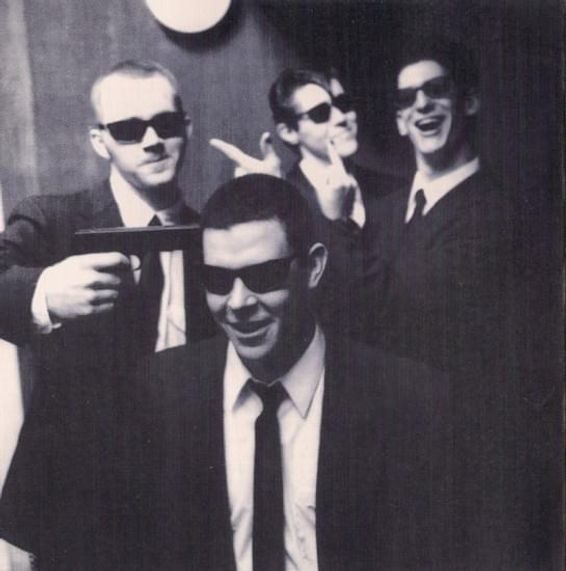
The Reservoir Dogs thing was kind of just a fluke, and turned into a thing for a little while. There was a movie theater in Berkeley on University Avenue. I don’t know if you’d call it a second-run theater, but they showed things that were not current. There was a poster for Reservoir Dogs in front of the theater. We were walking past the theater one day, and it was such a striking image. We were probably in the process of discussing what the album cover was going to be, or just coming up with ideas and suggesting things. We passed the theater. I saw that poster and I thought, “Why don’t we do something like this?”
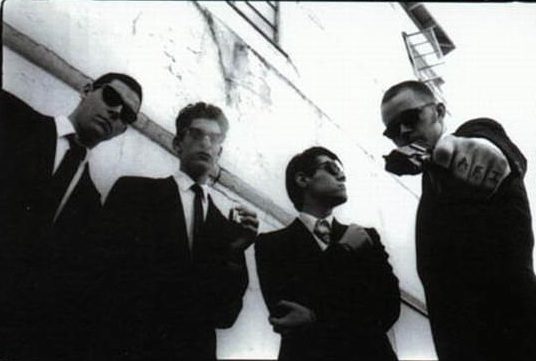
Steve Z, who did the photos for the album, actually referenced some stills and poster art from the movie. He posed us to make it look just like the Reservoir Dogs poster. There’s that aspect of it. It was just a weird timing. Then it turned into wearing the suits that we wear on the album cover on stage. I don’t know where the idea came from to do that, but it did become a thing. That was one of the memorable experiences that stayed with me from that time of making that record, too. We went up and down Telegraph Avenue in Berkeley. If you’re not familiar, it was the happening area. It leads up to the UC Berkeley campus. It’s a largely foot-traveled area.
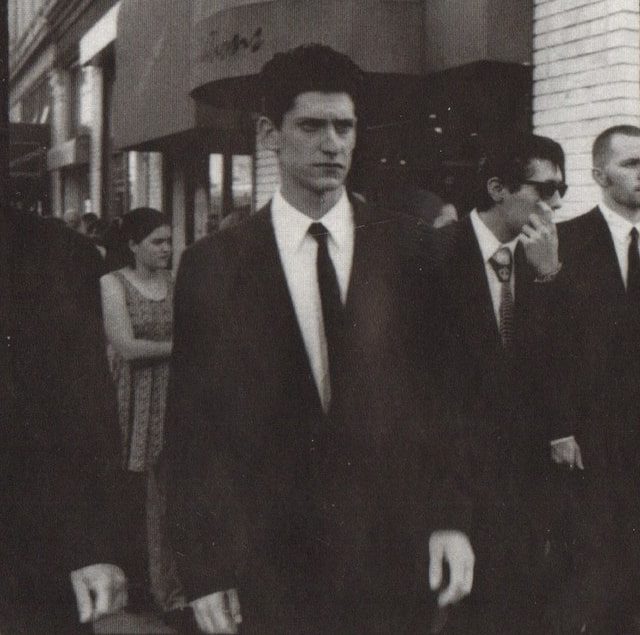
Here we were dressed in black suits like Reservoir Dogs, carrying around an air pistol that looked like a 1911 model pistol. Steve is there with his camera equipment in the middle of a busy crowd of people, and we stop in the middle of a crosswalk to take photos. I should also mention that in addition to shooting the photos for the album layout, he also accompanied us on our first US tour, selling T-shirts and helping us out with driving. He photographed a lot of that tour, too.
What I personally was listening to at the time, and what was influencing me as far as the musical aspect and whatever lyric content I brought into that record would have been, specifically, the first two DOA albums, Hardcore ‘81 and Something Better Change. GBH has this compilation album of their early EPs, and it’s called Leather, Bristles, Studs, and Acne. Between DOA and GBH, I was heavily influenced by two bands with initials during that process, go figure. I was also listening to the Germs and Negative Approach a lot at that time. It was around that time they had done the Germs anthology called M.I.A. on CD, and they had done the Negative Approach Total Recall CD, which had everything on it. Those were definitely in heavy rotation for me.

That was, sort of my daily stuff that I listened to, and the first Discharge album. A lot of that stuff, if somebody were to listen to it, especially the first Discharge album. I wasn’t imposing any kind of playing style on anybody else. That was kind of the beauty of bringing in something that’s influenced by something that it never could possibly sound like with the four of us doing it. That’s kind of where our sound basically came from, I suppose.
The album has sound clips from movies and shows. I didn’t realize that the title, Answer That and Stay Fashionable, came from the Comic Strip Presents… I thought that it was Monty Python for years.
It’s a pretty obscure reference. They used to show Monty Python’s Flying Circus and The Young Ones on MTV. The “Bad News Tour” episode of the Comic Strip Presents…, is where that sound bite comes from. It’s outrageous. There are so many things that happen in it that so many people in a band can relate to. Going to where there’s supposed to be a gig and it’s news to everybody there. Even though it’s a mock heavy metal band from England, it’s very appropriate for a punk rock band from Mendocino County, California, too. I want to say I had maybe recorded it from the TV. That non-musical influence was that kind of humor and taking bits and pieces from things that we liked, thought were funny, or maybe some of them might be inside jokes.
As far as some of the lyrics go, they were sort of a collective thing. Maybe not among the four of us, but definitely among the majority of us latching onto similar things and becoming a part of the collective persona of the band. Whether it be attitude, sense of humor, or listening tastes, certain things that we would all gravitate toward that made us what we were at that time for that period of time.
What song lyrics did you write?
I wrote lyrics for, “Half Empty Bottle” and “Your Name Here.” I also wrote “The Mother in Me” and “Don’t Make Me Ill.” The vocalist added a few words. “High School Football Hero” is mine. The satirical aspect of it is still relevant, despite some maybe seeing it as jokey.
“Yurf Rendenmein” and “Two Of A Kind” get re-recorded for Very Proud of Ya. Were those the only two songs that stayed over when you guys started writing new songs and making your sets for shows?
No, that was a contractual situation. It wasn’t something that any of the four of us really wanted to do. It was an agreement that we made when we were offered the Nitro Records contract. Sometimes, I forget that that happened. When it comes back to me that we did that, it still kind of rubs me the wrong way. I didn’t like having to redo those two songs, even though we had previously redone other songs. The way that it happened wasn’t cool. I think it shows in the recordings of those two songs.
You did the remix of the album when it went to Nitro. How long did that take?
I think that was two days. That was just me and Andy Ernst again at Art of Ears. I mentioned earlier that there were a couple of tracks that had been from a demo session that we did there. It was a lot of fussing around and a lot of tweaking of knobs to get things to sound a certain way that they weren’t recorded that way. It was sort of like trying to get lemonade out of a lime. When we sold that record to Nitro, part of the agreement was that I wanted to remix the record to the version that everybody now knows.
Basically, what we did between Andy and me is undo a bunch of the overdoing of things with EQ on drums or guitars or whatever it was, and just made it sound a little bit more open and a little more raw. It’s not a raw-sounding record, but it sounds more like a band playing in a room. We were just laboring over it too much. This was like scraping a couple of layers of paint off of it to make it sound more like what the band sounded like.
Do you know if they’ve done another remaster on it since then? Being an album from the 1990s and the technology then compared to the technology they have now, it sounds great.
Thanks. Honestly, I don’t know if anything else was done. I know that it’s the same mix that we sold them, that was the master of that mix. I have some alternate versions, but I am also the owner of the actual tapes. They haven’t had access to the tapes to do anything. They, being the record label, whoever owns the record now, I don’t. I don’t even know who owns Nitro Records now, to be honest.
Nitro changed hands at least once in the last decade or so. I’m not sure what the parent company is now, but I feel like I saw something about it having been released on vinyl earlier this year. Maybe for the first time in a while. Unfortunately, I’m not a part of any of that process. I haven’t listened to either of those records for quite a while, but the last time I did, it brought a smile to my face when I heard it. There are good memories attached to it for me.
My wife and I don’t cross on music very much. She likes the middle era AFI, and I like the early AFI, but we cross on this album.
It’s interesting from my perspective, having been there for five of the first six years, and hearing people say things like that, their connection to Answer That… There’s a big division between the old band and the new band. It’s nice to hear from people thirty years later, “Hey, that’s a cool record, or I like that song on that record,” or wherever it might be. It’s a really cool feeling because who knew at the time we didn’t know that anybody outside of Berkeley was ever going to buy that record, you know? Aside from family members or friends that were still in Ukiah or Sonoma County.
Were only your friends really buying the EPs, or were record labels buying copies?
The EPs I had sent out to a few labels just to see if anybody was interested in doing another seven-inch. I sent out probably ten to twenty copies of each EP to various other small record labels. As far as what went to Nitro, that first Art of Ears demo was specifically recorded to send to them and a couple of other labels. I want to say that the demo got sent out to like fifteen or twenty different labels. That was a specific thing with that session. Let’s do a demo to see if somebody is interested in putting out a record for us that’s not me. It just turned into we’re going to do a full album, but we did not send a demo to Josh Levine at Wingnut Records, who originally put out Answer That and Stay Fashionable. He was local and came to see us many times, and lived down the street from 924 Gilman Street. He was one of the volunteers at the Gilman Street Project, so he was always around. He was the one who took the leap of faith with us.
Nitro came along after the fact. I can’t remember how much time passed between releasing the first pressing on Wingnut and when Nitro got involved off the top of my head. I do have to say that if it had not been for Josh, we wouldn’t be having this conversation right now. There wouldn’t be a thirty-year anniversary of any record that anybody cared about. A very, very large thanks to Josh from Wingnut for taking that chance on potentially losing a lot of money on putting out a record from a band that hadn’t ever really been on the road before.
If its been sometime since you revisited the album, definitely give it a spin. It’s aged very well. Also, please check out Geoff on his instagram here. On top of being a fantastic artist, he tattoos at Secret Kingdom Tattoo in Roseville. If you’re in the area, go in and get some ink.



mike v
I totally agree with all of this. When I first heard Turnstile years ago, they reminded me of Gorilla Biscuits and I thought they were really mainstreaming (in a good way) hardcore music. Now, this album feels like the yacht rock version of their older stuff. This Is Yachtcore.
Though, I don’t really hate it. I bet the next album will be a banger.