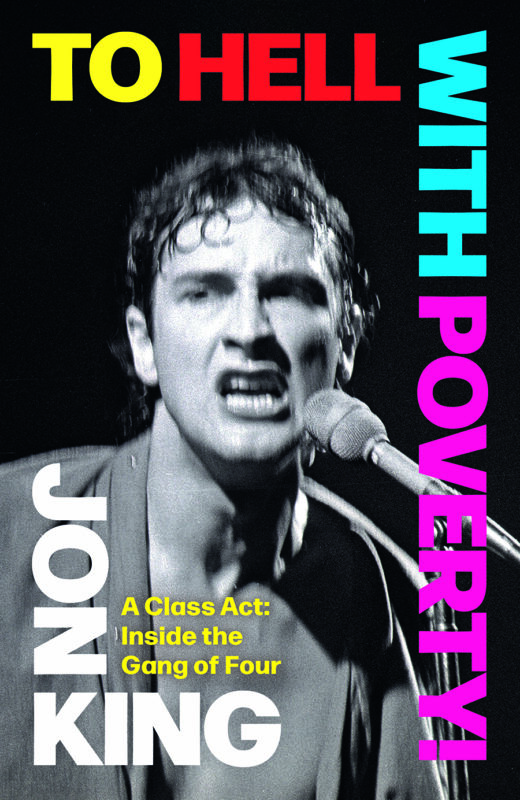
Gang of Four were not a conventional band, which is why lead singer Jon King’s book is not your conventional autobiography. Spanning from the beginning of Jon’s life through the end of Gang of Four’s initial run in the mid-1980s, To Hell with Poverty: A Class Act Inside the Gang of Four is filled with stories of the band and the scene. Throughout its three hundred thirty-six pages, Jon King’s experiences shape a life well lived on his terms while singing lead for one of the best post-punk bands to come out of England’s music scene.
Jon King’s writing is concise. The chapters are short and punchy, making it easy to find a place to stop when needed. In a time when many of these voices feel suppressed, not by content but conveyance, it sounds natural. In some places, the book feels like journal entries; in others, it feels like drinking beers and telling stories. The footnotes, providing context, are the most entertaining I’ve read in a while, and little postscripts give (sometimes ironic) updates. I like the raw and unashamed way Jon King reveals the things he liked in his youth. Things like spy novels, Marvel comics, and rugby gave way to a need for more dangerous music, smoking, and sometimes fights. It was nice connecting on things like that.
I like the context Jon King gives with some of the more regional history of Leeds. Being from America, we only get a broad (used lightly) sense of England’s local history. Unless you’ve been listening to British punk for a while, there isn’t much reference to it beyond Rock Against Racism and the race wars. Jon was kind enough to give us some time to talk about the book.
Dying Scene (Forrest Gaddis): I really enjoyed the book. What was the process for writing the book? Did you collaborate with anybody?
Jon King: No, no, I wrote it entirely myself. It was new to me. I bumped into Steve Diggle of the Buzzcocks at Abbey Road Studios.He told me that he was having an autobiography written, which surprised me because Steve is a natural writer. He said, well, why didn’t I have a go at it as well? He was using a ghostwriter, but I thought if I’m going to do it, I’m going to write it myself.
And so that was it. It was very hard to get going because what I wanted to find was a voice that was my own and that also carried through the urgency of it all and the immediacy of it all. It took a while to do that, but then I found writing in the continuous present was something that made it more zippy.
I also decided to write it in British English. I mean, obviously, I am British, but I know that some people try to write a kind of international way of doing things, but, eliminating British slang and things like that. Some of the words you use are very unusual. They’re actually very usual for British people, but not necessarily for Americans.
I actually appreciate that about your book and Steve’s book. I listened to a lot of British punk rock growing up, watched a lot of British Mysteries with my grandma. I’ve picked up a lot, but I was able to learn more than I hadn’t before. I’ve noticed this in your book and another book, that it’s written in kind of bite-sized portions rather than chapters. Was that an editorial thing?
No, I didn’t. I didn’t have any editorial input at all, really, on it. No, it’s entirely my decision. I’m a great reader, in the sense that I read about a book more or less every week. So I read about fifty books a year. For example, I like reading 19th century novels, you know, Charles Dickens and Jane Austen and things like that. There seems to be sort of a struggle with the very long sentences and very long chapters. I mean, Dickens can write a sentence that lasts almost a chapter.
I wanted to write it in bite-sized chunks and not to overdo it. There was a kind of running gag, which I think is not uncommon, which is that I’ve told lots of stories about the things that have gone on and I’ve told them so often, we might just say to someone, oh, do you remember story number forty-seven ? And they go, oh yes, that’s a great one and then you laugh. Hugo and I are a bit like that, because we both know each other’s stories.
The structure of the book, whatever its faults or merits are one hundred percent my decisions. Except for one thing, the publisher corrected all of my use of the Oxford comma to the non-Oxford comma. I was very upset about that. They said, no, that’s the house style. And I said, you can’t do that. That’s what made the American Constitution go wrong.
You mentioned in the book that you read Anna Karenina, Great Expectations, and David Copperfield every decade, and you find something new about it every time. Did any of those influence your art or the songs throughout those re-reads?
Not on the book side. That’s much more to do with my interest in situationism, the French movement of the late 1960s and French films, particularly. That’s more on the art side of things. I think that was much more of an influence on the way that I did the artwork.
I suppose on the structure of the book, those narratives like Great Expectations, where you have an unreliable narrator, as the Germans have called it, a bildungsroman; where someone eventually finds their moral failings become evident to them. They try to be slightly less useless. I think there’s that element of it in what I try to write. I wasn’t writing literature, I was writing a memoir. That sort of thing of gradually realizing that it could have been done slightly differently.
There’s a French phrase, which I think we’re all familiar with, which is called l’esprit d’escalier, the spirit of the stairs, which means the things after you’ve had a conversation or something’s happened, that you could have said something differently. Like five minutes afterwards, you go, I wish I’d said that.
At the end of each anecdote, story, chapter I often put a postscript after it, like the Tropicana (hotel in Los Angeles) was demolished, and the Ramada Inn is in place; or Emerald City was demolished, and it became Subaru UK’s headquarters, which always seem to have their own internal irony. Speaking of the l’esprit d’escalier here, that I missed putting in, was that the rather seedy house that I lived in with Andrew Corrigan and Mark White of the Mekons. It looked very like a scene from Withnail and I, is now a careers advisory center, which seems to me to be very funny, given that was the exact opposite of what went on in that house.
Sometimes footnotes are just tedious little things, but allowing me to put in things that I actually found rather funny. For example, when I talk about being trained in nuclear war preparations when I was a little boy, and this is good advice actually, should there be a nuclear attack, which is obviously imminent, the best thing to do is get under a table and cover your eyes. When we were being attacked, apart from obviously a mushroom cloud destroying everything that we know, gave us at most fifteen minutes of the Russians bombing us.
The alarm signal was managed by local people who had some kind of status in the community. The sirens were abandoned only in the 1990s because of double glazing (windows), and they said that no one would hear the siren. We were all going to die without hearing a siren, which I thought was quite funny.
Did you design all the covers for the Gang of Four albums, or just the first few?
No, I designed them all up until Hard, which of course I excoriated in the book, an awful cover with an awful photograph of me, Sara, and Andy. That was really entirely down to Bennett Glotzer and Andy Gill. I suppose if it was even more cheesy or more obviously shit, I think it might have been funny, but it was just dreadful. So yes, I did all that, and of course when I did the box set, which came out a couple of years ago, that was all entirely my creation.
At one point in the book you said that you didn’t want to play in a band and just wanted to paint. Was the plan just to paint and be an artist that way?
Yeah, well I had the great misfortune when the Damaged Goods EP came out that it was successful, which I didn’t expect that at all. I was really doing well (with painting). I’d won the Patsy Prize, the Yorkshire Arts Prize, and I thought that was all I had wanted to do, was to be a visual artist. So, I did quit the band at that point, because it was taking up too much of my time. Andy, Hugo, and Dave said they’d carry on, but they couldn’t actually find someone to work with; I wrote all the lyrics and the vocal parts. I suppose that had they found someone, they would have gone off in a completely different direction. It probably wouldn’t have had any political elements in it, or very little, and it probably would have been more like Dr. Feelgood, I suppose.
Is there a song on any of the albums that you feel didn’t get the credit it deserves?
Well, I don’t know. I think among people who really dig music, and fellow musicians, I can’t think of any song that hasn’t had enough praise from people whose opinion I respect. So I do think that there are some songs that have had praise that I don’t like.
For example, again in the book, I slag off “Armalite Rifle,” which we played last night, by the way. The rest of the band all love it. Under duress, I agree to play it. The reason I don’t like it is because the lyrics are sort of knocked out, and they’re completely inaccurate. It says, breaks down easy, fits into a pram, etc, etc. The one thing that anyone who knows about armalite rifles, which is owned by one in five American gun owners, is that it doesn’t break down easy, it doesn’t fit into a pram, a child really couldn’t carry it, and the police in Northern Ireland never used armalite rifles, anyway.
From a fact-checking point of view, and the rest of the band says, “Who cares about that?” In this post-fact world, I’m a fact guy. That’s my objection to it. Not that it’s not a good song. It’s not factually accurate.
I’ve read a few other books where they describe the Top of the Pops and the process for it. Was it ever worth it based on all the hoops you had to jump through?
I tell the story properly in the book, and it’s far more complicated than it might seem. We were thrown off the program and changed the word, but the word sounded too different from the original word. I can explain, it’s a very peculiar thing, I think it was unique that we were put on the show, probably against the wishes of the producers.
The agreement with the musicians union was that bands had to go on the show because their single was going up the charts into the Top 40. They couldn’t stay on the show if they stayed in the same position, which is quite an odd instruction. So we had to be on the show. They didn’t like the song at all, it turned out, but they did say to us, you must change the words.
When I wrote the words to (At Home He’s A Tourist), I used an American word for a condom, rubber. British people didn’t use that word. They might be called rubber johnnies, but johnnies was the slang word for it. I thought, okay, I’ll change it to packets. The packets you hide, In your top left pocket. It implied that people might be carrying contraceptives. It was really gentle. The BBC did agree to that. When we did the show, the producers were really annoyed. First of all, with us being there at all. Then they said, “we don’t like the word packet.”
We actually had a letter of agreement from the BBC to change the word from rubbers to packets, but when it came to the show, the producer said, “The last thing we would do is to censor you. We don’t believe in censorship. However, the word packets doesn’t sound like rubbers. We’d like you to change it to rubbish. So, that it doesn’t sound like you’ve changed the word. Of course, we’re not trying to censor you.”
I said, “That doesn’t make any sense. No one carries rubbish in their top left hand pockets that I know of.” And it doesn’t mean anything. I did say, fuck off. It’s regrettable having principles, isn’t it? The number one single that week was (Anita Ward’s) “You Can Ring My Bell,” which is the most incredibly sexually innuendo-like song. The week before, Squeeze had been on the show with “Pulling Mussels from a Shell,” which is incredibly filthy. The thing about Gang of Four stuff is it obviously meant something that was outside of the set of topics you’re allowed to sing about. You’re allowed to sing about sexual innuendo and to sing about having fun or lost love or whatever.
If you imply that there might be something else going on, which was in this case, quite the mild and not very original comment that people go. I’m going to break the news now. Some people go out to bars and clubs and hope to get lucky. I’m breaking the news to you. If only you’d known. Some people might even carry some contraceptives with them if they do get lucky. I mean that shows the level of basic censorship type stuff that goes on.
Of course, years later when “I Love A Man In Uniform” was also banned in the UK, not because it said anything bad; it simply happened to mention the army at the time that we had a war with Argentina over the Falkland Islands in the South Atlantic. I didn’t even know there was an island in the South Atlantic, nor did I think 99 percent of the British population. I had no idea that that was.
In England how many different regions had different scenes? Everybody talks about Manchester and I’ve read fifty books on the Manchester Scene, but how many outside of Manchester were there?
Manchester is a much bigger place. It’s either the second or third largest city in Britain. It’s always been the center of music production since the 1960s with the Beatles. I think it was all about music. The bands that came out were very melodic, like Echo & the Bunnymen and that sort of thing. I was good friends with Tony Wilson, who was the sort of auteur of Manchester. And our great friends and sponsors were the Buzzcocks. I think we must have played with them about 40 times.
London was where everything was centered and really no one paid any attention. I’m talking about the very influential music press, which has obviously gone away now. The NME sold 300,000 copies a week, but it was always centered in London. Anyone who was outside of that, like in Glasgow or where there was a big scene, you had to kind of accept that you weren’t going to get much attention. You could make your own mistakes without being noticed.
Then somehow or other, you break through. For example, metal was invented in the Midlands. Black Sabbath came from Birmingham and the Midlands was all about metal. It wasn’t about punk rock at all. And then you have punk in the U.S. and in Britain, that music tends to come from the suburbs then moved to the central cities, you know, like Sex Pistols and Siouxsie and the Banshees. That came from the suburbs of London, not the center of it. I think people who are prosperous don’t write good music. People who are not not struggling, perhaps emotionally or otherwise, don’t write good music. I remember there was an interview with Kenny Rogers. Someone asked him, “What’s the one gift you would have liked to have given your children?”
He said, “I would like to give them a gift of poverty.” And I know exactly what he meant. He didn’t mean he wanted them to be poor, but he wanted them to struggle, which probably would have made them a bit more interesting and stronger. I think that great literature and great culture, very often dominantly comes from people who have struggled to fit in or struggle to get on.
There were lots and lots of scenes, but being a musician, you don’t really get much chance to interact with other people in other areas, because you’re either working all the time or you’re where you are. I mean, it’s not like when we were in Leeds, although, it was the epicenter of pop and rock entertainment in Britain. They didn’t like what we did, the people who put on shows, so we had to put our own shows on. So We created our own scene because there was no new music scene at all. You know, it was bands like Wings and Roxy Music and that would come through Leeds and play. There was no room for bands like us because we didn’t fit in.
I know the Damned had already been to the US before the Sex Pistols, but after the reaction from the crowd from the Sex Pistols in the US, was there any hesitation to come over or was the writing on the wall already with how Malcolm handled everything?
Yeah, well, when I first came to America when I was 18, which I talk about in the book in 1976. I was really inspired by the New York art punk bands; Patti Smith to the Ramones and Talking Heads and Richard Hell. Actually, the other night, Lenny Kaye (Patti Smith Group) came on stage and jammed with us.
When we first came to the US, it felt more musically like sort of coming home, in a sense, because a lot of my favorite bands are American acts, from Funkadelic to Talking Heads to James Brown to The Band, Bob Dylan. I did love Led Zeppelin and acts like that, but it was really great to be here.I’m feeling that at the moment, you know, we’re now seven shows into a thirty-two city tour of America. Our last ever tour. Every night’s a last show and has its own sort of poignancy to it because I love America. I’ve always loved coming here. And it’s very I’m very deeply rooted in my my affection for the country.
You mentioned this is the last tour. Do you have any plans after?
When we go back, we have a little break. Then we’re doing about a month in Europe. We play a show in London at the Forum on the 24th of June, that’ll be quite a big gig. We do a couple of nights in Dublin and Galway and then we fly to Paris, then we do shows and end up at the Paradiso (Amsterdam). That’s the place where I went out for the night with the Hells Angels.
At that point, Debbie and I are going to get on a sleeper train down to Italy or Spain or both and just go around for a while. I’m going to work on my art, which I’ve been selling on tour, my posters and postcard designs. That’s what I’m going to concentrate on. I am writing other music, but not Gang of Four music. This is the end of the Gang of Four, but I’m still going to be busy doing other things like that.
Jon King’s book is available through Akashic Books here. Dates for the remaining Gang of Four shows can be found at their website.












Huddy
Has a Tony Sly vibe..