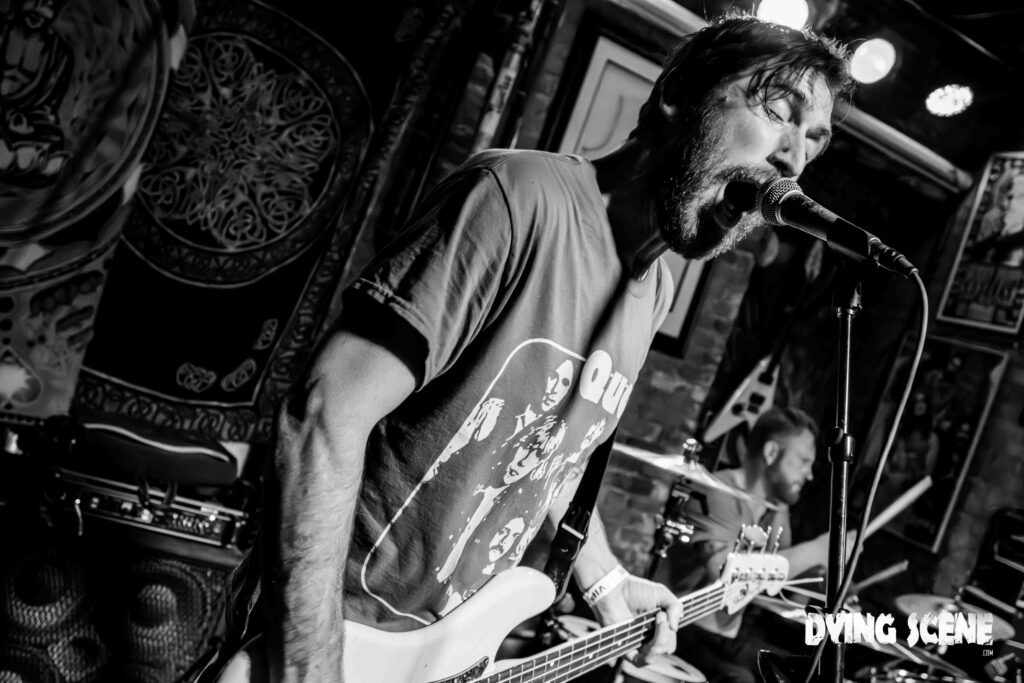
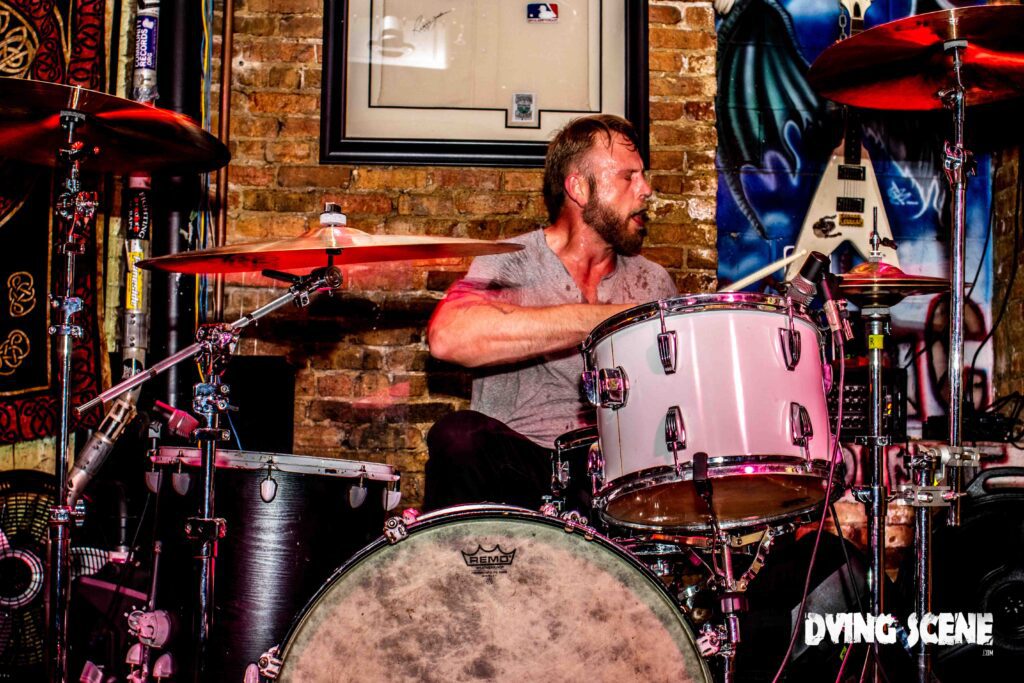
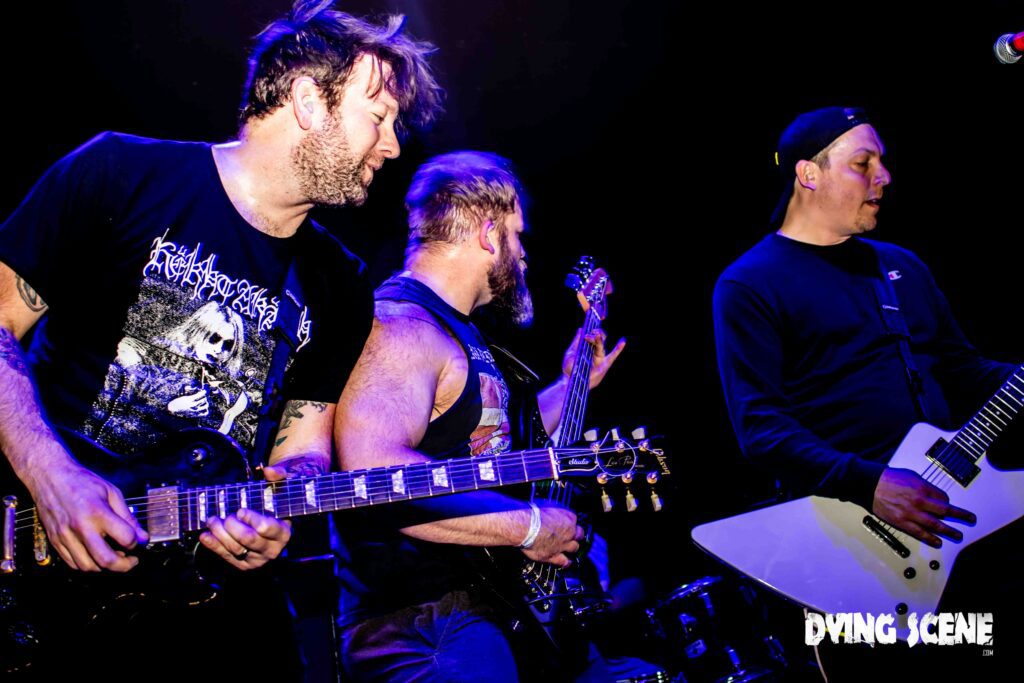
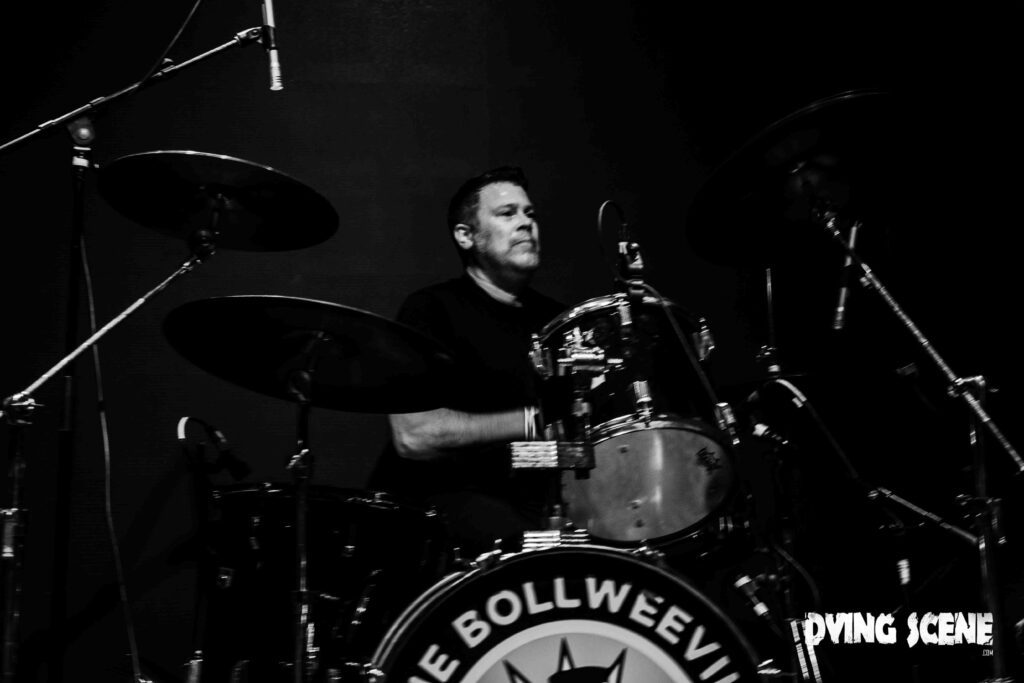
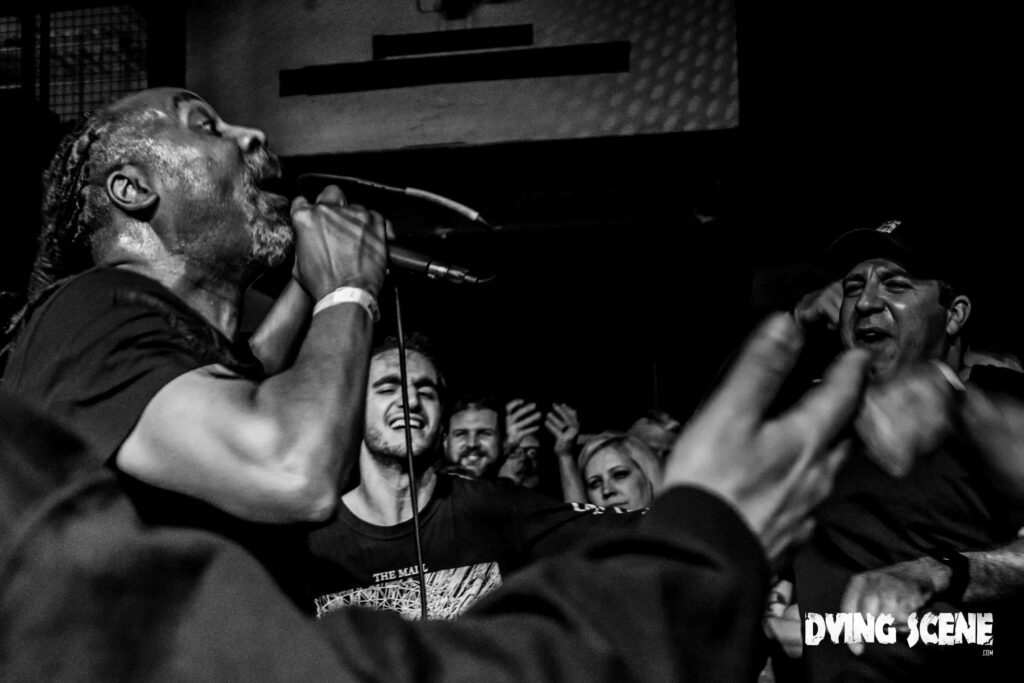
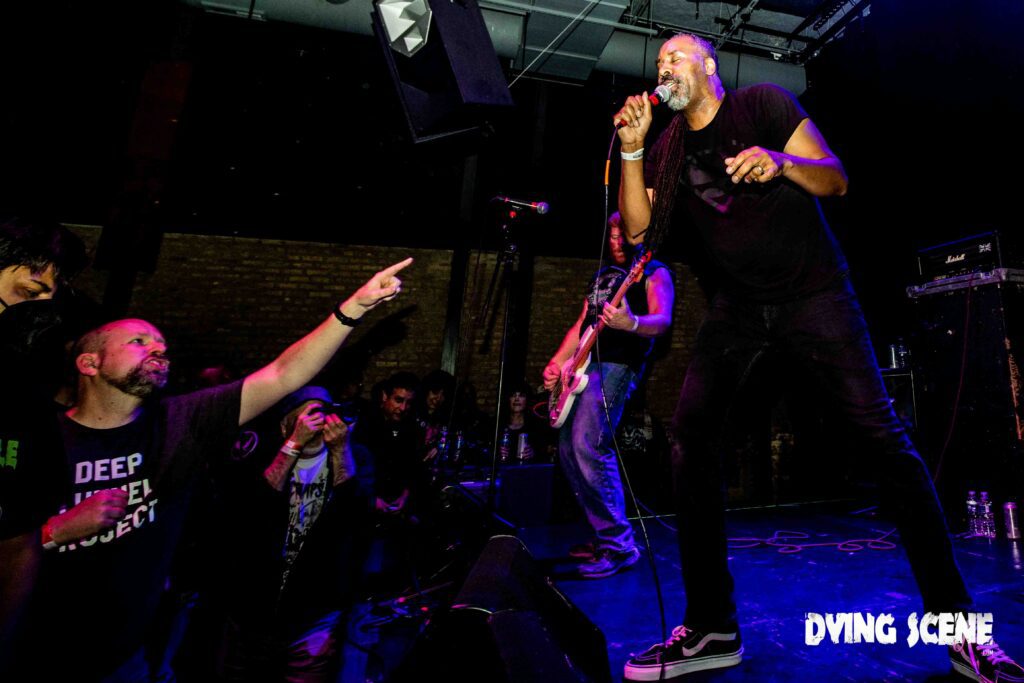
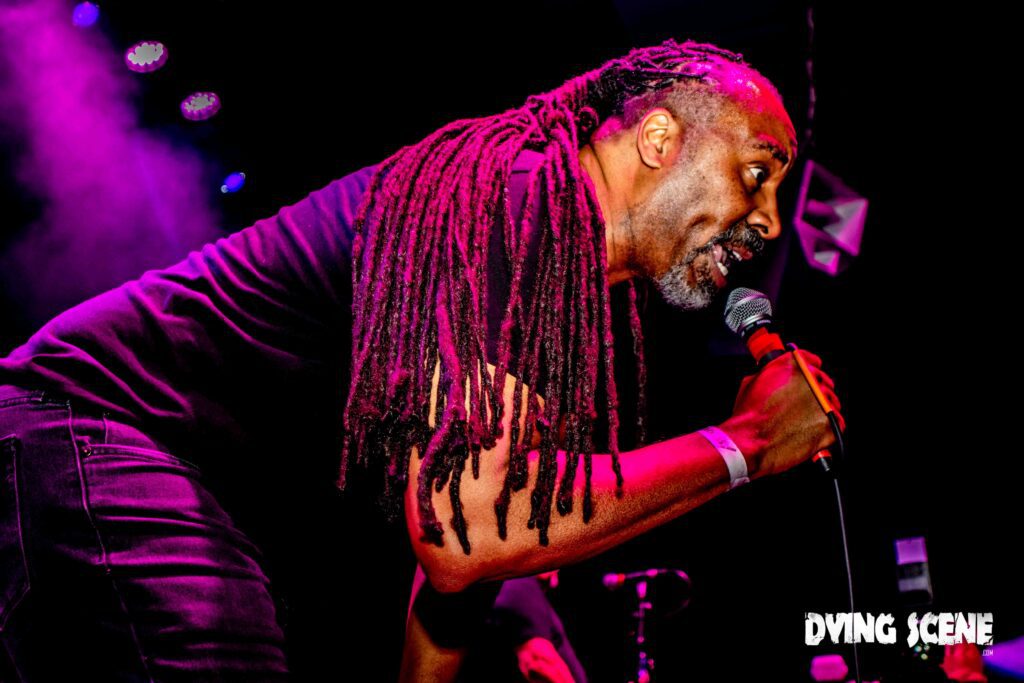
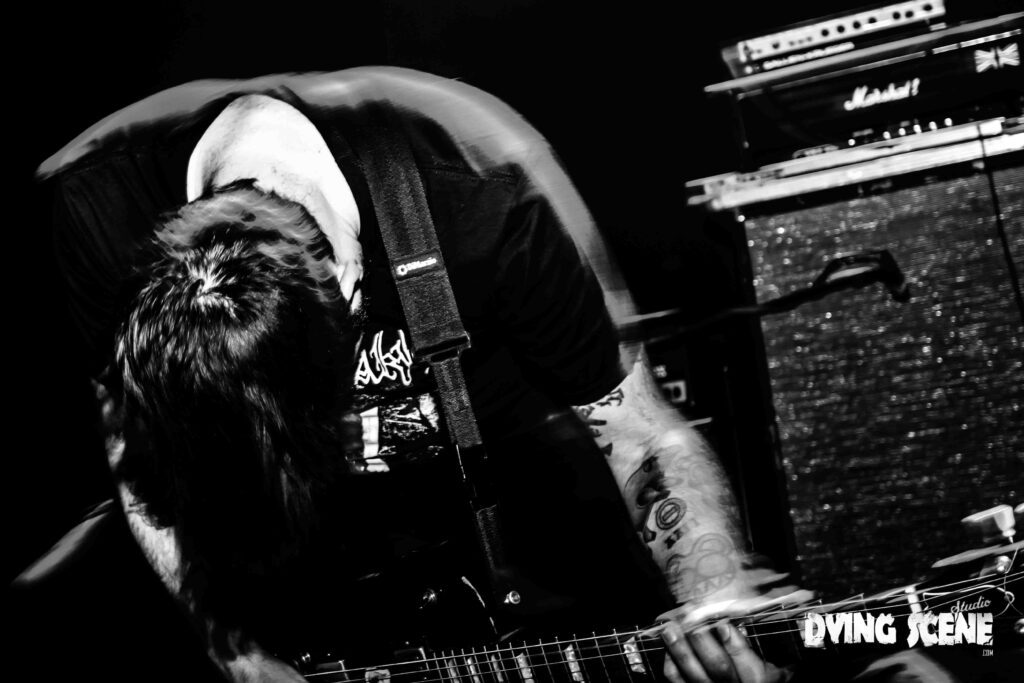
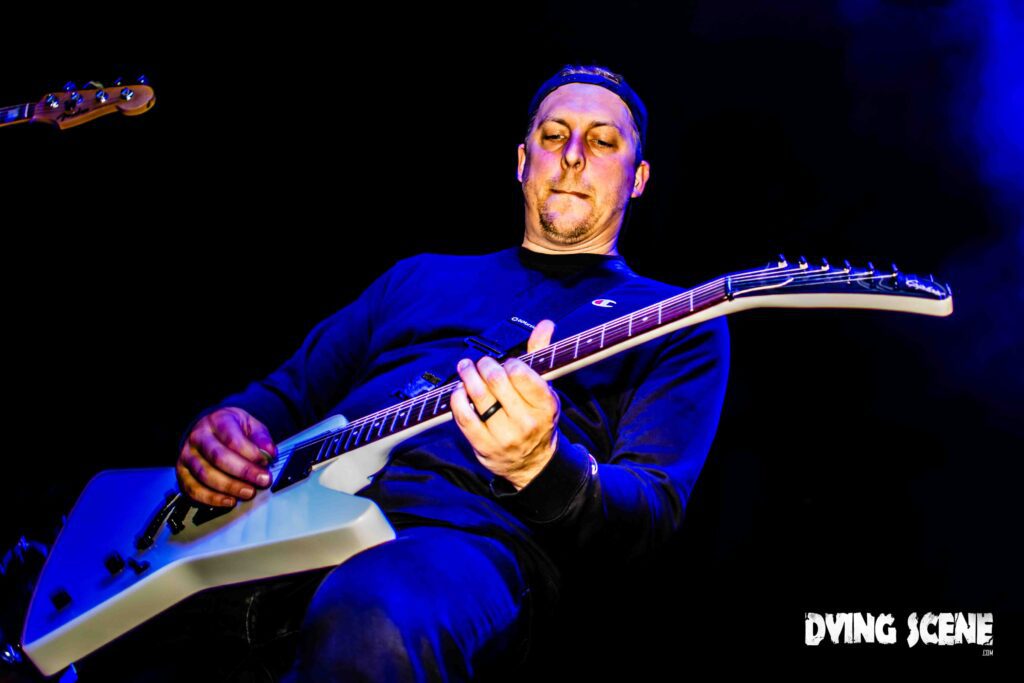
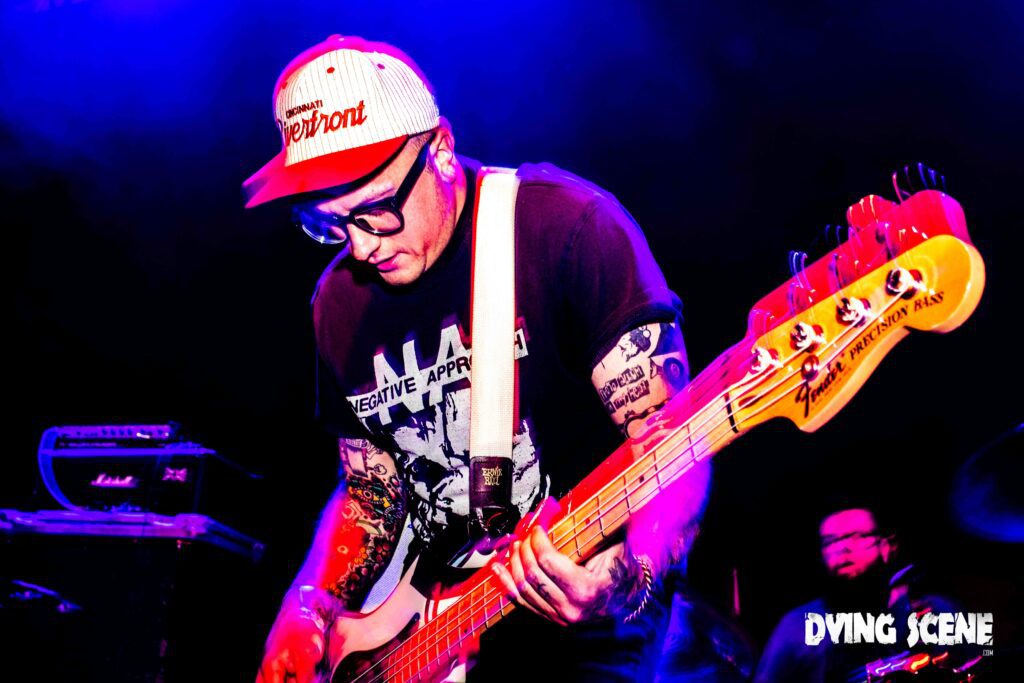
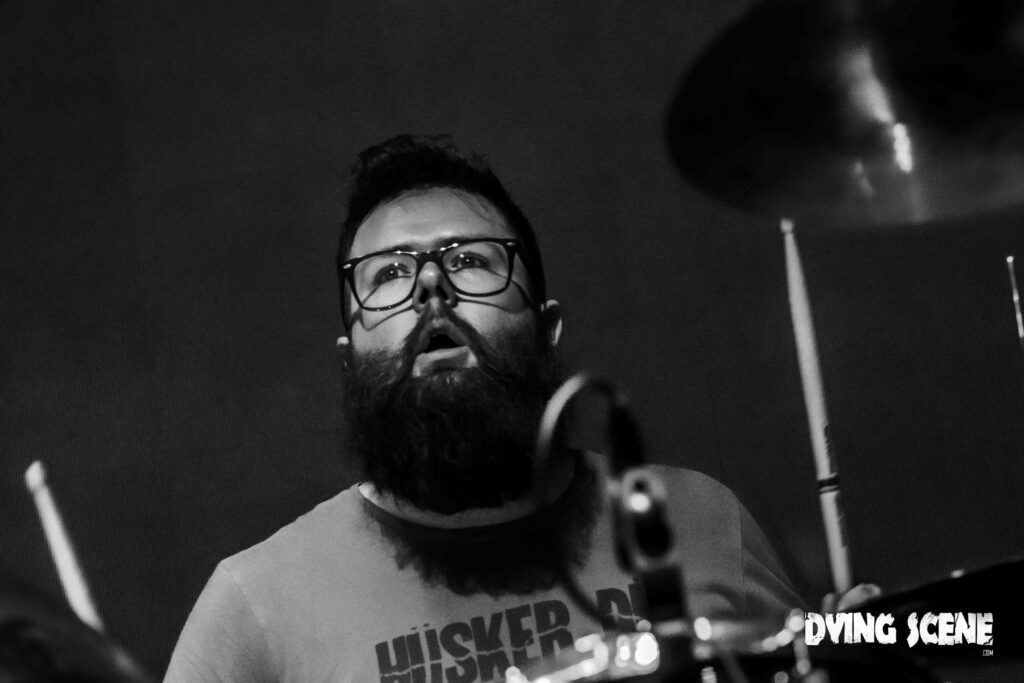
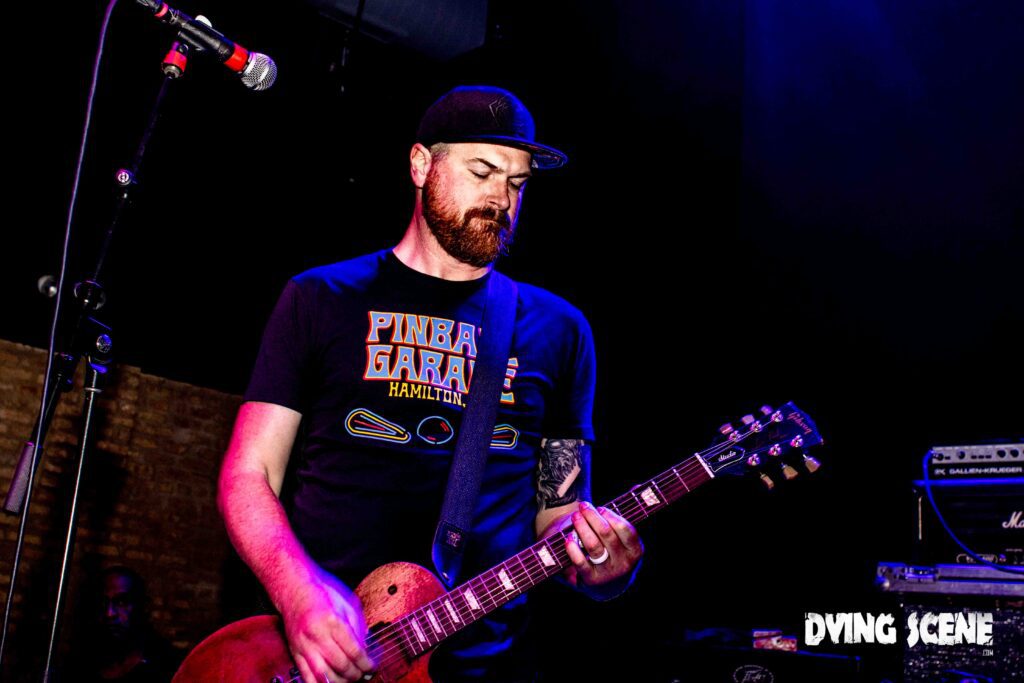
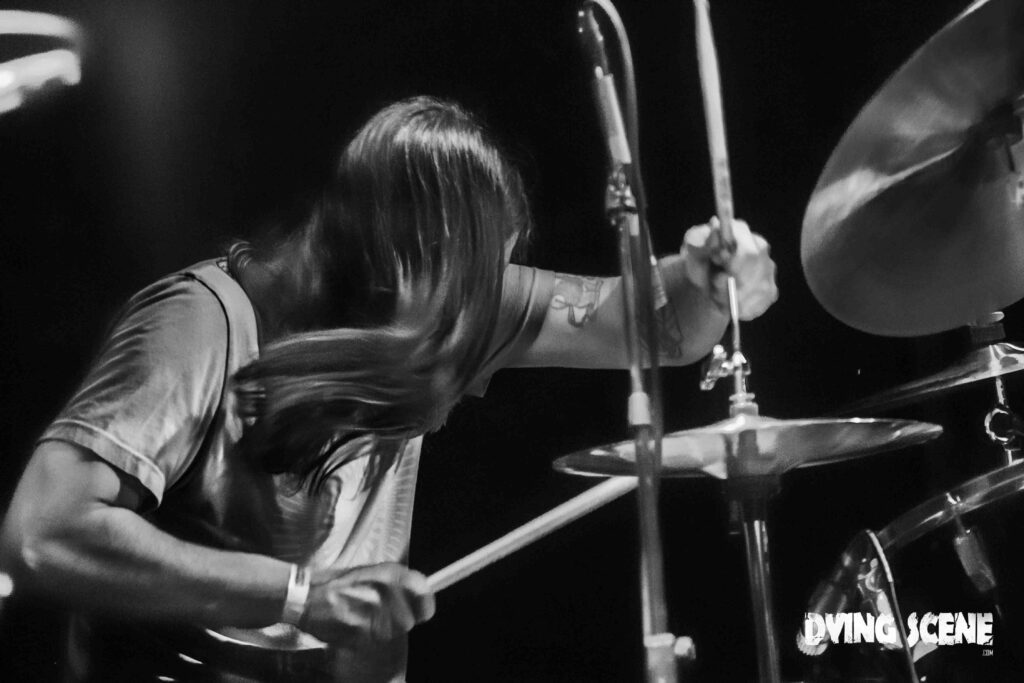
SPELLS traded in the Mile High City for the Windy City on May 28, 2023. The Colorado self-described “vacation” band was joined by Celebration Summer, and Heavy Seas at Reggie’s Music Joint. It was a low-key, but high-energy evening of compelling music and equally compelling performances. On this weekend Punk Rock Bowling lured many punk […]
SPELLS traded in the Mile High City for the Windy City on May 28, 2023. The Colorado self-described “vacation” band was joined by Celebration Summer, and Heavy Seas at Reggie’s Music Joint. It was a low-key, but high-energy evening of compelling music and equally compelling performances.
On this weekend Punk Rock Bowling lured many punk rock fans away from the Windy City, leading to a smaller crowd in attendance. Many bands would be disheartened by the situation. But not the trio of bands on the bill this night. In fact, in many ways, this situation enhanced the experience. Having become friends with several of the musicians who performed, as well as some showing support, it felt, to me, more of a personal house party. Intimate, yet super fun. You know how there are always a few friends who decide to break out into song during parties? It just happened to be that these friends are all excellent musicians. No drunken, cringy renditions of “Don’t Stop Believing” sung along to a Karaoke machine.
Instead, we got the hyper-goofy fun of SPELLS. The band, consisting of “Little Stevie Shithead” (aka Ben Roy), Charlie “Continental” Stimsell, Don Bersell (aka Duke “Box” Standard), Robert Drew Burleson (aka Peter “P.” Bohner) and Dawn “Dusk Monarch” King were clad in matching golf shirts, and at least partial tracksuits, as is their modus operandi, though they do maintain a rotation of different patterns.
Roy and King shared vocals and played off of each other in a dynamic way unmatched since Sandy and Danny hit the Rydell High Senior Fair. Ok, maybe that’s just a tad hyperbolic. Still, there is a crackling dynamic when they abandon the stage to mingle amongst the crowd, even more so when they draft fans to be a part of the show.
I spoke to Coffey, Burleson, and King several days after the show to get to their reflections on the evening. King told me:
“I think the show was amazing! Even though it was a small crowd, it’s the energy we feed off of. The people who were there were friends or friends of people who weren’t able to make it. Some of them were brand new to the SPELLS experience! I feel like over the years SPELLS have cultivated friendships all over the US and overseas. It’s hard not to fall in love with this band.
“Chicago is an amazing city and we’re lucky to have a bunch of buds there.“
King ended with:
“What’s up next? World Domination.”
Burleson also spoke to the sometimes smaller crowds which everyband experiences at some point:
“We are never really concerned about who attends shows. Staying in is the new going out so we get it. But for those who venture out to the dance party, we want to give them a complete 80% effort.”
Burleson shared some amusing memories from lesser-attended shows:
“One time we played in Quebec and the promoter got mad cause we were stuck in traffic and showed up a little late. He proceeded to take the opening band and all of the people who were there and went to another (bigger) show. We ended up playing to a room full of maybe 6 friends of friends, the bartender, the door person, and the sound person. IT WAS AMAZING!“
And he had some invaluable advice to other musicians:
“We made everyone get on stage and had a dance party. Maybe one of my favorite shows. Play to the people who are there and not the ones who aren’t. I’ve played to a room full of stuffed animals, GI Joes, and Kathy Ireland posters, and having a chance to play live in a club in a city we love (Chicago) to people we love is THE BEST.”
Oh, and Burleson also answered a query I’ve had for a while. That is, how they came up with the band name:
“SPELLS is an acronym for Stupid People Elevating Lonely Losers Socially. We came up with it after attending a youth leadership conference.”
Coffey echoes the sentiments of the King and Burleson:
“Like my bandmates said, we play our asses off for anyone that’s there and don’t sweat if it’s 10 people or 200. We do what we do because we love it.“
He added:
“It’s always great to see friends at shows. We do have an affinity for Chicago. It’s the city we’ve played the most outside of Colorado. We’re fortunate to have some great friends in town that have gotten us on some good shows and introduced us to a lot of rad people, such as yourself.“
Coffey is credited as the producer of the latest SPELLS release but he describes the process as this:
“I pretty much get producer credit cuz I’m there during the entire recording process, but it’s a full band effort.”
When not touring with SPELLS, Coffey, remains immersed in music as a producer and owner of his own record label.
“Yep, I started Snappy Little Numbers in 2011. I run it out of my basement. Rob helps out with art for SLN quite a bit too. Reminder… it’s not Fingers!! Even though there are fingers in the logo. I don’t always think things through, haha. [Coffey immediately followed up that he made the joke about “Fingers” “lovingly” sans disrespect to Stiff Little Fingers. He added that it’s quite common for people to make this mistake.]”
And because Burleson revealed the origin of the band name, Coffey thankfully offered how he came up with the name of his label:
“I came up with Snappy Little Numbers cuz it’s old-timey slang for a catchy song. Like, “hey that tune is a snappy little number”. Then I added an S to pluralize how many freakin’ hits we were gonna curate!“
With all this talk about sparsely attended shows, it should be noted that SPELLS shows are way more often playing to jam-packed crowds. No doubt the shows will continue to get ever bigger. With a set list like the band cruised through on this Sunday night, including “What The Hell is Caution,” “Some Would Say,” “She Wants to Die Before Me,” “Deceiver,” and closing with, of course, my favorite, the above referenced “80% Is Good Enough.”
SPELLS latest record, “Loose Change, Vol. 2,” is planned for release on June 29, 2023. If you want the vinyl version, you have a choice between “Dolphin Blue,” or “Drakula Red.” It’s available for pre-order now.
Celebration Summer, a wonderfully upbeat band moniker, sounds like the name of a music fest. However, per the band’s online press kit:
“Celebration Summer is a mash-up of sorts, pays homage to the iconic Hüsker Dü song “Celebrated Summer” and Washington DC hardcore’s significant social and activist “Revolution Summer” of 1985.“
The band’s songs are politically driven and have the mission of racial and social justice. With its powerful set, including “Disconnected,” “Silly Me,” “My Devotion,” “Patience in Presence,” “Bitter End,” and “Fraud,” Celebration Summer neither pulls its punches nor suffers fools. For those who lean MAGA, this is might not the music for them, as the band describes itself this way:
“Celebration Summer hit the ground running with anthemic, progressive songs capturing the struggles of modern life in Trump/post-Trump-era America.”
Actually, perhaps MAGAs should be listening to Celebration Summer. Perhaps they’ll have a change of heart. In any case, with compelling lyrics set to strident, in the very best way, music, this band should be celebrated this summer and in every season.
Celebration Summer will be festing in Gainesville, FL. You can check them out at Fest 21 in late October.
Heavy Seas co-founder/guitarist Jeff Dean has been a very busy man of late. Amongst other projects produced and engineered The Bollweevils latest release Essential. In the audience at this show was Daryl “The Punk Rock Doc” Wilson, to show his gratitude to and support of Dean, and other friends on the bill.
Dean told me:
“Recording [and] producing Bollweevils was rad…“
Heavy Seas founders Dean and Ronnie DiCola recruited former All Eyes West bandmate Justin Miller to fill in on bass after that position came up available. This Chicago trio kicked off its set with its own originals, “Waves and Dreams,” “Sunn,” “Idle in Life,” and “Oscillation.” Heavy Seas also included as surprise for long-time fans of the three musicians/ Per Dean:
“We also ended the set with 4 All Eyes West songs since Justin was filling in on bass.”
Dean continued:
“Ronnie, Justin and I were All Eyes West then Ronnie and I started Heavy Seas. So having Justin fill in basically made it All Eyes West.
Dean is currently in Baltimore, MD recording the third Heavy Seas album. He provided me with some information about this:
“Heavy Seas has a new album called Distortion Days coming out at the end of summer on Rad Girlfriend records for the US and little rocket records for EU UK.”
Looking forward to the new album and also Dean’s perspective on his role in making Essential. He pledged to tell us at Dying Scene more about it later. We can’t wait!
Please check out more photos from the show. Thanks & cheers!
SPELLS
SPELLS
SPELLS
SPELLS
SPELLS
SPELLS
SPELLS
SPELLS
SPELLS
SPELLS
SPELLS
SPELLS
SPELLS
SPELLS
SPELLS
SPELLS
SPELLS
SPELLS
SPELLS
SPELLS
SPELLS
SPELLS
SPELLS
SPELLS
SPELLS
SPELLS diehard fan
SPELLS
SPELLS
SPELLS
SPELLS
Daryl Wilson, of The Bollweevils, jumps in on the fun with Ben Roy
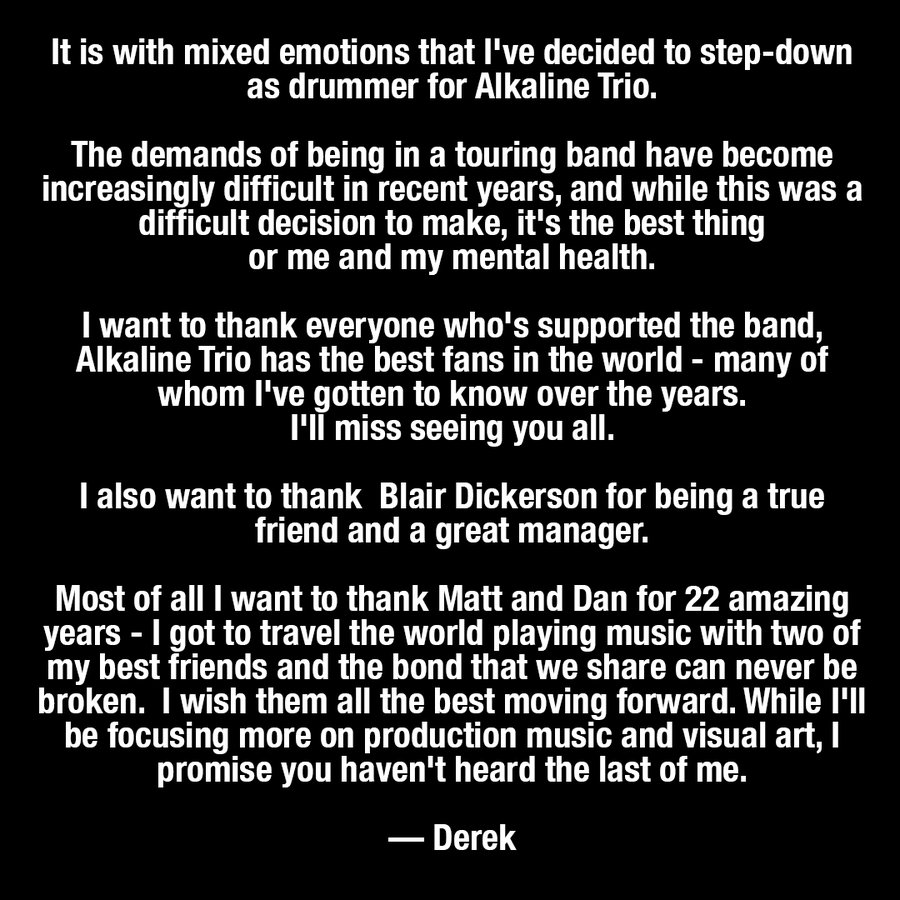
A week after announcing the departure of longtime drummer Derek Grant, Alkaline Trio has revealed Atom Willard is next in line to man the throne. A few other bands the journeyman has played in throughout his 30+ year career include Rocket From The Crypt, Against Me!, and Angels & Airwaves. Willard has also collaborated with […]
A week after announcing the departure of longtime drummer Derek Grant, Alkaline Trio has revealed Atom Willard is next in line to man the throne. A few other bands the journeyman has played in throughout his 30+ year career include Rocket From The Crypt, Against Me!, and Angels & Airwaves.
Willard has also collaborated with Matt Skiba on side projects like theHELL and, more recently, Lektron. Shit, he even did a brief stint as the touring drummer for Alkaline Trio in 2000! (video evidence below) Is there anything this man hasn’t already done?
Derek Grant parted on good terms, citing the demands of touring as his main reason for walking away from the band. The veteran drummer spent 22 years with Alk3, joining shortly after the release of their breakthrough album From Here to Infirmary in 2001.
Atom Willard’s first day on the job is June 21st at Wrigley Field. More info on Alkaline Trio’s upcoming tour dates can be found here.
NYC hardcore act MAAFA are releasing their debut full length album Because We Are this coming Juneteenth on Fuzz Therapy Records and to get you hyped for that impending release, the bad-ass Brooklynites sent over a track-by-track breakdown, giving insight into their writing process and the inspiration for each song. Read through this exclusive ‘peek […]
NYC hardcore act MAAFA are releasing their debut full length album Because We Are this coming Juneteenth on Fuzz Therapy Records and to get you hyped for that impending release, the bad-ass Brooklynites sent over a track-by-track breakdown, giving insight into their writing process and the inspiration for each song. Read through this exclusive ‘peek behind the curtain’ provided by lead vocalist and lyricist Flora Lucini whilst enjoying their latest Single ‘Welfare’ and remember to snag the LP on Tuesday!
1.“Origém (Intro)
The word “origém” translates to “Origin” in Portuguese and it is also the name of my father, Leonardo Lucini’s (Bassist/Composer) Brazilian Jazz band which he shares with my Uncle Alejandro Lucini (Drums/Composer.) For their album, they used their grandmother, Dora Muniz’s, painting (she was a painter) as their album cover. She thankfully lived long enough for me to spend time and live with her before her passing when I was a kid. Every morning before school I would sit next to her while she painted at our breakfast table. So, the artwork in the album for the page dedicated to this song is of one of her original paintings.
When I started MAAFA, I knew that I wanted to incorporate/reference these influences on the record and tribute my paternal family, but I also wanted to tribute my maternal family as well which leads to the music.
Originally the song had a sample of this style of music called “Tambor De Crioula” from my mother’s hometown in the northeast of Brazil São Luis, Maranhão. Which both myself and all the women in my family grew up dancing and participating in. Unfortunately, I couldn’t get permissions for that sample in time for this release. It was going to start with that sample from Brazil into the intro with Batá that you hear on the track now, to showcase the similarities and connection of the traditions through its African origins.
The Batá drums and rhythm on this track reminds me of the instrumentation and even some of the drum patterns found in Tambor de crioula. It’s very similar in the sense that both traditions use 3 double headed drums, “small, medium and large” that are all assigned different functions and both traditions are African Traditions brought through “THE MAAFA” to Brazil and Cuba (then to other parts of the diaspora later) and used traditionally in African traditional religious ceremonies. This was one of the ways to incorporate a tribute to my mother’s hometown as well. All the references from the album art to the actual musical styles point to my “Origins” in some way.
I also split playing the bass on this track with my Bassist Ray Russell. He plays the majority of the bass lines on the intro and I play the Tumbão Groove in the second half of the “Batá” section in the intro.
2. Welfare
This was the first song I ever wrote specifically for MAAFA. The lyrics really embodied where I was/still am politically and in terms of what I wanted the message of this first record to convey.
I wrote all the songs on this album on classical/acoustic guitar because I couldn’t afford an electric one at the time. I also just write everything on acoustic LOL.
Welfare was not intended to be an “anthem” like song but it has definitely grown to that. I was trying moreso to mash up some of the more traditional styles of Hardcore and Punk into one song while the lyrics ushered in a perspective that called out a lot of the more problematic ideologies that plagued/continue to plague both our scene and our society, seeing as how music is a reflection of culture.
3.Deficit
The intro to Deficit was written before the song was. I had this idea for the intro after being inspired by a call and response pattern I had heard in an African Drum and Dance class in 2008. I slowed it waaaay down and translated the inspo from it into a heavier style. I had always heard Kora in the intro too and am so glad it worked out where the professor of the class, Amadou Kouyaté, who is also my friend of almost 20 years and is one of the original members of MAAFA is playing Kora in the intro. He is also playing a series of drums such as 2 Djembes, Dudunba, Sangban, Segesege and more. This same Djembe pattern repeats in the outro and slows down even more as it transitions to a more typical “beatdown hardcore” feel which is when the gang vocals start screaming “Reclaiming my time.”
I wrote the lyrics after a frustrating experience with a former colleague who kept abusing their access to me by constantly bombarding me with requests to correct their problematic behavior, specifically around racism and homophobia. They never asked me, they demanded, they never offered to pay me for my intellectual labor, they never gave me credit for said labor and the entire interaction was transactional and unwarranted. Just kind of kept messaging me over and over again until finally I had to block them.
This led me to reflect on the history of QTBIPOC interactions with folks like that, especially sense this happned during the height of social unrest around the murdering of unarmed Black folk. It remonded me of how often we all are constantly being put in positions like this to do all this labor and are expected to do it for free.
This song was written in 2017/2018, around the time that U.S. Representative Maxine Waters (a Black Woman) went viral for standing up to her problematic colleagues in government by “Reclaiming Her Time” during a house committee meeting. She was coined #AuntieMaxine shortly after. The visual of a Black Woman in power stating “I’m Reclaiming My Time” from problematic “colleagues” fit perfectly with the messaging of this song. It’s really about paying BIPOC for their labor, self-advocacy, boundaries and self-care.
3. Libation
There is a theme about water here: cleansing, ritual, baptism, sacrifice, rebirth, death, legacy, tribute and worship. Libation is a reflection on the legacy of what our ancestors have left for us and what we are responsible to build moving forward as the descendants/survivors of Chattel Slavery. It’s about ancestral worship, ancestral memory, a moment to reflect on our loved ones who have passed.
It is part poem, part prayer, part ritual and of course, part call to action.
I wanted to give myself space to write a song both musically and lyrically where I can depart from the typical lyrical styles and song structures we find in Hardcore but while still pulling from influences like Spoken word, Reggae and Hip-Hop influenced-Hardcore. For example, Lyrics like “Black is the river now. So much flesh in the waters, the waters have changed.” Was inspired by a statistic I read that said so many African bodies were thrown overboard into the Atlantic Ocean during the middle passages/ The Maafa, that it changed the temperature of the water forever.
Naming the song “Libation” was inspired by the history of the Black American ritual that some of us do when one of our loved ones passes away i.e. “Pour one out for our homies” and the fact that some in the States who practice that and learned that from Hip-Hop didn’t or don’t know that pouring Libation is African Ancestral Memory, it can be traced back to many of our ancestral nations on the continent as an important ritual across many religions and cultures it is also not exclusive to Indigenous African Nations but also to Indigenous Nations in the West. It has been said that for many Africans & her descendants “Nothing important happens without Libation.”
I am of Yoruba (Nigerian) descent, and a lot of the lyrics reference ritual/aesthetics still present throughout my family and that can be found in some African Traditional Religions (ATR’s for short) such as Black American Hoodoo/Brazilian Candomblé, Cuban Lucumí/Lukumi etc. But also Black American Christianity/Southern Baptist + Pentecostal references.
I wanted the overall feel to take the listener on a journey and for it to be like spoken word meets hip hop influenced hardcore in the verses then the Reggae part allows you to meditate then finally resolving on a metal/opera like ceremonial vibe that centers hope in the end.
It was important to me to make a moment for meditation that musically centered the real, Black African tradition of Reggae. The whole song touches on the connection of the spiritual and the political being in balance for true resistance. Which we see in historical victories such as The Haitian revolution, for ex. Very rarely do I hear true stories about uprisings and revolts of enslaved Africans where we did not seek the guidance of our ancestors and the spirit world/our religions to see them through.
All the way to the civil rights movement and how a lot of organizing happened in the church, (regardless if everyone was actually Christian or not.) So many of our diasporic African religions are practiced under the guise of Abrahamic Religions because we were forced to hide our practices during enslavement. Take the saints of Catholicism for example (i.e. where “santeria” came from and that many feel should not be the appropriate term to use) in order to avoid being murdered by slave owners because our religions were considered “savage, primitive and of the white Judeo-Christian Devil.” Our political resistance and our god(s) have always and to this day remain connected for many of us (with all due respect to our very powerful atheist siblings who fight very hard on the frontlines and some even while trying to heal from religious trauma) and this song sheds light on that. Which is what “Libation” is really about: how the spiritual and political are connected when it comes to our living, our afterlife and our fight here on earth against systemic oppression and religious (ATR) prosecution.
The breakdown pays tribute to the traditional Rastafari community I grew up around in D.C that are responsible for some of my earliest exposure to Pan-Africanism and Militant Black Liberation Politics very early on in life.
The end of the song is an extension of the meditative reggae break, but the vibe changes into a more metal influenced, almost operatic style to evoke the feeling of a ceremony/ritual chant for the hope of where we are headed as a people and that the deaths of our ancestors were not in vain, instead their legacies fuel our resistance and our “big dreams” to this day. One that factors in the entirety of our history and “The Legacy They Left Here for Us” (the very last line of the song) a lot of our traditions teach us that when we die we then are promoted to “ancestor” and have to begin our duties as an ancestors over our descendants that are still here on earth. The overall feel is about hope and how we must carry on to a better world, which is a great segue into the next song “A Luta Continua.”
5. A Luta Continua (Interlude)
“A Luta Continua” translates to “The fight goes on” in Portuguese. This interlude was an instrumental bass and percussion duet I wrote and am performing on. It is a duet featuring me playing the bass (everything you hear on this track that is not vocals or percussion is the bass. There are no guitars) and me singing/harmonizing with myself. The only other musical instruments are Traditional Brazilian percussion played by my friend Everton Isidoro who is also from Brasil. The style of music is a mix of Traditional Capoeira percussion & rhythm and the lead Bass lines were inspired by a style called Baião .
Overlayed is a sample of Councilwoman Marielle Franco’s speech (SPEECH HERE) at a hearing on violence against women in the Favelas, given about a week before she was assassinated. This interlude is to usher in the song “Filha Da Luta” that also features Afro-Brazilian Musical elements.
6. Filha Da Luta
“Filha da luta” translates to “Daughter of the fight” in Portuguese and is a saying I saw become popular on protest signs during uprising against Bolsonaro’s election and when Marielle was assassinated. “Filha da luta” is a play on words for the insult “Filha da puta” (which translates to what in the U.S. we would say “son (Filho) of a bitch” but in this case it’s daughter(filha) of a bitch lol) activists changed it from the cuss word “Puta” to “Luta” which means fight. “Puta” is also a misogynistic slur in Portuguese for Slut/Whore.
The song’s intro features a rhythm called “Samba-Reggae” that is very popular in Brazil during carnival especially in the northeast of Brazil so places like my mommy’s hometown and Bahia, considered the “Black state of Brazil” which has similarities we can find in some Afro-Caribbean cultures.
My friend Everton recorded the Brazilian percussion for this song as well, he played a bunch of the traditional instruments that go along with this style like the surdo, agogo, pandeiro, atabaque and more.
The choruses and the breakdown at the end features a rhythm that is very dear to my heart called “Afoxé” (Here’s a video of my cover of that Afoxé song I arranged, choreographed and sang for Harry Belafonte at my Almer Mater, Berklee College of Music) which is an African-Brazilian Rhythm that my dad uses a lot in his songwriting and which has a long history with Black resistance and enslaved African uprising during the Maafa. It is also a rhythm that primarily is used in religious ceremonies and rituals in the ATR- candomblé. (Video of my uncle and friends back home in DC playing Afoxé)
I dedicate this song to Marielle every time we play it live and to all Black/Brown, Non-Cishet male activists globally that we’ve lost and whom are still here fighting and organizing.
7. Not Your Exotic (CW: Sexual Assault)
The inspiration for this song’s title and for some of its lyrics is the poem “Not your erotic, Not your exotic” by Palestenian-New Yorker poet, Suheir Hammad. She and I have become really good friends after I wrote this song when one of her homies happened to come to one of our shows and connected us. This poem changed my life and finally made me feel “seen” and most importantly she found the words I had such a hard time formulating over the years. It unlocked my voice about this issue, and I owe it all to her.
The song is simple, straight to the point heavy punk rock. I wanted to write a groovy, still “Maafa” style punk song, that emphasized the lyrics more than anything else.
The lyrics are about the violence that Women/Femme identified and presenting Black and Brown people like me face from being hypersexualized/fetishized/Other’ed etc.
Hypersexualized for being a Black Woman, A Brazilian woman, lightskinned/mixed race presenting Woman/ for my body type etc. You name it! We’ve heard all the gross and highly offensive things “Spicy, Sassy, pretty for a Black girl, Pretty for a fat girl etc.” my darkskinned siblings have to then add colorism on top of that like “Pretty for a Darkskinned girl” or fetishized statements like “You’re the Only/first Black/Fat/Brazilian etc. Girl I’ve ever been with/liked” etc. or “why are you so Angry/Emotional/Hysterical/Crazy/Irrational/Sensitive/Moody” etc…AND the FAVORITE one they use for Black Women: “You have an attitude.”
The album art for this song features the song title super imposed over a picture of one of the signs used to announce the auction/arrival of an enslaved Black Woman named Sarah Baartman aka Venus Hottentot who was enslaved and treated by her capturers as like a zoo animal they paraded around the world naked, on display like a circus freak show/side show so that white people can come and stare and violate at her “exotic” body. (This is a gross over simplification of her life and legacy, due to the sake of time.)
It’s wild to think this actually happened and that a body type that is extremely common amongst Black and some Brown folk (and that she and I both share similarities with) is somehow “exotic” and “freak-ish” “abnormal” or a “deformation/illness” that it needed to be literally caged and put on display.
DISGUSTED is the first word that should come to mind, which is exactly how I feel and how many folks like me feel regularly. Sexual harassment is part of my everyday life. My safety is something I have to factor in when I get dressed, what time I leave my house, what kind of clothes I want to wear or go shopping for etc. Shopping is a lot of “Damn, I shouldn’t wear that, I COULD GET HURT.” I have been assaulted more times than I can count, I haven’t taken the subway alone in 6 years because I was sexually assaulted on the train 3 times in broad daylight.
I, like many BIPOC femmes, have survived sexual assault, being followed to my house, to my car, to public bathrooms, physically sexually assaulted at shows, cat-called on the street, etc. My friends have to literally make sure I make it home all the way in the door when dropping me off in an Uber. I’m required to check in via messages with my homies as soon as I’m in the house just so they know I’m ok and they are also required to do the same. None of us drive off until everyone is inside their homes with the doors locked and accounted for in the group chat. If one of us forgets to check in, we can absolutely expect several missed calls the next morning.
In fact some of my girlfriends and I have a group chat that we all send “I’m home” or “I’m on so and so street, with so and so, his/her/their license is…and I’m wearing…. etc.” even though we all live in different states. We all have access to our parent’s/spouses’ information, address, emergency contacts etc. and we all carry emergency contact and information cards with info like “I’m allergic to penicillin.”
Having to live like this since I was little which was taught to us by our mothers/sisters/elders/community and theirs to them and so on for survival, is absolutely normalized. And this song feels like a collective “exhale” for 2 minutes and some change that we can all take and scream all the pain and frustration we feel that is constantly being dismissed.
NOTE: Most CisHet masculine Men and Boys NOT having to ever think about stuff like this is a type of privilege I speak about in “Welfare”: “To Inhabit your skin without fear (white privilege) / To inhabit your body without shame (Fatphobia/skinny privilege/Masculine body privilege) / To love who you want (Hetereosexual Privilege) / TO WALK AT NIGHT ALONE (that part) / To be standing on the outside looking in / THAT’S PRIVILEGE!”
8. For The Culture
My hometown here in the states is Washington, DC. And D.C. has its own original style of music called GO-GO that I grew up on. Go-Go and D.C. Hardcore have a lot of history together and sometimes , many many moons ago traditional Go-Go bands would play Hardcore shows.
So this song musically is a love letter to my hometown. Go-Go, like Hardcore, has also evolved tremendously; for example, THIS is one example of what modern Go-Go can sound like with more rock influences. I love everything about Go-Go, especially all the obvious ancestral memory you see in every element, down to its own dance called “BEAT YA FEET.”
The artwork on the album for this song depicts the Bucket drummers that perform at the metro stations in DC that I also grew up listening and dancing to – also another example of ancestral memory.
“For The Culture” is a phrase some Black folks use when we are acknowledging something that is being done strictly for the sake and the betterment of Black culture and Black people.
The lyrics are calling out gentrification, posers and people that want to exploit how “trendy” being Black and “punk” or “alternative” is now a days all of a sudden. When most of us grew up getting beat up or harassed for listening to “White people music” and it was actually dangerous for us to “dress punk” back in the day. Oftentimes the violence came from our own people as well as racists that we faced at shows, so we caught it from both ends. But now a lot of those same people want to dress like us and study what we’re doing in our scenes cuz they think it’s “cool and trendy.”
The song was inspired from my rage against corporate “alternative music” festivals that exploit the word PUNK and the people in the community in order to chase “clout” and be trendy, when their festivals have absolutely nothing to do with our communities and do nothing but erase actual Black punks and Hardcore kids like Maafa and our sibling bands.
9. Dichotomy
This is my break up song, but you know I can’t do a break up song without making it political lol. Relationships bring out things in you in a way that only they can, because of the unique things it forces us to face when having to deal with other people in a romantic way, like during talks about the future, children, expectations etc. It will bring up your own traumas and sometimes your partner can treat you so badly that they become a trauma themselves that you’re forced to heal from. Which is in part what happened here as well: this was written after I got out of an abusive relationship.
Things like infidelity & betrayal trauma are also experiences that inspired this song. It’s my most vulnerable song & most personal.
Basically, the inspo for this song is how a break up was the catalyst to my journey with mental health that saved my life and how during that journey the issue of mental health in the Black community came up i.e. still not having a therapist or the right meds because they’re low income; how HR from Bad Brains is/was treated/talked about during his battle with mental health; and the stigma in the Black community around mental illness and seeking help, especially amongst Black men.
My experience with depression and anxiety during this period felt like I was possessed by a demon or something really dark that had more control over me than I did so there are moments in the lyrics that reflect that down to the very last line that says, “Release Me, Please,” as if pleading with the demon to exorcise itself from my mind/body. But the song is also about healing and about taking control and responsibility for my healing which is how I reclaimed my power over the “demon.” Which is also reflected in the lyrics and in the aesthetic of the album art depicting items one would find in an apothecary to symbolize healing with medicine and healing with spiritual/religious ritual. My parents and I are best friends and my father is my guide post in all things “life.” So to tribute him and how much he supported me during that time I made the song’s intro my interpretation of the intro and outro of my dad’s song “PEGA” – the sample is from the outro of the video in that link, so the Jazz sample at the end of the song is actually my dad and his band playing.
10. Blindspot
White boys get to make angry chugga chugga music to “bitch” about the things they hate all the time and they get praised for it, even though 99.99999% of the time the things they sing about hating are people and ideas that are different than them. They also love to gatekeep Hardcore for white straight men who are hyper masculine and violent. Well, this is MY angry chugga chugga song about the things I hate the most which are problematic white boys who make chugga chugga Hardcore and are put in a position of power to control the entire narrative of who and what Hardcore is and looks like and then, being true to their nature, they cry victim and get defensive when someone calls them out on how they protect and perpetuate harmful ideologies and behaviours in our scene. Hence: DECOLONIZE HARDCORE.
Now, I absolutely love and grew up on chugga chugga hardcore MUSIC* ( i.e. Beatdown Hardcore/ Traditional NYHC/ or my favorite as I like to call it “That Castle Heights shit” lol) so I’m not coming at the music, I’m critiquing SOME of the bands and their content, who are really the minority in the scene but because of privilege and supremacy are glamourized as not only the majority, when they’re not, but as the only “true” definition of Hardcore. As I often say, it’s “bullshiterious.” (I got that from a Black Feminist FB group)
Decolonizing Hardcore is also about reminding Black people in our scene and those who are new to our scene that they should NEVER have to negate their Blackness to be here. Manipulate their appearnce or the way they “talk” just to “assimilate.” That it’s about re-educating my own people about the Black history of Hardcore and Punk, that everything hardcore is and stands on comes from Black people who invented rock n roll, call and response, oral history keeping, communicating through dance without words, singalongs and pile-ups and spinkicks.
OUR FOOTPRINTS AND EXCELLENCE ARE EVERYWHERE and in EVERY INCH OF THIS CULTURE.
This is a house our ancestors built for us too, we are not guests here, this is part of our birthright and if anything, like any other subculture, it’s usually the descendants of our colonizers and the ones who benefit from white privilege who are the “guests.”
Decolonizing Hardcore is about centering the QTBIPOC presence visibly and loudly and unapologetically reclaiming not just our time but our rhythms, our dances, our styles, our languages, our lands, our spaces and our scene.
NOTES Batá Drums, Yoruba Tradition, Babalawo, Lucumi religion (aka Santeria, we do not Call it Santeria because that term is a colonial term and can be seen as offensive. The actual name of the tradition is called “Lucumi”or “Lukumi” Loo-koo-me)
The Batá drum is a double-headed drumshaped like an hourglass[1] with one end larger than the other. The percussion instrument is still used for its original purpose as it is one of the most important drums in the yoruba land and used for traditional and religious activities among the Yoruba.[2][3] Batá drums have been used in the religion known as Santería in Cuba since the 1800s, and in Puerto Rico and the United States since the 1950s.[4][5] Today, they are also used for semi-religious musical entertainment in Nigeria and in secular, popular music. The early function of the batá was as a drum of different gods, of royalty, of ancestors and a drum of politicians, impacting all spheres of life in Yoruba land.[6][7]
The drummers on Batá and Djembe for the intro song. One of them is Jabari Exum. He and our Friend Amadou Kouyate who is not only my former mentor but my former professor and one of my best friends and is an original and current member of MAAFA, he is on this album, they both were best friends with Chadwick Boseman from The Black Panther Movies (Wakanda Forever) so when it came time to make those movies Chadwick hired Jabari as choreographer, Lead Djembefola and to be his right hand man meaning every time he was on set, at a red carpet etc. Jabari, who is on this album, was playing Djembe next to Chadwick. Jabari was also in both movies in several Djembe scenes and as an extra in a few scenes in the second movie.
“Stemming from humble DIY beginnings, Drain built up their scene alongside friends who would go on to form bands like Scowl, Gulch, and Sunami and in the process of paving the way for hardcore to thrive in their beach town of Santa Cruz, CA, they’ve cemented a legacy that transcends their California roots.” The small […]
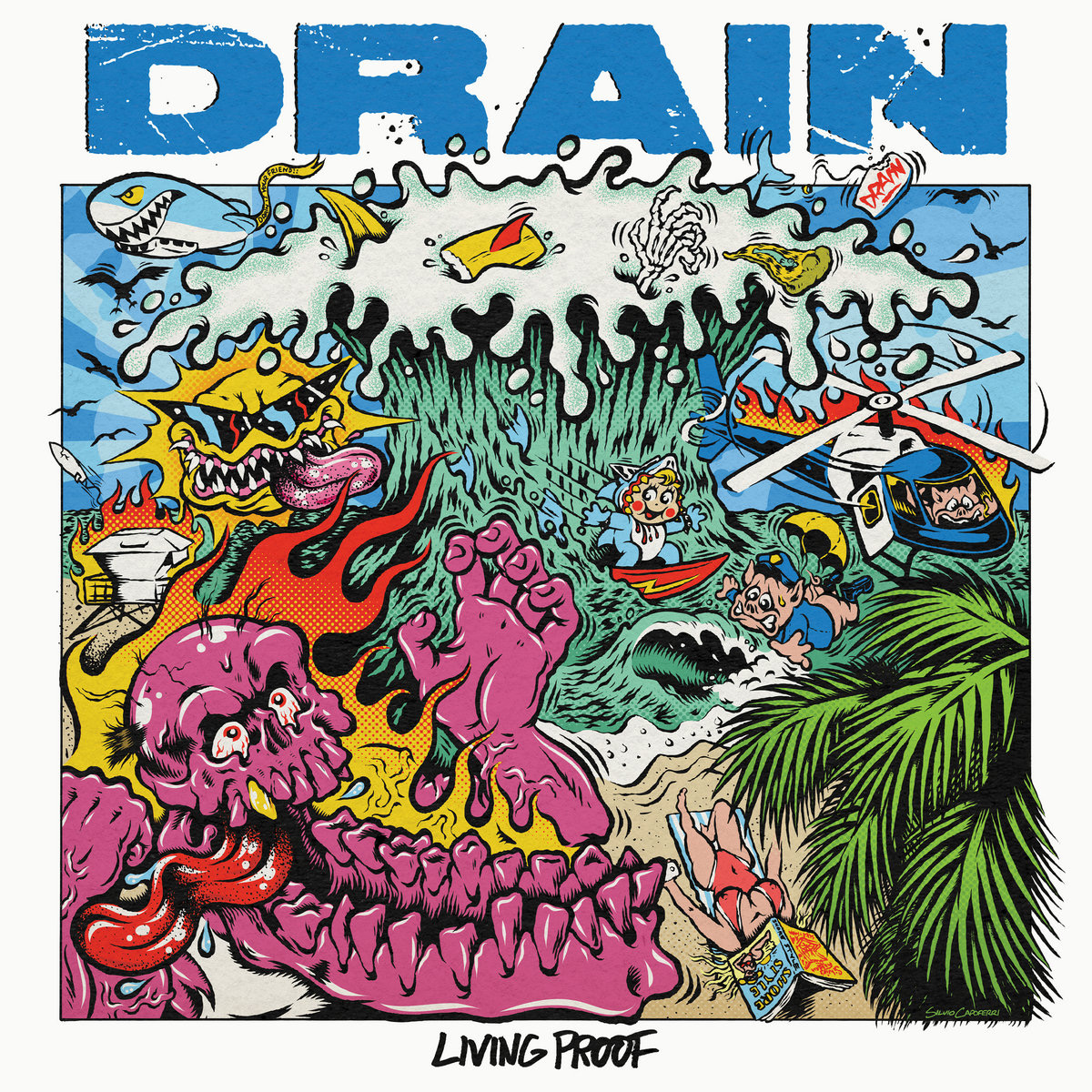
“Stemming from humble DIY beginnings, Drain built up their scene alongside friends who would go on to form bands like Scowl, Gulch, and Sunami and in the process of paving the way for hardcore to thrive in their beach town of Santa Cruz, CA, they’ve cemented a legacy that transcends their California roots.” The small excerpt quoted there was from the email that I received in preparation for this review, and while this excerpt feels like it says it all, I can’t help but feel the need to point out how similar these dudes started their journey to so many of my hometown local bands here in Alaska, and feel like I can say something worthwhile about them!
The first track of the album, “Run Your Luck”, gives me Godsmack vibes. They give off a unique rock sound, bringing in multiple styles of guitar riffs to their songs. I’m loving that in one song, I can get Godsmack, then the next I get Metallica vibes that slide back and forth with Suicidal Tendencies-like riffs and vocals. It’s a band that absolutely keeps you on your toes when it comes to the song’s dynamics. Drain genuinely reminds me of a few of the bands I went to see at our only all-ages venue here in Anchorage, Alaska, called Anchorage Community Works (at the time it was the only all-ages venue and it has since closed down). Not just in the way they came out of the woodwork, but also when it came down to the vibe. When I was introduced to this scene in 2014-2015, 85% of the bands that I saw, or that opened for the larger names, had a similar sound and intensity to their performances as Drain gives in this album. “Evil Finds Light” and “Imposter” both have equally in-your-face vocals that bring me back to my freshman year of high school at my first show and I truly appreciate how it sort of just slams into your ears without warning, much like those bands at Anchorage Community Works did at my first show.
“Intermission” features Shakewell and hits a different sound entirely. Throwing in an artist like him out of left field and mixing the rap/rock genres had me thrown into the back of my seat in shock, just to hear the callout to Drain and the breakdown, and headbang like it was my first metal show. It was a pleasant surprise, but might be an even more of an acquired taste when speaking in terms of the metal/rock community. Having “Intermission” followed by “Weight of the World” and “Watch You Burn”, which both throw us back to the sound of Suicidal Tendencies, is a cool transition that just seems to work well with the flow of this album. “Watch You Burn” has an ending that has you headbanging so hard, I couldn’t imagine anyone’s hair that’s in a basic bun or ponytail staying in, the chug in it is just too good to not give it all you got each beat.
“Good Good Things” changes the pace almost as much as “Intermission”, but in an entirely different direction. It goes to the softer side of the rock scale and has a sound that throws me back to middle and high school when I listened to Type-O Negative and Sick Puppies. The song has a sort of comfort sound, personally, and I love that it gives the listener a small break from the intense vocals that are forefront and in your face in the majority of the others!
Last, but absolutely not least, we have the title track for Living Proof. This track brings it in hard with everybody’s favorite instrument… THE COWBELL. With a very Metallica-esque intro and the cowbell assist, it gave the title track its own unique spin that would absolutely make it easily distinguishable as its title track. I personally love when the title track is distinguishable in albums and the way this one progresses as the album comes to its end, I can honestly say, I personally have never heard a band or artist fade an album out the way they did and I am HERE for it.
Killer job on this album, Drain. I generally think that to some, this album may be a bit of an acquired taste. Despite the fact I feel the technique is pulled off beautifully with the slow, chugging moments in the guitar that will unexpectedly pick up and give a perfect segway for the vocals to come tearing in. This album has a seriously cool dynamic. With the few songs that just come out of left field and transport the listener to an entirely different genre, to the style switches and how smooth they all are, it makes me excited to see the growth of this band and see if they bring any other styles into their music discography.
Living Proof is out now and available on Spotify and Bandcamp!
I’m not sure how it happened, exactly, but late April marked the official street release of Drive It Like It’s Stolen, Dave Hause’s sixth solo studio album. I say street release because anyone who ordered the physical album from him, whether in the States or abroad, got the album well in advance, meaning folks with […]
I’m not sure how it happened, exactly, but late April marked the official street release of Drive It Like It’s Stolen, Dave Hause’s sixth solo studio album. I say street release because anyone who ordered the physical album from him, whether in the States or abroad, got the album well in advance, meaning folks with access to record players got to hear the album and fall in love with it well before their digital-only counterparts did the same. It’s not unlike how Pearl Jam released Vitalogy back in 1994, only that was a matter of the vinyl coming out maybe two weeks earlier not several months earlier, and that was also not a matter of Pearl Jam owning their own record label as Dave and his brother Tim do (Blood Harmony Records). But I digress…
I say “I’m not sure how it happened” because it seems like it wasn’t long ago that Dave and I caught up before a show at Boston’s House Of Blues, where he was slated to open for Flogging Molly later in the evening. It was the first real sit-down interview of my Dying Scene “career.” Back then, one of the topics of conversation was that he was about to rent a car and drive solo for the rest of that tour because he was experiencing a few stuck points in finishing the writing for the album that he was slated to record once that tour was over. It was an album – Devour – that would eventually cement Hause’s position as a bona fide solo artist and not just “Dave from The Loved Ones.”
And now here we are, more than a decade later. To say that Dave has grown and matured and progressed as both an artist and a human is to worldly understate things. Much of that growth and maturation has been laid bare over the course of the now half-dozen albums that form the Dave Hause solo oeuvre. Six albums is a long enough time into a career for an artist to have not only established themselves as a lasting artist but to have started to branch out and explore new stylistic and creative directions. Think 1372 Overton Park or Rubber Soul or Aladdin Sane or Nebraska or Highway 61 Revisited.
If you’ve heard Drive It Like It’s Stolen at this point, you’re no doubt aware that Hause took the opportunity to lean into some new and different sounds and tones and textures, resulting in what is – at least musically – his most ambitious and artistic record to date. That is not only by design, we can probably expect more of it going forward. “There is a lot of new ground being covered, and there is a certain ferocity with which I’m trying to do that,” explains Hause. “I think going forward, I’m going to lean further into that. I’m not really looking to repeat myself.” While there were hints at newer musical directions on past records, some of the vigor that he applied to the writing process this time stemmed from a decision that his brother and longtime songwriting partner Tim made earlier in the year. While the brothers Hause had been a dynamic creative duo for closing in on a decade at that point – at least since parts of Dave’s 2017 release Bury Me In Philly – Tim decided it was time to put his own creative stamp under an album of his own. (Here’s our interview from back in January about that very release.)
Dave Hause press photo by Jesse DeFlorio
“Once he did that and made all of the creative decisions that needed to be made,” states the elder Hause, “he did that with a ferocity that didn’t so much have me in mind.” While they continued to remain co-writing partners, once the initial sting of not being involved in the studio when Tim went back to Nashville to work with Will Hoge on the album that would become TIM wore off – “I would never give myself the night off (like that)” Dave jokes – big brother was left with the realization that he, too, could exert a little more one-sided creative control over his own future projects.
It doesn’t take much more than one cursory listen through Drive It Like It’s Stolen to realize that while there are definitely some “Dave Hause songs” on it – that four-on-the-floor, punk-adjacent rock and roll thing that seems to be the core of his wheelhouse, there are more than a few curveballs (or sweepers or whatever we’re supposed to call off-speed pitches nowadays) in the mix. Perhaps the most jarring stylistic departure is the coda at the end of “lashingout.” The song deals with the uniquely American and primarily male phenomenon of creating physical chaos, escalating with the narrator expressing the school shooter-esque desire to play God and wreak havoc on those around you…set to a piece of music that transitions from finger-picked acoustic to distorted banjo to piano-driven Wild West saloon ragtime. “Everyone kind of looked at me like I was crazy” says Hause of the end of that song. “Everyone was like “What the fuck is he doing?” And then it worked. It clicked, and everyone was like “Oh this is so dark and so demented, and it adds a gravity to the song that wasn’t there before.”
At first listen, “lashingout” and its equally curiously-named “chainsaweyes” – the latter with its musical bed that consists of a synth loop and dark, haunting strings – are two songs that are stylistically different enough that it would have been understandable to have left them to appear on a B-sides collection some Bandcamp Friday years from now. And there were a few other songs that, while not quite finished, certainly could have been rushed into completion once Hause arrived back at the studio in Nashville, and that may have resulted in an album that fits some preconceived notion of what a Dave Hause album sounds like. But Hause and Will Hoge – back for his third stint in the producer’s chair on a Hause family album – decided that that which was not quite finished should remain that way, at least for now, as it probably pointed toward a different direction anyway, and it doesn’t makes sense to move on to what comes next if you haven’t yet finished what’s in front of you.
It’s a bit of an interesting needle to try to thread; leaning into whatever weirdness or different textures a song may need while being careful to not just be weird for the sake of being weird. “I don’t want to make reckless artistic decisions for the sake of recklessness, but I do want to be fearless in the way I go forward,” Hause explains, adding “I don’t want to do things in a self-destructive way, like “I’m going to make this super weird record to see if I can fool people!” It would be more “Hey, this is what I’m hearing in my head and I want to bring it to bear and surprise myself and surprise the people around me and give people what they didn’t know they needed.”
Those of us that exist in the center of the Venn diagram that has “pretend music critics” on one side and “actual music fans” on the other give artists like Hause props for making the music that he wants to create and not rolling out the same boilerplate album every couple of years. It’s an idea that’s not lost on Hause himself, albeit more than a tad self-depricatingly: “I may end up accidentally getting more credit than I deserve for that,” he jokes. “Like ‘Oh Dave just does whatever the fuck he wants‘ and that sort of thing. It’s like,no, I just don’t have any hits!” It’s a sentiment that’s also reflected in Drive It Like It’s Stolen’s penultimate track, “Tarnish”: “I found a golden goose here and I’m squeezing it for songs / I never got a golden record, I guess the melodies were wrong.” The song serves as a sort of love letter to his twin boys and the hope that as they grow and learn about some of their dad’s trials and tribulations, they don’t lose the glimmer and child-like adoration that kids should have for their old man.
“Tarnish” leads into Drive It Like Its Stolen‘s closing track “The Vulture,” combining for a brilliant – if incredibly heavy – one-two punch that closes out the album as a sort of micro-level companion to the macro-level post-apocalyptic openers of “Cheap Seats (New Years Day, NYC, 2042)” and “Pedal Down.” “The Vulture” deals with the harrowing realization that you may have passed on some of your own negative behaviors and conditions to your children and how best to help them succeed where you might not have. While Hause is a hopeful and positive type in person, he’s at his creative best when he’s grappling with some of the complex and pessimistic realities of American life circa present-day. “That’s the weird thing,” he explains. “I want joy in my music, I want celebration, I want those up moments to be represented, but that’s not what’s constantly on my mind as a person, so it’s a fight! It’s a fight to determine where you’re at, how stable you are, how steady you are, and that’s what comes out in the writing every now and again. In this instance, it’s really in there.”
While the financial payout from having a bona fide hit or two in his arsenal would certainly help, what with a wife and four-year-old twin boys to consider, Hause seems more than happen to trade that financial windfall for an artistic one, particularly one that grapples with some weighty issues in a personal and yet fulfilling way. “I know friends of mine who are tempted (to continue chasing a particular sound after producing a hit). That’s not that appealing to me. The financial stability that would come along with having a couple of hits would be great. But what that does to an artistic career can be troublesome if you don’t handle it right.”
The Brothers’ Hause started their own label, Blood Harmony Records, a handful of years ago. Not an offshoot or subsidiary of a larger, corporate behemoth; it’s their very own boutique if you will. As such, they’ve figured out a way to maximize the economic payout when someone buys an album or a t-shirt or a snowglobe bearing the family name. Hause is also quick to point out that the collection of fans he’s got in his corner – affectionately called the Rankers and/or the Rankers & Rotters in some corners of the interweb – make it not only possible, but play their own part in keeping the pedal down. “For whatever reason, maybe because it’s a smaller career, but I do think that the audience and I have been good to each other. I think everybody is kind of okay with going on the journey.” As a result, the Hauses have also figured out a way to maintain a fairly steady albeit intimate manner of touring that keeps the personal and professional lights on. “On the East Coast we can have a band, in Europe we can have a band, on the West Coast we can have a band, lots of other places we can just go Tim and I, or maybe Tim and me and Mark (Masefield) or something.”
Hause and the Mermaid from Faces in Malden, MA, April 2023
That band, The Mermaid, has had a variety of interchangeable parts over the years, anchored by Dave and Tim Hause and generally longtime collaborator and fellow former East Coaster living in Southern California Kevin Conroy behind the drumkit. Hause emphatically calls the current iteration of The Mermaid, which features the multi-talented, multi-instrumental Mark Masefield on keys and sometimes accordion and whatever else the brothers throw into the mix, and bona fide songwriter in his own right Luke Preston on bass, “the best band I’ve ever played in,” and with them at his side, Dave and Tim decided this year would be the ideal time to bring idea that could very reasonably have been referred to as a pipe-dream-at-best into fruition: their very own music festival.
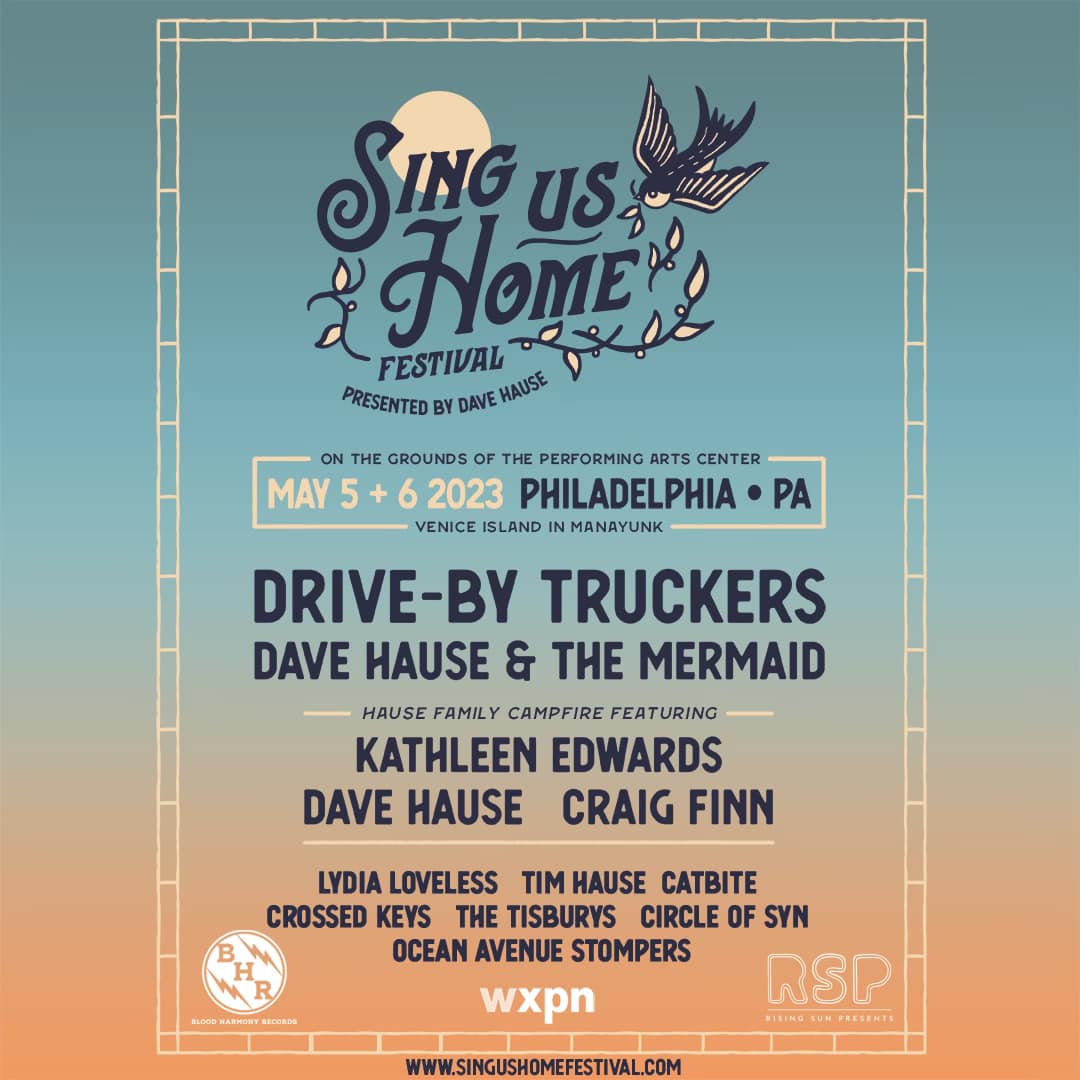
Taking its name from a song on Dave’s first solo record, 2011’s Resolutions, the first annual installment of the Sing Us Home Festival was held last month and marked a number of different milestones for the Hause brothers. After a successful Mermaid show at their hometown’s Union Transfer in April 2022, the brothers thought it would be a good idea to go bigger, in this case, to throw a two-day outdoor festival in their ancestral homeland, Philadelphia (Tim and his wife still live there, Dave moved to California a decade ago). But not in Center City or in the South Philly wasteland sporting complex area. Rather, they decided to have it in their old Lower Northwest neighborhood of Manayunk, a less-traveled, almost small town part of the big city on the banks of the Schuylkill River.
What could have been an admittedly hair-brained idea was taken seriously from the outset by the brothers’ manager, Alex Fang. “He was really excited about the idea and really saw the potential in it,” Hause explains, adding, “what that really means is you’re having meetings with the Manayunk Development Corporation and you’re meeting with the city and you’re filling out permits…the very unsexy stuff.” Unsexy, sure, but no doubt necessary if you’re trying to build an event from scratch in an area that isn’t used to having such events. “We wanted to put our stamp on the city, and we wanted to do it in our old neighborhood,” states Hause. “It takes over a year to make it happen, and if it rains, you’re fucked. If L & I (Department of Licensure and Inspections) shuts you down, you’re doomed. There’s just so much risk involved.”
The risk paid off. By all accounts, the two-day festival which, in addition to Dave and Tim solo and with the Mermaid, featured appearances from Lydia Loveless, The Hold Steady’s Craig Finn, Kathleen Edwards, Catbite, Drive-By Truckers, and more. “We had a successful one…I didn’t move in with my dad afterwards!” he jokes. “Everyone from 3 years old to 83 years old had a great time. People just had a blast, and that’s such a joyful thing to know that we had a hand in. If it never happens again – which it will, we’re going to do it again (hold the dates of May 3-5 open on your 2024 calendars, comrades) – but if that was it, I feel like those are two days that I’ll remember for the rest of my life as being just spectacular.”
You can head below to read our most sprawling Q&A with Dave Hause to date. Lots of info about the new album and about Tim’s record and about the newest additions to The Mermaid and about Sing Us Home and about therapy and sobriety and his always-evolving roles as a husband and a parent. Do yourself a favor and pick up Drive It Like It’s Stolenhere or at least hit the ol’ play button on the Spotify thingy below while you read!
The following has been edited and condensed and reformatted from two separate conversations for content and clarity’s sake.
Yes, really.
Dying Scene (Jay Stone): I was looking at my list recently, and it’s ten years now that we’ve been doing this.
Dave Hause: Terrific, man! That’s awesome.
Drive It Like It’s Stolen is album number six. First off, congratulations. Second off, I totally ripped this off, but do you listen to Craig Finn’s podcast (That’s How I Remember It)?
I have heard it. I haven’t made it to every one, but I have listened to some of them.
I certainly haven’t listened to all of them either, but I’ve listened to a bunch, and he just did a live episode to finish the second season…
Yeah, the one with The Hold Steady. I did hear that one.
Yeah! Their new record, The Price Of Progress, is their ninth record, so he asked everyone in the band what their favorite ninth record of all time was – and he had a list. So I thought, out of curiosity, I wonder what exists in that realm for sixth records…
Oh, good question!
So there are certainly a bunch that were way outside my wheelhouse so I didn’t write them down, but these are a combination of some big ones and then some of both of our overlapping musical tastes. R.E.M. – Green, which the hipsters say is like their last “good album.” White Stripes – Icky Thump. The Doors – L.A. Woman. The Cure’s The Head On The Door, and The Beatles Rubber Soul, which to me is an interesting one. Pearl Jam’s Binaural, The Hold Steady’s Teeth Dreams, and the Bouncing Souls’ Anchors Aweigh. So that’s where Drive It Like It’s Stolen falls in terms of career arc. Are any of those things that you listen to regularly now?
I’m familiar with all of those records, but the only theme that is scary that has emerged as you named them all is they are all precipice records. Certainly Rubber Soul gave way to a lot of really cool music. I love that period. I think everybody kind of loves that Rubber Soul and Revolver period. Icky Thump, I love that record. But I do think that for all of those records, you have most of those at maybe their artistic high points? After that, there is obviously tons of greatness that came from every one of them. But you also named all bands, right?
That’s true, you’re right. No solo artists. And I think that’s because I accidentally skipped David Bowie’s Aladdin Sane. That was his sixth record and it was when he had killed off…
Ziggy Stardust!
Yes! And so also obviously a transition record for him.
So maybe that’s the best theme from the ones you named is that they’re all transition records. Bands were sort of wrapping up a phase and moving into a new phase. But then, I’m not a band. And the way (Tim and I) create is peculiar. One thing for me is that I’ve embraced the peculiarities in my career. If you look at it more from the objective point of record-making, I made kind of five records – the Paint It Black record, two Loved Ones records and Resolutions and Devour – all in a ten-year period. And then I took a break. It was a three-and-a-half-year break. I moved to California and all that stuff, so there was a weird space in there. And then my record-making career resumed in 2017 and it hasn’t really stopped. It’s been between eighteen and twenty-four months ever since, and sometimes even less than that. There’s also a cover record in there. So I don’t know, those parallels to draw between other artists are fun, but I remember sitting down and doing this with Bury Me In Philly, and that’s part of what took me so long to finish it. I was looking at what other artists did with their third records. Those were big records for my heroes. That’s Damn The Torpedoes and Born To Run and all that kind of jazz. (But in some ways) that wasn’t my third record, it was my fifth because I had done the two Loved Ones records. So it’s all confusing. But I would say for those, the one thing that could be true is that this could be transitional. I think just in terms of bringing creative songs to bear, going from the germ of the idea, sussing it out, recording it, and then bringing it to people, I want to try significantly new things, and I think you can hear that on this record.
Oh definitely!
There is a lot of new ground being covered, and there is a certain ferocity with which I’m trying to do that. I think going forward, I’m going to lean further into that. I’m not really looking to repeat myself. I never really have, but I do think I’m just less and less concerned with like, okay, “do we have an up-tempo song? Do we have a quiet song?” Those little checklists that you sometimes find yourself making as you near the studio, I’m not making as many. I just don’t care as much. I’m more interested in what we’re going to etch onto the door, to mark where we are at that year. Because I plan to make a bunch more records. A lot of what’s going now is that I’ve made a bunch of records, depending on who you ask it’s six or eight or ten…and at that point, I kind of at least know how to get them done. I don’t necessarily know what I’m doing (*both laugh*), but I know how to get a record completed and then into people’s hands. Knowing that much is exciting and looking back and going “oh wow, we’ve done this much work!” – that emboldens me to do more work. If that’s any kind of suitable answer! (*both laugh*)
Dave and Tim from Faces in Malden, MA – 4/2023
Oh it definitely is, and I think it invites a bunch more questions! I think Tim tipped me off to you leaning into that new direction in the studio. I’m trying to remember the timeline, but it was either when he and I talked for his record or when he was here on that run with Will Hoge. He was like “Dave really went for it and embraced some weirdness in the studio this time.” He was super proud of you sort of trusting that instinct to go for it and to not worry about things so much. “Weird” is obviously oversimplifying things quite a bit, but did that come from the writing process in your home lab making music, or did that come from being in the studio and figuring out how to translate the songs as they started out into what ended up being on the record?
It’s interesting that you bring up Tim, because I think when he made his record, we hit another crossroads in our writing life, where he wanted to make a record of his own, and he went and did it without me to sort of avoid the shadow that I would cast on it. And then as he sort of rolled it out…
Not to interrupt, but was that a mutual idea or was that a Tim idea, and if it was a Tim idea, how did that land when he brought it up?
It was certainly his idea. I would never give myself the night off (*both laugh*). I would never opt to not be in the studio, but I did think it was wise. I thought it was an interesting choice. I mean, I wanted to go, but I also respected the decision and I thought “This will be interesting.” I think he was really just trying to distinguish himself, as you do when you make a record of your own. Once he did that and made all of the creative decisions that needed to be made from then on in, whether it was mixing or what it looks like, or deciding how it is going to come out, etc. etc., he did that with a ferocity that didn’t so much have me in mind, which I really liked. I found it a little bit peculiar because I felt like I had made a lot of room for Tim on Blood Harmony and Kick – not as much on Bury Me In Philly, but that was sort of his initial brush with record-making. Especially on Kick, it was really almost a duo presentation. We’re both in the pictures in the liner notes…
And the album just says “Hause” on the cover
Right! That was another thing we were toying with was a potential rebrand. Because he brought “The Ditch” to that record and that was a major song for it. And so, I was trying to make as much room for him as I could, and really at some points considering rebranding as a duo. And we did an interview with Benny (Horowitz) from Gaslight (Anthem) and he was sort of off-handedly suggesting “Why don’t you guys rebrand as a duo and only come out with the best ten songs that you guys write every time you want to make a record, and then you’ll have the strongest material?” I feel like that’s kind of what we were toying with in the first place, so to have him suggest it was a bit of a mirror. But, as he said it out loud, I thought “That’s a commercial decision.” That, again, is sort of not embracing what we actually have, and what we actually have is this strange, developing story. If people take a second and want to learn about it, it’s really cool and it’s enriching. It’s certainly enriched both of our lives. And we both like to write lots of songs, so why would we do less of that? I love Elvis Costello and Bob Dylan and people who make a lot of work. I don’t always follow all of it, but I like that they’re doing it. I like the act of creation, and I think for me, when (Tim) went and did (made his record), I thought “Well, that gives me license to do the same thing.” I don’t need to make ASMUCH room for him if we’re carving out a niche here for him on the record label and in terms of our presentation; there’s the Tim record, and there will be another Tim record.
So that was really an accidental giving tree. It was like, “Well, I’m not going to ask the question as much as I did before.” Like, when you’re singing a vocal and the producer says “Well, what is it that you want to say there? Are you sure about that?” I would often defer to Tim and ask what he thinks, or Tim would jump in with a syntax issue or an “I don’t really like that guitar tone.” It wasn’t always critical, but when it came to critical decisions, I would defer a lot. In this instance, I was like, “Well, you’ve got your record. (*both laugh*) I know what I’m doing and what I like to hear at least with my own songs, so I’m going to just make the call.” So I think in certain instances, like at the end of “lashingout” everyone kind of looked at me like I was crazy. When that saloon idea came about and that weird banjo, everyone was like “What the fuck is he doing?” And then it worked. It clicked, and everyone was like “Oh this is so dark and so demented, and it adds a gravity to the song that wasn’t there before.” So it was cool to take sort of full lead control again and then see it blossom into something new. Some of that is just recklessness from boredom (*both laugh*). I’ve made records where there was a simple, quiet song with finger-picked guitar. Lots of those. And it just wasn’t the reading that I wanted on that song, you know?
That’s a really interesting song, and we can talk about that more later. But man, that’s a really interesting song.
Thanks man! I think it wasn’t before it got that treatment and before it got that coda at the end, and I also was pretty reckless in terms of not being precious. Once you get six albums in, you’ve seen songs live and die, you’ve seen songs come back, you’ve seen songs that surprised you and that had lives of their own, that you didn’t think were going to be anything that would poke their head up. So I kind of was ready to delete certain songs or to rearrange the order, or just lean a little bit more into whatever the best artistic decision was. I was just looking for that, I wasn’t really looking for “what song is going to have the best commercial impact” or anything. I felt like a guy in a painting studio just painting whatever he wanted.
Was that from the actual songwriting process before you went into the studio with Will, or was that like once you got in there and started playing around? Because you were only in the studio recording for what, a week or so? So I feel like a lot of that must have been hammered out ahead of time.
There was a lot, yeah. And there were a lot of songs. There are more songs that we didn’t even get into.
That’s always the case with you though, isn’t it? (*laughs*) I feel like every time we talk about a record you’re like “There’s this whole other EP that might never see the light of day…”
It is, yeah! There was also this interesting thing that happened when I was showing Will the material. There were a couple of songs I hadn’t finished that I thought were really good starts, and I played I think two or three of them for him and I said “Well, I could finish these and they would maybe bump off these other ones I’m not sure about,” and he said, “well, you could, but those songs sound like whatever you’re going to do next.” Like, well, I could work hard over the next night or two and finish them up and he very wisely said that they have sort of a different disposition to them. Thematically, he thought “chainsaweyes” I had to do, and he thought “lashingout” was really good and I should put that on, and that the other ones were maybe really promising, but they weren’t done and that they were part of a different batch. When we had those ten or eleven that we initially recorded that each shared a theme and a vibe, then he thought I should run all the way down that road. Once I had that, I knew what the parameters were and we could just let each song have its own identity from a recording perspective.
There’s that thing in “lashingout” – yes, there’s sort of that saloon sound at the end, which is probably the biggest thing that catches peoples’ ears, but as much as I like to pretend I’m an audiophile sometimes, I usually tend to listen to music on my laptop while I’m at work. With the job I have now, I’m not in the car all the time, so I usually just throw it on when I’m at work. But I had headphones on the other day, and I hadn’t caught it probably the first hundred times I heard the song, but there’s that double-tracked vocal in the chorus, and one of them is almost whispered, and that changed the entire song when I finally heard it. It was really jarring A) because I felt dumb for not picking up on it the first hundred times, but B) it really changes the meaning and the tone of the song. That’s an evil sort of thing. The lead vocal is not sweet…that’s the wrong word…but it’s almost considerate. It’s almost like a therapist and you’re trying to talk to a child who might feel like lashing out…but then there’s this whisper voice inside your headphones going “do you feel like lashing out?” like it’s trying to talk you into it. That changed the entirety of the song for me.
That’s essentially the duality of how I view that statement. There’s a bit of a fear that those of us who are raising kids, are you going to raise the next school shooter? That’s a person that obviously at some point has something go really haywire, and I do think the adult urge at 40 to feel like lashing out is not where we want to be. When I’m around my European friends and I’m having dinner with them on tour, they don’t feel like lashing out. I think part of that is the way that their society is structured, and the values that have been cultivated. Whereas here in America, everyone has had their moments where they want to lash out. It’s a really frustrating place to live. That was a tweet of Laura Jane Grace’s, “I feel like lashing out.” And I texted her to see if I could write a song about that, because it was really the duality of it that I was tapped into. I wasn’t looking at it like “This would be a great chorus for a punk rock song.” I mean, partially, yeah, I feel that with her. I feel like lashing out. But I was also concerned about, like, why? Like, please don’t! I hope you don’t lash out and hurt someone or hurt someone else. As I age, there is that thing like “Well, we don’t want to be lashing out. Lashing out is how we got here, you know?” That’s what I’m working on in therapy, so yes I get that a person would be feeling that way, but also, hey, we need to work on that! We need to examine that! (*both laugh*) I think all of that is built into the song, because the song also didn’t have the coda. Once it had the coda on it, then I had a finished product, because I had “I want to be God for a day.” That’s further into the feeling of “I want to lash out.” It’s much more into that mentality, not only do I feel like lashing out, but I want to be God for a day. I want to reign down judgment and make things the way I want them to be.
I think I’ve even heard you talk about it – I think you mentioned it when you were up here in Malden last month, about the sort of duality that exists in that song, but that was the first time I physically heard and felt it because of the way the two vocals are layered on top of each other.
I’m surprised you didn’t hear it because I kept fighting to have it louder! (*both laugh*) I was like “Turn the whisper up so loud that it becomes a prominent thing!”
Well and now it becomes a thing where every time I hear it I’m like “Oh my God, of course, it was right there the whole time.” Anyway, so you went back to Nashville and worked with Will again, but you worked with a whole different lineup this time. Was that by choice or by circumstance? You’ve got some cool people on this record too. That Jack Lawrence has been on some amazing records.
Yeah, he has! It was by choice. We had more of a batch of songs based in American roots music on the last record, and we wanted to make an old-fashioned record where everyone plays together in a nice-sounding studio. It was incumbent upon him to put together that kind of a cast; a cast that would be able to knock it out. With this (record), I was less concerned with that because I was trying to make more of a layered statement. It wasn’t just “go in and cut in a really nice studio with the best players you can find.” It was, like, get what’s best for these songs by any means necessary. We compiled a lot of that on our own and then added people. It was also just me being more comfortable with how Nashville works and knowing that “I’m not worried about getting a trombone player, we’ll find one.” You can’t swing a cat without hitting some incredible musicians. So there’s a confidence in knowing that you can just make this be whatever it needs to be and you can find whoever the players that you need to do that based on the way that the songs are coming.
Whereas, I think for Blood Harmony, that was an exciting and fun way to do that record, based on how those songs felt. They felt more lush and family oriented so it made sense to cut them that way. For this, it was more that we left some stuff unfinished (going into the studio) and said well, we need some strings here, or we need 40 seconds of a band here, let’s find those people. We played the “live band” – in quotes – as almost another fader on the board. Some of that was by virtue of having built loops of my own and mapping things out, and then either rebuilding those loops in the studio or using some of those same loops in the songs you hear. It was just a different process, which, now that I’ve had this new chapter of Nashville recording – we’ve made three studio records and then we cut a bunch more songs there that may or may not see the light of day – but having worked that much there, you just get a feel for it and so it’ll be interesting to go forward from here just knowing more about how that process works. It’s good to have all these experiences and to allow them to kind of build on each other.
You mentioned the sort of “live band” in quotes…sometimes on Blood Harmony, there were a lot of songs that could definitely be played either just you or you and Tim together, but there are some songs on this record that really sound like they were meant for the full band. The first two songs, “Cheap Seats” and “Pedal Down,” are not four-on-the-floor rock and roll songs, but they sound like they’re really built for a band. Does that become a thing you take into account when you are writing – what version of the Dave and Tim touring experience is going to be able to do the most justice to these songs?
No, I just try to make whatever is most compelling and then worry about that stuff later. Hopefully, if we made a sturdy enough song, there’s a way to play it on an acoustic guitar or a piano that will translate. Sometimes we even beat those full-band rock versions. So, no I don’t really think about that. I may end up accidentally getting more credit than I deserve for that, like “Oh Dave just does whatever the fuck he wants” and that sort of thing. It’s like, “No, I just don’t have any hits.” (*both laugh*) If I had a couple hits, they would haunt me…
Because then you’d be trying to recreate them every time you make new music?
I would think that you’d naturally be tempted to, you know? I know friends of mine who are tempted. That’s not that appealing to me. I mean, the financial stability that would come along with having a couple of hits would be great. But what that does to an artistic career can be troublesome if you don’t handle it right. My mother-in-law paints. She just paints and paints and paints and paints. Some paintings sell and some sit on the shelf, and there’s not one that was clearly her best and that was selected by the Smithsonian or something and she has to beat that. It’s more like “Hey, I have a long life of painting.” That’s more of the artistic life that I’ve been given, so I think worrying about how to bring those songs to people is just not something I really worry about. Also, I think there are just too many songs now. So, like, if we’re pulling into a town to play, if we can’t play “Cheap Seats” that night because we don’t have a version ready or we don’t feel compelled by the version we have or we don’t have drums or a sampler or whatever would make the song work the way we did it, we’ll just play a different song. (*laughs*) So no, it’s not as much of a concern.
Does having a wife and kids change that math a little bit? I mean, do you feel like you could go full Tom Waits’ Mule Variations when you have a wife and twins to think about?
I think that’s the kind of thing that compels me! That’s the kind of inspiration that I’m drawing from as I move forward! That’s the bargain that you’re trying to strike up with the world. If there’s a record like that, a Mule Variations, and it doesn’t do what it did for him, where it got him a Grammy, and people don’t like it, I still feel like I’m going to be okay. I don’t think I’d be putting my kids or my wife at risk. Ultimately, I think that the conversation that I’m having with the audience would allow for that. Because I’m not playing that game, you know? I’m not doing that “am I on the radio” thing. I mean, we do that – we do push songs to radio, but it’s not what we live and die by. We own the record label, so people who take a shot on what we’re doing, we get the biggest economic impact from that, and then we tour in a way that is sustainable and smart for the places that we’re at. Like, on the East Coast we can have a band, in Europe we can have a band, on the West Coast we can have a band, lots of other places we can just go Tim and I, or maybe Tim and me and Mark (Masefield) or something. So I’m looking to push into those realms of pure creative inspiration, more than I am about worrying about my wife and kids, because I don’t think those things cancel each other out.
So I guess the other side of that then is that if it doesn’t put your wife and kids at risk financially, maybe it puts dad at risk to not be doing the things he thinks are fulfilling creatively. Not to bridge into the therapy part of the conversation, but if dad is doing the things that he wants to be doing artistically, then maybe he’s less at risk of swan-diving off the Golden Gate Bridge, right? (*laughs*)
Yeah, I think so! I think it’s important to try to balance all of that. I mean, I don’t want to make reckless artistic decisions for the sake of recklessness, but I do want to be fearless in the way I go forward. That’s the needle I’m trying to thread. I don’t want to do things in a self-destructive way, like “I’m going to make this super weird record to see if I can fool people!” It wouldn’t be that. It would be more “Hey, this is what I’m hearing in my head and I want to bring it to bear and surprise myself and surprise the people around me and give people what they didn’t know they needed.”
So, I haven’t commented too much on the record yet because I wanted to wait until we talked, but even from the first listen on crappy laptop speakers, I thought that this was my favorite Dave Hause record since Devour, and you know the regard that I hold for that album. And I will tell you, that I’ve had a few conversations with friends who are also longtime fans of yours and they’ve sort of said that “it’s like a grown-up Devour.” And those weren’t people who know each other, necessarily. But I thought that was interesting. I think thematically the albums are worlds apart, except that there is a sort of processing thing that you’re doing on this record that you were also sort of doing with all that went into Devour. The stakes have changed now because you’ve got a wife and kids obviously, but some of that challenge and struggle is still there. Even though in the press for this album it talks about the sort of post-apocalyptic vibe to the album – and I understand that part of it – but it also seems like it’s really honest and personal.
If you look at it now, there’s six (solo records). You can see that “well, Dave’s feeling pretty good on Resolutions” but then there’s Devour. (*both laugh*) And then “Oh, Dave moved to California for Bury Me In Philly and things are good!” and then “Oh, here comes Kick…” That title is about the struggle of just trying to keep your head above water. The same thing happened with Blood Harmony and this one. They aren’t intended that way, I think there’s just a cycle of how I’m processing the world and sometimes I’m up and sometimes I’m not, and on this one, I was not up! I was starting to feel kind of terrified about the world around me and what I was bringing my kids into, you know? The first couple years, I was just at home quiet with them, because we were all shut down. But in this eagerness to get back and keep the pedal down, all of a sudden we’re faced with a lot of those problems that have worsened since 2020. It’s definitely processing the world around. That’s the weird thing: I want joy in my music, I want celebration, I want those up moments to be represented, but that’s not what’s constantly on my mind as a person, so it’s a fight! It’s a fight to determine where you’re at, how stable you are, how steady you are, and that’s what comes out in the writing every now and again. In this instance, it’s really in there.
“Pedal Down” specifically – first off, I love that song. I love the sonic build to that song. I think there’s something about that you can want joy and harmony and all those things and I think we should probably be striving for those things, but that last third of “Pedal Down” where’s the big full-band chorus…there’s something unifying about that. Even though the situation that’s laid out in the build-up to that is sort of bleak, I think there’s a collective thing that “it sucks for all of us right now, but we’re all doing it together.”
Yeah, I think there’s an ambivalence to that. The “we can grieve it later, keep the pedal down” line isn’t just a negative thing, you know? It might seem that way and a lot of times I think that’s a terrible way to move forward. But there’s also a sort of “no way out but through” a lot of times, and maybe there is celebration in that. Like, we’ll grieve it later, keep the pedal down for now, let’s go. Let’s fucking go!
Exactly, it’s like keep your warpaint on, keep the pedal down, we’ll sort of get granular in looking back on it afterward but for now let’s keep fighting.
Right, yeah! That’s interesting. I think that definitely went into the subconscious of making a big mosh part at the end with trombones, you know? (*both laugh*) There’s something really big at the end and you have to at least have something in mind. I think in the previous song, “Cheap Seats,” there’s this nod to “American Girl,” when we’re off to the races with the rock band. There’s a celebration there too – “Take one last bite of this old rotten apple and ride off to the country with me.” That’s a little bit more deliberate of what you described, like “Alright, let’s start up the van and let’s get the fuck out of here!” I think that weaves its way in and out of the record and I guess a lot of my records if I’m forced to think about it. (*laugh*)
How often do you think about that, and is that a thing…I’m trying to figure out the best way to phrase it…but you’ve talked pretty openly in the past about being in therapy and whatnot; how often do you think your songwriting works its way into therapy, whether it’s because you are talking to your therapist or therapists about what you’re working on or what themes you seem to be coming back or a rut that you might be in that producing a certain kind of material.
I would say it’s the other way around. Realizations and conversations from therapy make their way into songs, because I kind of view therapy as a mirror, you know? If you were going to try to do your own facial, you would try to get the best mirror that you can in order to do that. I think that’s the goal of therapy; find the best mirror that you can find in order to then do the work yourself. You have to do the work yourself…
How many mirrors have you had to go through before you realized it was working? Did you find the right therapist or the right sort of style the first time you tried it?
Yes and no. I’ve got a good guy, but also, my expectations for that guy were different when I walked in versus where they are now. I had these lofty expectations for him that were totally unfair, and I was looking more for an advisor or someone to tell me what to do. That’s not what therapy really is. So I had to learn that it’s what you put into it that you might get out of it. It’s peculiar. And part of that is being married to a therapist. If one of her clients had the attitude that I did going into it, I certainly wouldn’t think that was a fair expectation to have of my wife. Part of that helped. Like “We’ve got an hour here and I’ve got a full day booked, I’m not going to solve all of your problems, and it’s really not my job to solve all your problems. It’s my job to help you see them and guide you.” So I think the work you do both inside therapy and outside it that ends up hopefully informing the songs.
How old were you when you started going to therapy and, I suppose in hindsight, how old do you wish you were when you started going? Like, now that you know what you know, do you wish you had started earlier?
Maybe? I would say that the main regret with sobriety would be that I didn’t go (to therapy) right away. But I try not to look at things that way because you kinda only know what you know when you know it. I’ve had a good life, so it’s not like I can cite this spot where “Man, if I had only gone to therapy then, things would have turned out differently.” Maybe you could do that but I’m not so sure I’d want it any differently. But how old was I…it was years ago, but it wasn’t right when I got sober, and I wish I would have done that. I think when those wounds are really exposed and those nerves are raw, that’s a good time to start working on them and I should have started working on them then. I think it took me two or three more years to go into proper therapy. I got sober in 2015.
Right, that was that big tour with Rocky Votolato and Chris Farren.I feel like maybe we’ve had this conversation even back then, but did you view it as “getting sober” in quotes back then, or was it more of “let me see if I can do this without imbibing”?
Yeah, the goal was to try to do a tour without boozing and drugging. That was my initial goal. And that was a long tour. That was an eight-week run, so there was something about the length of it that even subconsciously I was like “I wonder if I can do this…” Then, like with a lot of things in my life, I sort of fell backwards into things, you know? Like “Let me try being sober for eight weeks and then if it’s working for me, I’ll keep going.” “Let me roadie for a popular band and if I like that lifestyle, I’ll continue.” (*both laugh*) The thing with sobriety is that the one thing I wonder about is that had I gone in sooner, would I be as black and white about it? Would I be “sober guy” where I don’t drink at all or do drugs at all, or would I have a more balanced take on it, which I think in my objective brain, I do. I can sort of see the benefit of psilocybin or THC or having a ballgame beer. I can make those distinctions intellectually and the reason I don’t go back to it is, like, the juice ain’t worth the squeeze. I’ve got four-year-olds, I’ve got a wife, I’ve got a career, I don’t want to fuck things up.
But I do think that in terms of being a more balanced human, it would be great to have some of that in my life. Like, I don’t bang the drum for sobriety as much as some people do. Once you’ve been sober for a while, people come to you and say “Can we talk about this?” I usually say “Don’t do it unless you feel like you have to.” Like, if you can have balance and drink a glass of wine with your significant other at a wedding or whatever, do that. Don’t cut it out completely if you can help it, which is often a weird thing to say. I think if you’re in the program, that’s kind of forbidden. So ultimately, that would be my only therapeutic wish, is that I would have gotten to the sobriety stuff sooner when it was more acutely presenting itself.
There are people who talk about artists who either got sober or got “sane” or started therapy and taking medications and all that, and that their songwriting changed. Do you subscribe to that idea, that your songwriting changes or is better or worse when you’re on meds and in therapy versus not, or sober versus not?
No, I don’t buy that, because I think it’s a discipline. I think you can find plenty of other instances in other types of writing…for example, for you to write a novel, it takes work. It takes sitting down and working at it. Over the course of how long it would take you to write a novel, you do have good days and bad days, mentally. You’d have days where you were hungover and days where you weren’t. You’d have days where you had a hold on your anxiety and days where you didn’t. And all of that would seep its way into your work. I just think that that’s part of writing. That’s the beauty of it. And I want it to change! Maybe that’s because there’s no big hit, where it’s like “Oh, I’ve got to get back to that mountaintop!” I’m still climbing the mountain. I’m not in that position where a lot of my peers are in the position where you know what they’re going to play last at a show. For whatever reason, maybe because it’s a smaller career, but I do think that the audience and I have been good to each other. I think everybody is kind of okay with going on the journey. There are certainly going to be nights where we end on a weird song or we don’t play some of the favorites. In that sense, I want the writing to change. I want to see what’s next and to see what Tim and I are capable of. I’m not looking for a former high or a former mountaintop that I’m trying to get back on.
That’s an interesting way to look at it, really. If you haven’t been on the mountaintop, you end up – not to make an addiction reference, but if you get that first high, you end up chasing it forever. If you don’t feel like you’ve reached the mountaintop, then you’re not chasing “it,” you’re just chasing what feels right at the time.
Yeah, and I’ve got to say, my hat goes off to a band like The Killers. They haven’t reached the heights of their first record, and I think of (Brandon Flowers) as someone who is still writing amazing, really compelling work. I think that’s rare. I think sometimes people fold up the tent if they can’t get back to a certain height again. That doesn’t appeal to me. I really like the act of creating. It’s where I’m most engaged and where I feel the best. That’s the feeling I’m chasing. I mean, it’s great when you put something out and people respond to it. That’s terrific. But it’s the act of bringing it into the world that’s so spectacular. That feeling of “Oh man, I really want to get this to people! I really want to get this recorded!” That’s the high, if there is one, that I’m chasing. You can get that every time you write a song.
Is it a different high when it’s a different type of song? Meaning that if you write a song like “Hazard Lights,” which has – maybe not a ‘classic Dave Hause sound’ because I don’t necessarily know what that means, but it sounds like thing that you do really well. That feel and that tempo and that style of song. It also might be the kind of song that the bulk of the listeners gravitate towards. So when you write a song like that, is it a different sort of high than when you write a song like “Cheap Seats” or “lashingout,” where at the end it’s like “Wow, this is really cool and really different and I can’t wait for people to hear it”?
That’s a great question. I don’t know! Maybe? Maybe it’s a little different? To answer your question honestly, it’s not lost on me that a song like “Damn Personal” or “Hazard Lights” sound like they would fit nicely in a Mermaid set. A Friday night Mermaid set in London or Boston, you know? I know that, but they weren’t intended that way. No, I guess to answer your question, getting that all done and having it all rhyme and feel good, THAT’s the feeling. Not that “Oh, I know we got one that the tried and true fans are going to love.” I wonder if the tried and true fans are going to love “Pedal Down” more BECAUSE it’s something different. But maybe this far in, I’m less concerned with all that stuff? Like, no matter what’s on there, I’m going to be anxious about bringing it into the market and I’m going to be excited. And so, the purest part of it is long before any of that. It’s when it’s Tim and I, and I’m like “This is done, let me play it for you,” or where we could play it for the band, or I can show it to another songwriter and have them go “Oh cool!” That is the purest part of the whole endeavor to me and the part of it that I’m most seeking, which is part of what’s funny talking to you now, because I have so little of that in my life now! (*both laugh*) Like, we finished this one and it just came out and we’re touring on it, and I don’t have a ton of song irons in the fire right now. I mean, I could. I guess I could look at the whiteboard full of ideas that I could pick at…
Yeah, that actually sounds sort of surprising given what I know of how you work. Every time I feel like I talk to you or Tim, it seems like there’s always this other thing cooking. I think when we talked for your last record, Tim was going in to record his, and then when I talked to Tim he mentioned “Dave’s got his next record all done!” so it seems sort of surprising that there aren’t that many irons in the fire.
Yeah, I mean I’m looking at maybe 10…well no, I guess it’s 15 unfinished songs. Some of those are the ones I was describing before. But we’ve just been in a different mode with the festival and getting the record out and touring. I’ve been so busy with all of that that I just haven’t had the clarity. Then when I get home from those endeavors, I try to spend as much time with the kids as possible. That’s its own potentially full-time job. (*both laugh*)
Or two of them. (*both laugh*)
Luke Preston at the Dave Hause and the Mermaid Show at Faces in Malden, MA – 4/2023
So “Hazard Lights” is another song I wanted to talk about, specifically, because you wrote that with Luke (Preston), the idea of co-writing with somebody who doesn’t share your last name. Walking through that process and how it was sort of stepping out of the comfort zone you’ve got working either by yourself or just you and Tim, and is that a different sort of vulnerability? Does it feel different presenting a song or an idea to someone else versus your normal comfort zone with Tim?
It predates that, is the preamble answer. In the whole pandemic thing, I think a lot of songwriters were willing to do other stuff because we were so worried about never playing again. So, I wrote a song with Fallon, I wrote two songs with Brian Koppleman, Dan Andriano and I were working on material. Somewhere in there, the song “Surfboard” had been started. Heather Morgan, who’s an amazing songwriter, a really successful songwriter in Nashville though I think she lives in Austin now. She’s written big country hits. She and I worked on “Surfboard,” and Tim and I had written with her in Nashville. We had a song called “Sunshine Blues” that we sat down and wrote with her when we were in Nashville in like 2018 or 2019. I was really nervous, because I only knew our process. I didn’t know shit about Nashville, I didn’t know shit about the songwriting world and that whole country music bubble. She was amazing, because we sat down, and she just did it very similarly to the way we did. And by that, I mean in her own incredible, indelible way. And she turned to Tim and I and was like “Why are you writing with me, you guys know what you’re doing?” (*both laugh*) She was like “You don’t need me, you guys are firing.” Some comment like that. And we were like “No! So much of this comes from what’s happening right here in the room, and your ideas are awesome!” We ended up with this song, and I don’t even know what happened to it, it’s on a hard drive somewhere.
But then in the pandemic, I called her and said “Heather, I loved writing with you, do you want to write some more?” I had “Surfboard” pretty far along. She ended up sort of like a backboard on that song. I wouldn’t have gotten as many of the points as I got on that song so to speak without having her being the person to help me get the ball in the hoop. (When we were writing), I was like “Is ‘dear Lord, I need a surfboard’ any good?” And she said “Yeah, it’s fucking awesome!” I said “Yeah, but it sounds like a joke” and she said “Yeah, but that’s funny. That’s good.” She really helped love it to life. She had a couple more or less pointers. So that had happened and it was heartening. She was encouraging on the first session, and then on “Surfboard” she just helped me love the work that Tim and I had done on it to life. So, there was another person who had entered the (songwriting) fray. I mean, I had written with The Loved Ones guys, I had written with the Paint It Black guys, I had written songs with the Souls. I had done all kinds of collaboration, but not much of it in the early parts of the solo career.
So it wasn’t that foreign, but the vulnerability you tapped into, that part of the question is a really good one, because if it hadn’t been a vulnerable situation with Luke, I don’t think that we would have gotten “Hazard Lights.” And then, once we had “Hazard Lights,” I was more open to co-writing. He helped write on “lashingout” too. The vulnerability was key because he was pretty freshly sober, and he was familiar enough with us and what I do. Maybe he was a Loved Ones fan, I forget exactly. But he was like “Hey, so I’m newly sober,” and I just kind of delved into that. That’s a really vulnerable way to start a songwriting session, and then we were off to the races. But here’s the funny thing: I’m so into that vulnerability and that exchange, and that I think the problem that I have with the whole songwriting thing in Nashville is that I can’t just leave it at the write. Like, Luke’s in our band now! We wrote a couple songs with Heather and I’ll probably always be like “Should Heather open these shows?!” I really like a long conversation with people. That sort of hit-and-run songwriting style is tough because I’ll want more from that person, because you do get so vulnerable if you do it right.
It does seem like a weird process. I’ve talked to Will (Hoge) a little about that and Sammy Kay did some songwriting in LA for a while and I’ve picked his brain about that, but that whole process is so, so foreign. That you can write songs and just leave them, and sometimes they get picked up or sold to someone and sometimes they don’t but you just keep writing them, and they aren’t for you. It seems so foreign and I don’t want to waive the “punk rock” flag, but it seems so different than the way that punk rock works. I can get why, if you find someone that if you really drive with, you’d want to keep them around.
Yeah, exactly. That’s the thing: if you really assess The Mermaid, Luke is the main songwriter in the band. He doesn’t write on many of the songs for the band, but that’s his job. He writes dozens and dozens and dozens of songs. Tim and I write dozens, you know?
Right!
He writes more songs, and gets paid to do so. But I think one of the things that he helped delineate for me – you start to pick up on some of these terms when you spend enough time around those Nashville people – but he was like “You guys are on the artist path. You’re in artist careers. For me to bite that off at any point is going to be a massive undertaking, because it involves touring and an aesthetic, and a point of view that’s really specific.” Once he sort of put it that way, I was like “Oh right…” I only know what I know. I know there’s Bruce Springsteen and Taylor Swift and Beyonce and Rancid and Bad Religion – I have my limited scope of what music-making is. And he’s like “For artists, yeah, if you’ve chosen the artist path. But there are people who just play keyboards and there are people who just play drums and there are people who write songs.” And so, in some ways, it’s even more vulnerable to be a songwriter, because you never get the release of performing the song. You’re in these acutely vulnerable situations and then you’re done, so you’re kind of like an actor in a sense. Actors have to tap into this really big reservoir of emotion for a concentrated period of time, and then they move on. It has a little bit of that one-night-stand feel to it. To me, it’s like the artistic or aesthetic cousin to a one-night-stand, and I think in that realm, I’m like “Oh wow…this feels weird!” So yeah, I loved writing with Luke. I look forward to writing with him more. And for me, for lack of a better word, being on the “artist path” for this long, I’m always looking for whatever is next, and for whatever will inspire and help me sculpt and deliver my point of view. Right now, with me being in the best band that I’ve ever been in, I’m super into tapping all of those guys for their input and seeing where that steers the songs in the next batch of creativity.
This is really probably a question for Luke, but I would have to imagine that for him, to work on a song like “Hazard Lights” and then actually be in the band that gets to play it every night must be a little different than the sort of normal songwriter “thing,” and so maybe gives him a little more satisfaction getting to see it sung back at you every night. That’s gotta be a cool feeling.
Yeah, he has said as much! He’s pretty measured in how much he talks about all of that. A lot of it is just we’re having fun, and we’re talking shit “Did you hear this song? What about that production? Oh, that lyric is terrible! Holy shit, this is the greatest thing I’ve ever heard!” A lot of that is what we’re usually talking about. But in those moments of introspection or reflection, he’s definitely said what you just said. He’s also helped my perspective. He goes out and plays bass or guitar with country artists and does that circuit a bit. He writes songs, and he hustles most of the different aspects of the music industry to stay paid. And he was like, “Well, from where I’m standing as kind of a mercenary, you’re living the dream!” I was kind of startled, because there are bigger artists that he plays with. He’ll play bass for some country artist that plays to like 5,000 people on a weekend at some festival. And he filled in a lot of the blanks for me, because he was like “Look, it’s cool to play to that many people, but everybody on that stage including the artist knows it’s fleeting. They may not be able to do that the following summer. You pull into a town and there’s a given amount of people at every show. It’s not the biggest thing, but it’s certainly not the smallest, and then you have these hot zones where you can play for a couple nights in Boston, you can play a fairly big rock show in Boston, or you can go to Europe! None of these artists that I play with can go to Europe. You have a worldwide conversation with a small audience that keeps you afloat. That’s the dream. If I could do that, I wouldn’t to any of the other shit!” (*both laugh*) I assumed that this was something that helped him make his annual fee or whatever, but he was like “No, I love this. This is the dream. And I also get it – I’m the bass player in your band, you’ve built an artist’s career.” So his perspective is really interesting, as is Mark’s. Mark is a guy who, at different points, has struggled to get out on the road with the same act and have it click despite being uber-talented and super eager and professional. Also, he’s voiced some of the same thing, that this is the dream. Like, “You play in London and lots of people come! This is your living and you play me a proper wage to come play keyboards. This is fucking awesome!” So having those two guys there and having their professionalism and their passion and their perspective has been really helpful to me. And just their creativity. There are so many good ideas that come from those guys, which has been true of Kevin the whole time, but now we have two newer guys that bring that to the table.
Did Mark maybe not catch on with somebody else because he brings too many shirts when he goes on tour? That was a riot.
The only thing that Mark’s got going against him is that everything is too much! (*both laugh*) There are too many shirts, there are too many ideas, too many keyboard notes. You just have to remind him “No, no, no Mark…less! Less! Benmont Tench!” And then he’s like “Oh yeah, okay!”
Mark Masefield and Dave Hause probably talking about cricket lollipops
Yeah, he seems like he has a good sense of humour about that stuff, which you have to, because the road will eat you alive.
Yeah, he’s great. We always say he’s the zestiest member of the band. He’s the first one up and ready to go out and he’s the last one to bed. We try to ride that zest as much as we can. He’s the guy that’s like “We can rent these bikes and we can drive around and we can take an architecture tour in the middle of the Chicago River and we can still be back in time for load-in.” And sometimes you’re like “Are you fucking crazy? I”m going to sit here on my phone until load-in.” But then there are other times where you take him up on it and you’re like “Wow, I just had the most fun day on tour that I’ve had in years.” He’s such a great add in that regard.
One of the reasons that I think Drive It Like It’s Stolen is my favorite post-Devour record (of yours) is how pitch-perfect some of the sentiment on the album is. You know my thoughts on Devour, and that “Autism Vaccine Blues” is one of the very few songs that I can vividly remember the very first time I heard it because of the effect that it had, and then as years go on and life progresses, it actually became even more poignant to me. We’ve talked about the one-two punch at the beginning of this album with “Cheap Seats” and “Pedal Down,” but I think the one-two punch at the end – “Tarnish” into “The Vulture” is just about perfect. How they support each other thematically – “Tarnish” with that idea that you hope your kids never lose the glimmer they have in their eyes for their dad, and then “The Vulture” being that thing that happens when you start to see some of your own tendencies and idiosyncrasies passed down to your kids and how sobering that is…as the parent of a teenager (*both laugh*) I can attest to seeing your kid and think “oh, I know exactly why she’s doing this, because I did it or still do it.” I think really though, that idea of flipping the hourglass on its head and dancing on the sand takes what is a heavy song and still makes it hopeful. Sort of like the turn that comes in “Bearing Down,” on Kick, where there’s eventually some hope and optimism in it by the end.
Yeah, there’s a Father John Misty lyric from a few years back (“Pure Comedy”) where he basically lists the ails of mankind in a really articulate way. He gets into all of it; he gives you every reason to believe that we’re doomed and he intelligently and artfully does so. But at the end, there’s a simple and heart-breaking resolve that “but this is all we have.” It’s always helpful when somebody comes along and helps calcify what you were sort of getting at. That song did it. That sentiment that “Yeah, this is fucked up, but it’s all we have, so what are you gonna do?” I mean, “Bearing Down” gets into that from a much more fatalistic standpoint. But “The Vulture” is struggling, at that point, with having a three-year-old and the idea that none of this went away when I had kids, at least not entirely. But, on some level, I’m kind of out of options when it comes to hope. I HAVE to have hope. There are seeds of this in “Pray For Tucson,” with “They’re unaware of modern science/They may be wrong but I don’t care.” There’s a lot of that where you go “This thing is probably doomed…”
However, maybe that’s just the way everybody has thought about it forever. And maybe it is!? So then, if that’s true, what are you going to do with that? Are you going to walk out into the ocean and drown, or are you going to dance on the sand with the people that you do have? Because there is joy to be had. There is fun to be had. There is wonderment. There’s Sing Us Home, you know? Pure elation for me, and so many people who were there. It was like “Wow, we did a thing that’s bigger than us! We’re all here having a great time and it’s a beautiful day!” So if you tap out, whether that’s suicidal ideation or just the slow, suicidal thing of just throwing in the towel, then you miss out on so much joy. I was convinced “Oh, I’m not going to have kids…” but then I had them and my life is so much richer. It’s so much more complicated and so much more terrifying at points. Like, you’ve got a teenager, I’ve got four-year-old twins, you’re constantly worried about them. It’s just part of the equation, you know? That’s the whole thing of “The Vulture” and the line “I’ll stay worried / You’ll stay worried.” Like, that’s probably just the way it’s going to be. But there’s also the idea that “I’ll stay worried THAT you’ll stay worried…”
I was just going to say, that line is a huge double meaning.
Right! “I’ll stay worried THAT you’ll stay worried,” or “We’re both just going to stay worried.” (*Both laugh*) But at the end of it all, “row your leaky boat, life is just a dream.” Like, it’s over quick. Not in the sense of “Let’s live it up without any responsibility.” It’s not a bacchanal or whatever. But think about your family life and how much joy is in that. I think that’s what is swirling around “Tarnish” and “The Vulture.” Maybe looking at it like we’re all just doomed is silly; yeah there’s climate change and there’s all this worry and there’s war and there are all kinds of reasons to believe that things are going south or the ship is going down or whatever, but that’s A perspective. There’s different ways to frame it. I hope that my kids can frame it a little bit more like their mom does and less like I do.
I think part of what “The Vulture” does especially well is that it is mindful of how you maybe processed the world at one point and then if you start to see things in your children, who better to help them through than someone who has navigated those waters already.
Maybe so, yeah. Maybe so. And it’s funny…we talked about the ferocity of creativity once Tim made his record and how much more I was like “Look, this is how it’s gotta go” on this one. But there was a question with that one, and that was at the end, what are we going to repeat, “Life is but a dream” on the way out? Or what I kinda wanted which was to go back to the vulture being in the tree. “Row row row your leaky boat /The vulture is in the tree” and Tim was like “No…No…it’s ‘Life is but a dream’.” And so live, I volley back and forth because I do think that is kind of the difference between Tim and I…I’m likely to say “row the leaky boat, the vulture is in the tree…death is coming” and he’s more likely to say “row the leaky boat, life is but a dream.” They’re different existential principles. I’m glad we left it in, but I’m glad I sometimes get the opportunity to change it live.
I wonder if part of that is parenthood versus non-parenthood. I mean, obviously, Tim’s got nephews and nieces and whatever and so he’s not totally oblivious to the responsibilities and the weight of parenthood, but I wonder if some of that is having kids versus not having kids of your own.
I would tend to argue that his perspective is the more healthy one.
Oh it definitely might be. Absolutely.
You know, like, to bring the listener back at the end of the record to the idea that “the vulture is in the tree! They’re coming for you! They’re coming for your carcass!” is pretty dark. It’s pretty bleak. It’s a pretty bleak thing to say to your kids. To me, it’s kind of funny. But I do think it’s a little more hopeful to end on “life is but a dream.” It’s over so quick. Trying to hover above some of it and think of it like this ethereal thing is healthy sometime, as opposed to thinking “Oh, when is this going to end.” It’s a weird thing. But I like that song. I like playing it. It’s a weird one.
It is, and I love that. I think I’ve said this about most of the album at this point through our conversations, but I think that’s part of what I love about this record. Not that there haven’t been artistic high points since Devour, obviously, but I think it’s pitch-perfect for where we are right now, and you went for it.
I think I’m at a point now where I can hear that and not be worried. I mean, there’s been times when I’ve put out records, and even talking to you and knowing how much Devour meant to you and how large that record loomed, because we recorded it in a fancy studio with all these amazing players and it was such a big step up. I was able to start headlining shows around then, and so it does loom large. But there are different people over time who feel that way about the other records. And part of that lesson is to just keep making stuff, because there will be records that really resonate with Jay Stone in 2013 or 2023 and then, there might be another song on another record that does that for you, or half a record, but the point is that everyone’s going to be tapping in and tapping out at different points, as I have done with a lot of artists who have put out a lot of work, and that’s cool. That’s what makes for a richness in the setlist, and it’s what makes the conversation fun.
I try to look at it more that way, versus looking at it like “Oh shit, am I trying to beat my last work?” Alex (Fang, the Hause’s manager) is really helpful in that regard too, because he helps remind me that this is a job. Like, I’ll tell him I was talking to such-and-such and they’re writing songs and they aren’t sure if this batch of songs is as good as whatever their major record was, and he’s like “you know, no one in I.T. does that. No one in insurance sales does that. No one in therapy does that. They don’t go “Oh man, that session that I did with that person struggling with depression in 2014, I wonder if that was my peak.” No one thinks about shit like that in regular jobs, so he’s like “Why would you? You’re just responding to an ecosystem that has to do with critics and what is the best and all that. Who cares what the best is, because the best is all subjective anyway, so keep making stuff!”
Those songs that are a little weightier, do you ever get moments where your therapist wife or your therapist therapist hear something and say “Hey, you alright there, bud?”
“Bearing Down” was certainly something to discuss.
I could see that. Do you discuss that before a person you’d be discussing it with has heard it? Like, “Hey, so there’s going to be this song and it’s pretty heavy so we should probably talk about this?” Or do you wait til they hear it and respond?
In the case of “Bearing Down,” I played that for Natasha. I was struggling with that, because we were having mixing issues on that record. We were having a big struggle until it went to Andrew Alekel. He mixed it beautifully and got it where I needed it to be. But that meant that I had to listen to that song a lot; a lot more than I would ordinarily listen to it. So I was listening and listening and listening and I think it was just wearing me out. It was a snapshot of a place I’ve been, but it’s not a place that I’m in every day. It started to wear a groove in me and I said “Man, I should probably play this for Tasha and at least just make her aware.” Because she’s asked at certain points “Where are we at with suicidal ideations? How much of that is in your history?”
Well yeah, I mean there are multiple references to swan diving off the Golden Gate Bridge, so…
Yeah! So it was a tender moment to play that for her, and she was like “I feel for you. That sucks that that’s part of what you’re wrestling against.”
Did you play an album version of it for her or did you sit down with a guitar and play it for her?
I played the mix for her.
That probably makes sense.
I rarely do that acoustic guitar thing and play stuff for her that way. I don’t know why.
I feel like you can maybe be a little more objective about it when you’re listening to it on the stereo or on an iPhone versus if you’re actually physically playing it. Maybe that would make it a little too raw in that moment.
Yeah. This is also a weird thing that I don’t really think I’ve ever said in an interview, but I have a weird thing about sharing the work with Natasha in general. I think it might just stem from … I don’t know what it is. Because I also, in the same breath, believe the more vulnerable you are, the more successful your relationship will be. But I think at different points, I don’t know what exactly I’m looking for when I share a song with her. And I don’t think she knows what I’m looking for. So if I don’t know, I certainly don’t think she would know. Am I looking for affirmation? Am I looking for a bigger conversation about my interior emotional life? Like…what’s my goal? So as we’ve gotten older and we’ve gotten busier with the children and she’s gotten busier with her practice and stuff, I kind of just do my work and she hears it whenever she wants to. She’s complimentary about it, but I don’t need compliments from my wife. My wife is my teammate in life, she’s rooting for me no matter what record I make. So it’s a weird thing. Whereas, with Tim, he’s much more willing to sit down with a half-baked idea and play it for his wife and they’ll talk about it and have a whole big exchange on it. That’s where they’re at in life though. I was like that with Devour; I was sharing those songs with Natasha, but we had just met. We didn’t have kids and we were free as birds, so it was like “Hey, check this out!” I guess over time, I’m like “This is the work, I hope you like it, but I’m not going to change it if you don’t.” (*both laugh*) I don’t know. It’s a very peculiar thing to even admit or to interface with and then to say in an interview…
Well I mean at some level, a lot of us don’t do that anyway with whatever our jobs are, right? Like, at some point, the longer that you’re married and the longer you successfully keep your kids alive, the more your job becomes your “job” and you start to compartmentalize things. Just that you guys who are in the creative fields, whether it’s songwriting or screenwriting or book writing, the “job” in quotes is different, so the result might weigh different on the spouse than a therapy session would for Natasha, or getting somebody’s taxes done successfully because you’re a CPA or whatever.
That’s all true! The only wrinkle to that is that these are deeply meaningful things, and they are deeply emotionally intertwined with who I am as a person. It is tricky business. Did you see that Isbell documentary?
I haven’t yet, because I don’t have HBO.
There’s a lot of exchange about the creative process between the two of them as spouses and as songwriters that is SO bizarre to me. That’s not a critique of them; do whatever makes you happy in life. But it was so foreign to me. Like, they were arguing over participle tenses and things in the movie…
Yeah, she’s got a Masters in poetry, so she KNOWS that stuff.
So there’s this whole creative thing that causes friction in the movie. That’s not spoiling anything, that’s one of the driving conflicts in the movie. But it just seemed about as far from how we roll as a married couple. I don’t do that with her therapy, either, you know? Like, we will talk about work, and she’ll tell me about what’s going on, but I wouldn’t say “Well, you should this with that client instead.” Although I don’t have a degree in therapy, but either way. We have what’s currently working for us, and that’s that I write batches of songs and I record them and I work really hard on them and I put a lot of myself into them, and we sort of have this careful truce about how to share them. I’m like “Whenever you want to hear them, you can hear them,” but I’m not the guy with the guitar going “Hey look what I just made up!” Because I guess I just don’t trust what my intention is. Do I want to have this really beautiful woman tell me that I’m cool? Because that’s not useful to either of us.
One can see where it would have been useful ten years ago when you were showing her Devour songs…
Yes! Yes, exactly! But that’s not the nature of where we’re at now. We’re teammates, and sure you want to impress her, but I think what would really impress her is if I did the fucking dishes. (*both laugh*) Or if I kept my cool when the boys are tantruming. She knows I can rhyme and come up with emotionally compelling ways to sing songs. She knows that already. And that’s also kind of a weird part of the job, like how much did this all start off when you’re craving affirmation and you’re craving attention. And now, I just try to be dignified in that, and not make that the whole point, you know? The goalposts are different. Let me make something that’s compelling and useful to people who are going through a difficult life. That’s different than “Hey look at me!!” There’s a more dignified way of doing it than a booze-soaked ego trip.
I just go back to this analogy over and over that there’s pure water running through a creek and a stream. Then it goes out to brackish water, and then it goes out to the sea. And Tim’s goal and my goal when we’re writing songs is to get as fresh water as we can and not taint it. The sea is the music industry, where there’s sharks and sharp coral and you can get sucked down. The brackish water is where you’re deciding how much touring you’re going to do and are you going to pay for a radio guy, is “Hazard Lights” going to go to Adult Contemporary radio or Rock radio? But that sort of includes mastering and what order you’re going to put the songs in. You’re in brackish water there. It’s not fully the ocean, but you’re not in real pure water. I try to think about it from that perspective. The goal is to keep it as pure as possible to the last possible second, and have as little brackish water as possible. Once it’s out in the sea, who knows. It might just float out, it might come back at you, who knows. There’s so little control that you have at that point. But what I’m kind of yearning for the older I get is to stay as close to the river as possible. The rest of that process is the job. You put the newsletter out and get them out to the fans to let them know what’s going on and keep the conversation going, but there is an element of commercialism to that. You have to keep the lights on. But even in that, you want to stay as close to that pure, creative force as possible. The job comes with learning to navigate the rest of the water.
Even the festival you put on, you did it down by the river, not on the waterfront!
(*both laugh*) That’s right! We could have done it on the ocean! We even did that on the river!
Sing Us Home Festival – Year One
So speaking of the festival…obviously people know at this point that you put on Sing Us Home in Philadelphia a couple weekends ago. Where did that idea come from, and how far back was the seed planted to do something like that in Philly?
The germ of that was well over a year old. We started to conceive of it I think before we played our last Philly headline show at Union Transfer, and that was last April. How did it come to be? That’s such a long time ago…
Well, it sounds like an idea that you could be tossing around after a big headline show, like “Oh, this was fun, we should do a festival!” but that it’s something you could just say in passing and then it never goes anywhere because it seems like…
It’s such a behemoth, yeah! That’s where our manager Alex (Fang) comes into play. I think he took it seriously and I think he was really excited about the idea and really saw the potential in it. He started chasing it, and what that really means is you’re having meetings with the Manayunk Development Corporation and you’re meeting with the city and you’re filling out permits. The very unsexy stuff. It’s certainly not picking the lineup! (*both laugh*) That’s almost the last thing you do. I mean I was bugging him about the lineup the whole time, and he was like “Hey man, if we don’t get permits, your lineup could be awesome and it just won’t happen.” There are a lot of logistics, and I thankfully we partnered up with Rising Sun Presents, which was a new partnership for me. I’ve been working with R5 Productions for most of my career in Philly and they’re kind of the punks, you know? It all started in a church basement for them, and now they pretty much run Union Transfer and they have their reach and they do their thing. In this instance, Rising Sun work a little bit more out in the suburbs and they have a lot of history of putting on like the folk festival at different points, the Concerts Under The Star series and things like that, so they knew what they were doing in a different way for this. Alex and they were super pivotal in basically making our dream idea into a reality. And, you know, friends of ours do festivals. Frank Turner has a festival that he does and that we’ve played at. It’s incredible. It’s a different kind of model.
For us, it was like “We want to put our stamp on the city, and we want to do it in our old neighborhood.” I didn’t want to do it downtown. I knew of a place that I thought was super cool and worked with my friend who runs the record store that I used to buy my records at as a teenager. He’s still down there on Main Street, so he’s tied in with the business bureau and all that, so he helped us out. But all of that is inside baseball and boring. Ultimately it was this great idea that was put into practice by an incredible team. It was funny, Alex was getting emails from other managers when we announced it saying “Hey, thanks a lot…five different artists of mine have emailed me saying ‘hey, why don’t we do something like this?” (*both laugh*) I think the reason people don’t do things like this is that it’s so cumbersome. It takes over a year to make it happen, and if it rains, you’re fucked. If L & I (Department of Licensing and Inspections) shuts you down, you’re doomed. There’s just so much risk involved. And we had a successful one. I didn’t move in with my dad afterwards (*laughs*). It worked. And still, I see what could have gone wrong and it’s got me even more nervous for year two. Like it was amazing. So now we have proof of concept and we can do it again, which is cool. We also have our eyes a lot wider about what could go wrong, and those risks do worry you. But it was amazing, man. It’s very rare at 45 years old to have a career high-water mark, and that’s what we had. It was incredible.
The venue that you did it at – the outdoor space there – was that a place that they normally do events or whatever? I didn’t necessarily get that sense. It’s not like you were just putting your event in a place where they do events and yours was just the one that week…
No. They’ve been desperately been trying to get that place on the map for events like this, and our guy at the Manayunk Development Corporation, which is the neighborhood entity down there, he said “You guys did in 48 hours what we couldn’t do in eight years.” They did one other event I think, a blues festival I think, but I don’t know what it looked like or what went wrong. Some people tried to tell me about that and I just blocked it out, because it just felt like bad mojo. But this was not bad. This was a family event. Everyone from 3 years old to 83 years old had a great time. People just had a blast, and that’s such a joyful thing to know that we had a hand in. It was great, man. If it never happens again – which it will, we’re going to do it again – but if that was it, I feel like those are two days that I’ll remember for the rest of my life as being just spectacular.
Obviously you’ve been involved in the business side of the industry, especially with owning your own label, but does it give you a newfound sort of respect for things like ticket pricing and booking of opening acts and merch cuts and all of that stuff? It’s the inside baseball stuff like you said, except that that’s the gears that make the whole scene turn.
Totally! Absolutely! It definitely makes me simultaneously more willing to play other peoples’ festivals so that I could help (*both laugh*) and at the same time, it also makes me understand why in certain instances we don’t get invited to play. You really key into this idea that there are headliners and then there are direct support bands to a bill, and then there’s everybody else. Now, I don’t think this way because I’m sort of an old-school, kumbaya kind of guy, but you can see where people go “Oh, it’s just mix-and-match, you just make it work.” I don’t want that, and I think that’s kind of what set us apart, that we want to cultivate a specific type of experience. I wanted to make a festival that I wanted to go to, and I don’t really like going to festivals.
That’s a very good way to put it.
It occurred to me that when we were kids, we had this May Fair in our neighborhood, and people would sell little toys and there was pizza and cotton candy and all that, and I LOVED IT. I looked forward to the May Fair every year. It probably just raised money for our Christian school or whatever, but I was talking about this with my sister and I said “We just threw our own little May Fair” (*both laugh*) and she just laughed and was like “Yeah, I think it’s a little different.” (*laughs*) But I wanted it to feel just as much or more like a family reunion than I do like Reading or Leads. I want it to feel like you know that we care about you, that we want you to have a good time, and that there’s plenty to eat and that there’s not too much music or too much of this or too much taking your money just because you decided to have kids here, you know? (*both laugh*) We don’t want it to be this crass, commercial thing. We want it to feel good, and to know that it did feels great. Alex is just getting back from his honeymoon, and I’m so excited to start talking about next year. I mean a lot of the shit is out of the way, like we have the signs, we have the website, we have the protocol, we have the permits. So much of the logistic stuff has already been done so to know that we can start to jump into the planning and the lineup is exciting.
California punk veterans Diesel Boy have premiered another single from their long-awaited comeback album Gets Old. Check out “Dirty Dishes” below and pre-order the record here (US) or here (EU). Gets Old is set to release on July 28th via SBÄM Records. It will be the band’s first album since 2001’s Rode Hard And Put Away Wet. They’ll be touring Europe […]
California punk veterans Diesel Boy have premiered another single from their long-awaited comeback album Gets Old. Check out “Dirty Dishes” below and pre-order the record here (US) or here (EU).
Gets Old is set to release on July 28th via SBÄM Records. It will be the band’s first album since 2001’s Rode Hard And Put Away Wet. They’ll be touring Europe in support of the record this August (dates below, tickets here).
Diesel Boy 2023 European tour:
8/4: Duffel, BE @ BrakRock 8/5: Nuenkirchen, DE @ Rock Your Holidays w/ Urethane +more 8/6: Dusseldorf, DE @ Pitcher – Rock’n’Roll Headquarter w/ Versus the World 8/7; Berlin, DE @ SO36 w/ Good Riddance 8/8: Munich, DE @ Unter Deck w/ Shöck 8/9: Vienna, AT @ rhiz Vienna w/ Versus the World 8/10: Tolmin, SLO @ Punk Rock Holiday 8/11: Villmar, DE @ Tells Bells Festival 8/12: Stuttgart, DE @ Goldmark’s w/ Urethane
Boy, the hits just keep on coming this week. First there was the Social D tour cancellation/Mike Ness cancer treatment story, and now this… Longtime Alkaline Trio drummer Derek Grant announced yesterday via social media that his time behind the kit has come to a close. Here’s the full statement… The band followed with a […]
Longtime Alkaline Trio drummer Derek Grant announced yesterday via social media that his time behind the kit has come to a close. Here’s the full statement…
The band followed with a statement of their own:
In light of Derek’s decision to step down as a member of the band, we’d like to send our love and thanks for everything he contributed. It’s impossible to put into words all he’s done, but we are endlessly proud of what we have accomplished with one another.
The 46-year-old Grant was by far the Trio’s longest-running drummer, having joined the band after the departure of Mike Felumlee (Smoking Popes) back in 2001. He also released a really great solo record of his own, Breakdown, back in 2015.
Chop Shop, in Chicago’s Bucktown/Wicker Park neighborhood, was the site of The Bollweevils‘ release show for its long-awaited new record, “Essential.” Heavy duty support was provided by Reaganomics, The Dopamines, Rad Payoff, and Butchered. The Bollweevils just released their first new record in almost a decade and a half to high praise from multiple outlets. […]
Chop Shop, in Chicago’s Bucktown/Wicker Park neighborhood, was the site of The Bollweevils‘ release show for its long-awaited new record, “Essential.” Heavy duty support was provided by Reaganomics, The Dopamines, Rad Payoff, and Butchered.
The Bollweevils just released their first new record in almost a decade and a half to high praise from multiple outlets. Essential hit the public in May. (Disclaimer: I contributed to the record’s inside photography.) I assure you I am not cutting and pasting past The Bollweevils reviews when I describe the band’s performance as wonderfully raucous. It’s just that I have yet to experience a disappointing show put on by these men. It starts with the charismatic lead singer in Dr. Daryl Wilson, M.D. A.K.A. the Punk Rock Doc, jumping well above his nearly 6’5″ frame, and providing the numerous shooters in the makeshift photo-pit ample opportunities to catch air in the form of cool images. But The Bollweevils are far from a one-tall-man show. Bass duties are performed by the red-headed Pete (“Publish only in black and white!”) Mittler or the 5th Bollweevil, Joe Mizzi, from the Mizzerables. The split bass player situation is due to Mittler, also of The Methadones, moving to Florida a few years back for personal reasons. On this night Mittler flew back from the Sunshine State to perform, and Mizzi, who provides vocals on Essential flew back from attending Punk Rock Bowling to provide support to his friends and bandmates. Mittler showed support for Mizzi as well, forgoing his most well-known “Smoke Crack and Steal” top (which he once wore on a popular local morning new programs) and instead sporting a The Mizzerables t-shirt.
Mittler has a well-known affinity for sleeveless shirts. But with his “guns,” many in the crowd appreciated them too. I write that respectfully for the hard work he puts in. Most importantly his playing was just as muscular as his upper arms.
Throttling through the set in conjunction with Mittler to make a dynamic backline was the other Pete, Pete Mumford. The double Petes provided a powerful backline to fuel a firecracker of a show.
Mumford, a charming, self-effacing personality with a sharp sense of humor, is also a fantastic drummer. Witnessing his jubilance behind his kit is always a delight.
Ken Fitzner, a Chicago Public School teacher, and former principal in the CPS, when not displaying his deft and blazing guitar skills rounds out the group. Fitzner, a founding member of the group, along with Wilson, has provided a crucial solidity to The Bollweevils. His near life-long deep friendship with the band’s singer is apparent both on and off-stage. They define “brothers from other mothers,” and it is a joy to observe. PBS agreed apparently. Actually, The Bollweevils can be described in whole, with apologies to Stephen E. Ambrose, as a band of brothers.
On this night, The Bollweevils’ hard-driving set included the highly liked, “Bottomless Pit,” “Galt’s Gulch,” (from the new album), and “The Failure of Bill Dozer.” But the top crowd pleasers had the crowd magnificently joining in “The Bollweevils Anthem.”
“Liniment and Tonic,” also (featured on Essential) and “999-Stoney.” That latter song, one of my favorites of this band, played as a part of the set’s finale, has perhaps my very favorite The Bollweevils lyric as its chorus. A simply stated, yet stinging, retort to those with a privileged view of the world,
“Things seem so different when you’ve got your rose-colored glasses on.“
In fact, the song itself seems to be an indictment of people who are apathetic to or willfully ignorant of so many sad states of the world. I loved it, as did the crowd, who sang along in glorious unity.
I’ll also say this every time I write about The Bollweevils: if you have yet to see them live, get on it as soon as the next chance arises. In the interim, pick up the new record, and as much of its discography you can get your hands on.
Next up for The Bollweevils takes place in Rancho Cucamonga, CA. The guys will sharing a stage with another legendary band, The Adolescents on August 12, 2023 at Haven City Market.
When you have such a beloved, forceful, and legendary headliner, on its record release show, it is essential (yes, I meant to do that) that the supporting bands can honor that with superb sets. Boy, did the show’s organizers deliver big time.
I like The Reaganomics name quite a bit but not the fiscal policies, upon first hearing the band name, are easy to misconstrue as the inspiration for said name. In reality, per Cantu,
“I think the band name is a joke, one of the guys old landlords looking like Reagan and some rules they had at their apt. Or something to that effect.”
Red Scare label mates with The Bollweevils, the band self-describes as “4 sweaty dads playing punk rock with constant pummeling banter mostly pertaining to collective soul.” It did indeed pummel the audience in the very best way. Roaring through “STFU,” “Meth Gator,” “The Four Cliches,” “Grown Ass Man,” “Worth A Damn” all from its 2019 release, The Aging Punk, The Reaganomics, comprised of Terry Morrow, Greg Alltop, Nick Mclenighan, and Eddie Cantu, granted the crowd a more positive experience in one night than the similarly named former screen actor did in 8 years as President of the United States. Well, the exception being Ronald Reagan’s effect on punk rock.
The Dopamines, out of Cincinnati OH, put on a fun and rollicking performance, tearing through its set list, which included “Business Papers,” “Night Vision,” “Ire,” and “Cincinnati Harmony.” However, bass player and vocalist Jon Weiner never did get the answer to his burning query. The same question he asked during the band’s set at the War on Christmas show this past December. The question being, “what it is that Congress does?” Having studied politics, law, and journalism, I suppose I could have provided a somewhat complex though admittedly somewhat convoluted explanation. However, I prefer to let my friend Bill take charge of answering it, at least partially. Still, I have a feeling the band will still search for the answer, at least until an audience member elects, pun intended, to step up and speak out. It will be an entertaining moment on top of an already very entertaining band.
This was not the first time I’ve documented Butchered, from Chicago, and I’m sure it won’t be the last. The band, composed of Nick Cvijovic, Louis Steimel, Derek Barberini, and Vinnie Dinwiddie, gave a boisterous performance, grinding through its set which opened with “Half-Assed” and closed with “Born to Run With Scissors.”
Cvijovic, who informed me his surname is pronounced “svi-oh-vich,” gave me his reaction, via direct message, to the night a few days after the show,
“Room was packed when we played, it felt real good. The whole show was insane and awesome and made us feel really great and [he inserted the 100% emoji here.]”
Your next chance to check out Butchered, or check them out again will be on July 2, 2023, at GMan Tavern in Chicago, They will be sharing a bill with Nowhere Fast, out of Kentucky, and another Windy City punk group Dying Scene has covered at least a couple of times, Torch The Hive. That should be a terrific show and a good time.
The one band new to me was Rad Payoff. The group has been a part of the Chicago punk scene for a while, but as far as I can recall, I had yet to see them live. I could say something like getting images of this band had a rad payoff, but that would be silly. In any case, the band, comprised of Jason Smith, Jon Olson, Zack Hjelmstad, and Mike Oberlin, whipped up the crowd as it ripped through a set list including, “It’s Pronounced Mogue,” “Sunglasses,” and “The Gender of My Animals.” The band also performed its single, “A Series of Excuses,” a song whose proceeds were donated to the National Association for the Advancement of Colored People (NAACP).
Please check out more photos from this really cool night! Thanks & Cheers!
Boy, just one bummer story after another lately, but today’s will hopefully at least have a happy ending. If you were like us here at Dying Scene headquarters, you were probably getting yourself psyched up for the upcoming Social Distortion summer tour (with our new friends The BellRays in tow). Unfortunately, that tour – and […]
Boy, just one bummer story after another lately, but today’s will hopefully at least have a happy ending. If you were like us here at Dying Scene headquarters, you were probably getting yourself psyched up for the upcoming Social Distortion summer tour (with our new friends The BellRays in tow). Unfortunately, that tour – and the new album that was FINALLY slated to follow, have been put on the shelf for now, as iconic Social D frontman Mike Ness is dealing with a recent cancer diagnosis.
Here’s the statement as posted to Social D’s social media:
We think that life is going to go according to our plan, but it has a way of saying “I don’t think so!”
In the midst of pre-production, I was diagnosed with stage one tonsil cancer. I was feeling well enough to continue with recording in the studio up until the very day before surgery. The band and I were so inspired and excited to lay down these tracks, which by the way sound f-ing AWESOME!
The recovery from surgery is a day-by-day process and in three weeks we start radiation and that should be the last therapy I need. The team of doctors are certain that once finished with this course, I will be able to start the healing and recovery process. We expect a full recovery enabling me to live a long and productive life.
It breaks my heart to postpone the Summer Tour, and this album release, but time is required to heal. I can’t thank our loyal fans enough who have been waiting so patiently for this. While it will take a little longer-I promise you that it will be delivered and it will exceed your expectations.
I want you all to know that this has opened my eyes to a whole new struggle. I know it’s one that many of you or your loved ones have personally endured, and my heart goes out to you-because I now know what it’s like from this heavy experience.
I’m surrounded by love and support from my friends and family ESPECIALLY my lovely wife and incredible boys (oh and don’t forget my 3 dogs and kitty) THANK YOU ALL in advance to our unbelievable fans for YOUR love and support right now.
We WILL get through this….
This would have been the Social Distortion’s first US tour to come East of the Mississippi since the year before Covid. Their last studio album was Hard Times And Nursery Rhymes, which came out like the week I started writing for Dying Scene…in January 2011! Keep Mike and his family in your thoughts if you’re into that sort of thing. We’re sure he’ll be back out on the road before long!
Happy Wednesday, comrades! Another super rad Dying Scene exclusive for your eyeballs today. It comes to us from Atlanta-based punks The Carolyn. It’s for a track from the band’s new EP, Harmful History, which is due out this coming Friday (6/9 – nice) on 59x Records and it’s a track that should sound familiar especially […]
Happy Wednesday, comrades! Another super rad Dying Scene exclusive for your eyeballs today. It comes to us from Atlanta-based punks The Carolyn. It’s for a track from the band’s new EP, Harmful History, which is due out this coming Friday (6/9 – nice) on 59x Records and it’s a track that should sound familiar especially if you’re, like some of us, “of a certain age.” Yes, it’s a cover of none other than The Cranberries classic “Salvation,” which, for my money, is the best Cranberries song that you’re allowed to cover; “Zombie” is off-limits because it’s perfect and because, if you’re a dude, you’re going to get it wrong. ANYWAY, here’s what the band had to say about covering the track:
“We always enjoy capturing a bunch of b roll and tour happenings when possible, and we came back from our last European tour with a ton. Recording this cover was some of the most fun we’ve ever had in the studio, and it made sense for us to capture that.”
Check out the video for “Salvation” below, and order your very own copy of Harmful History right here!