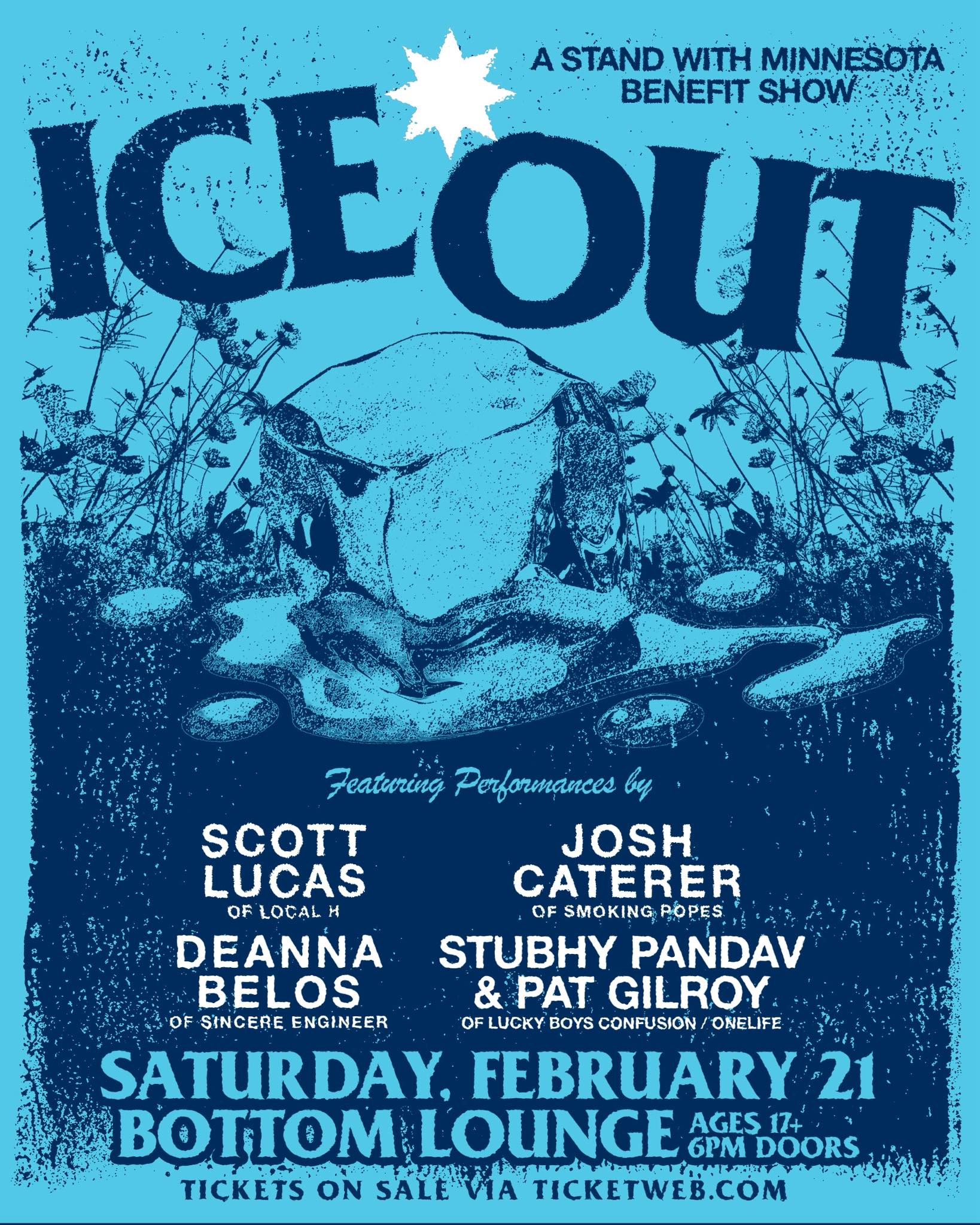
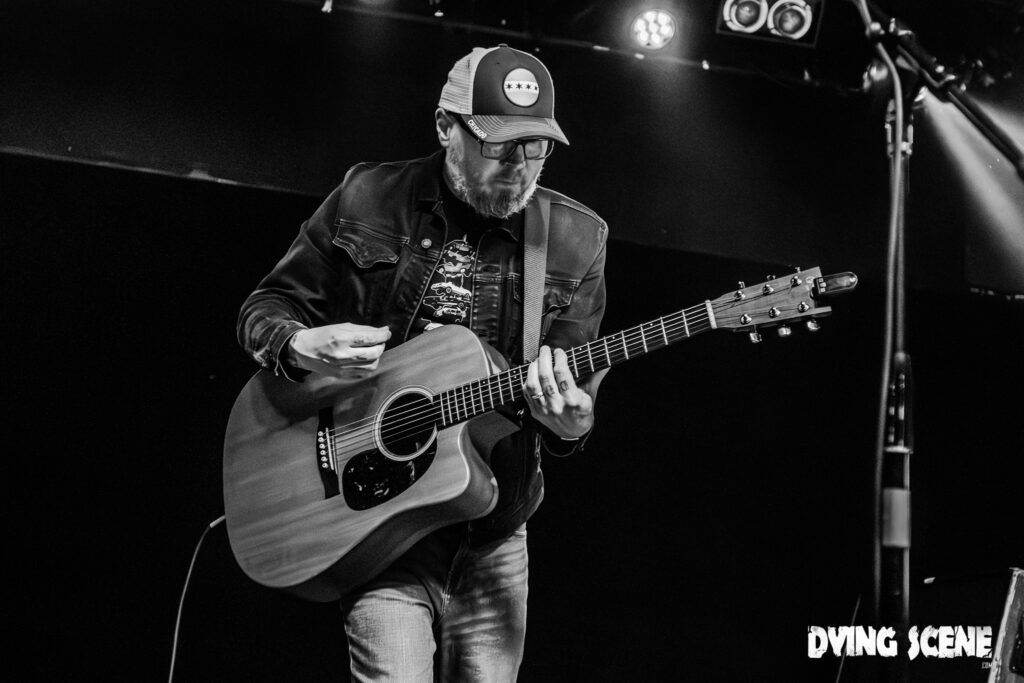
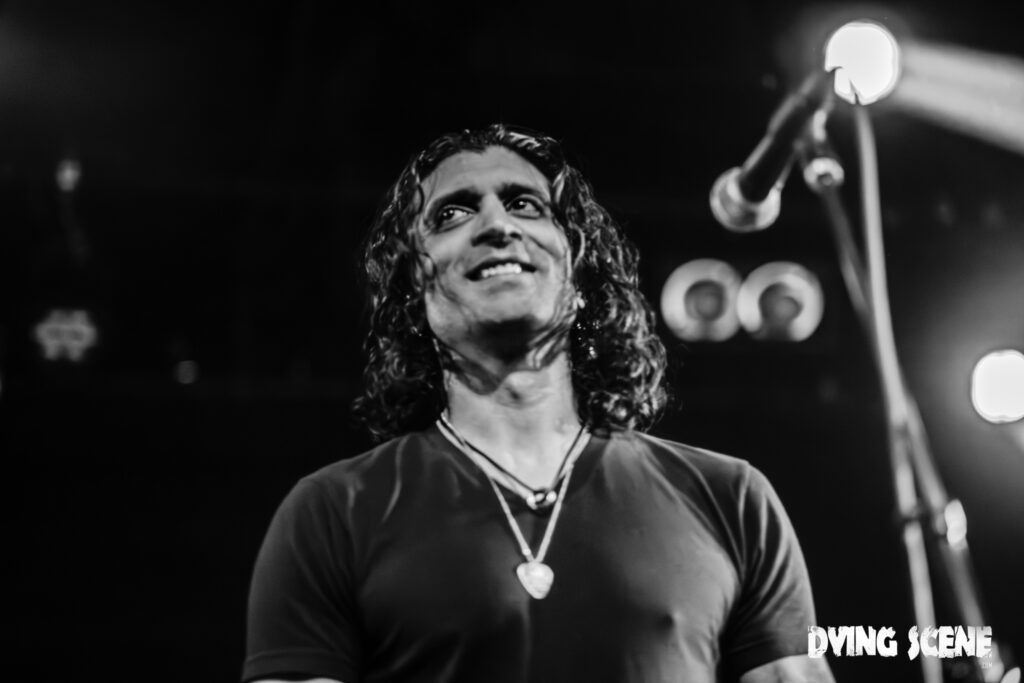
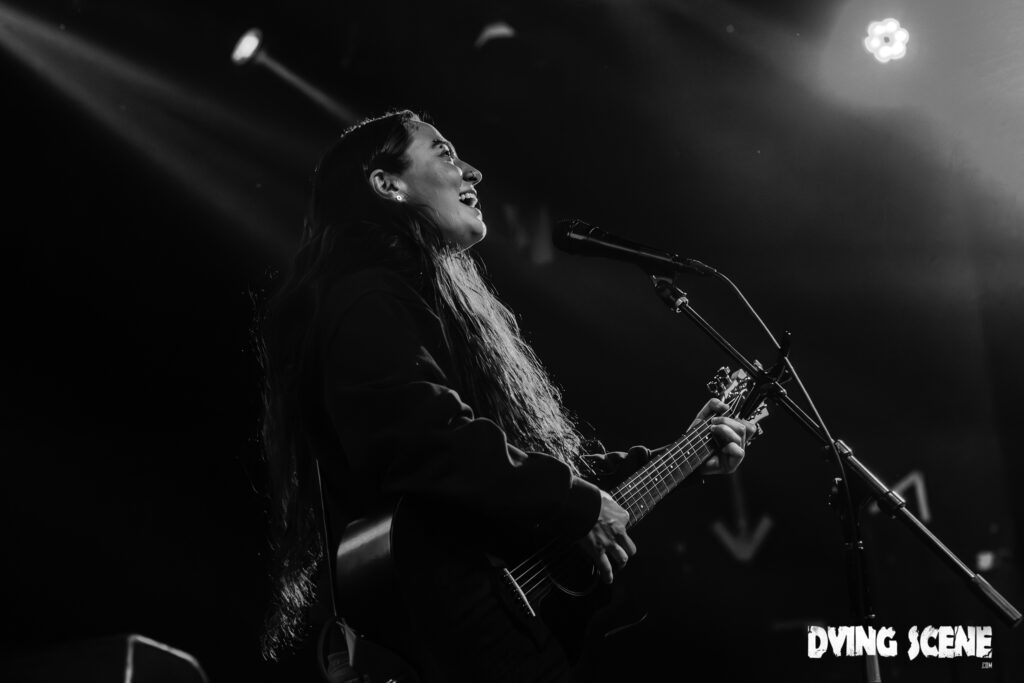
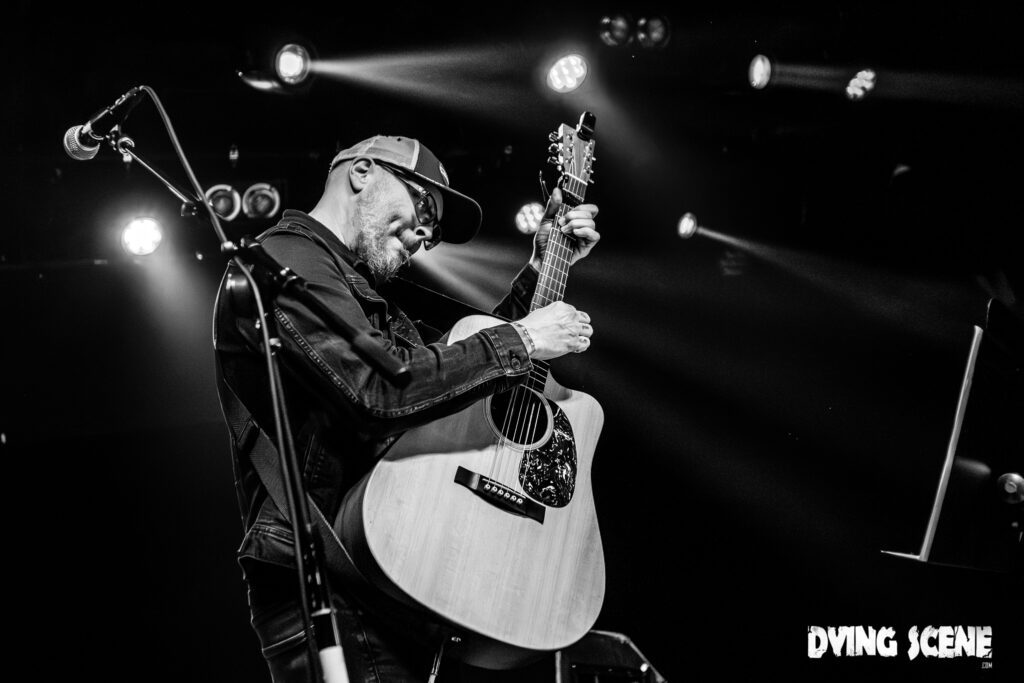
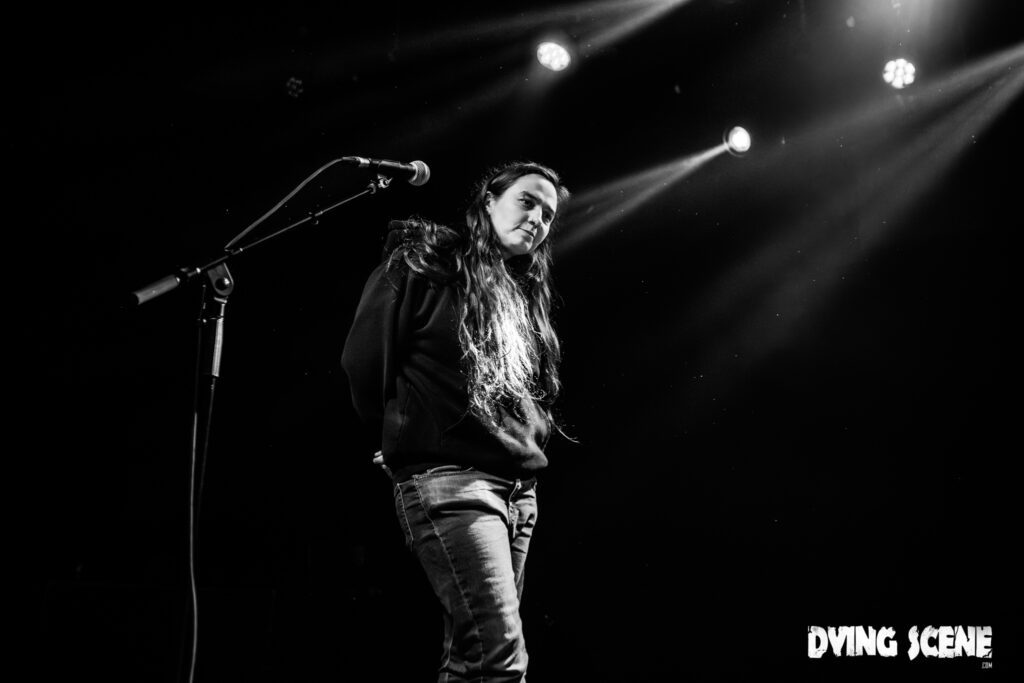
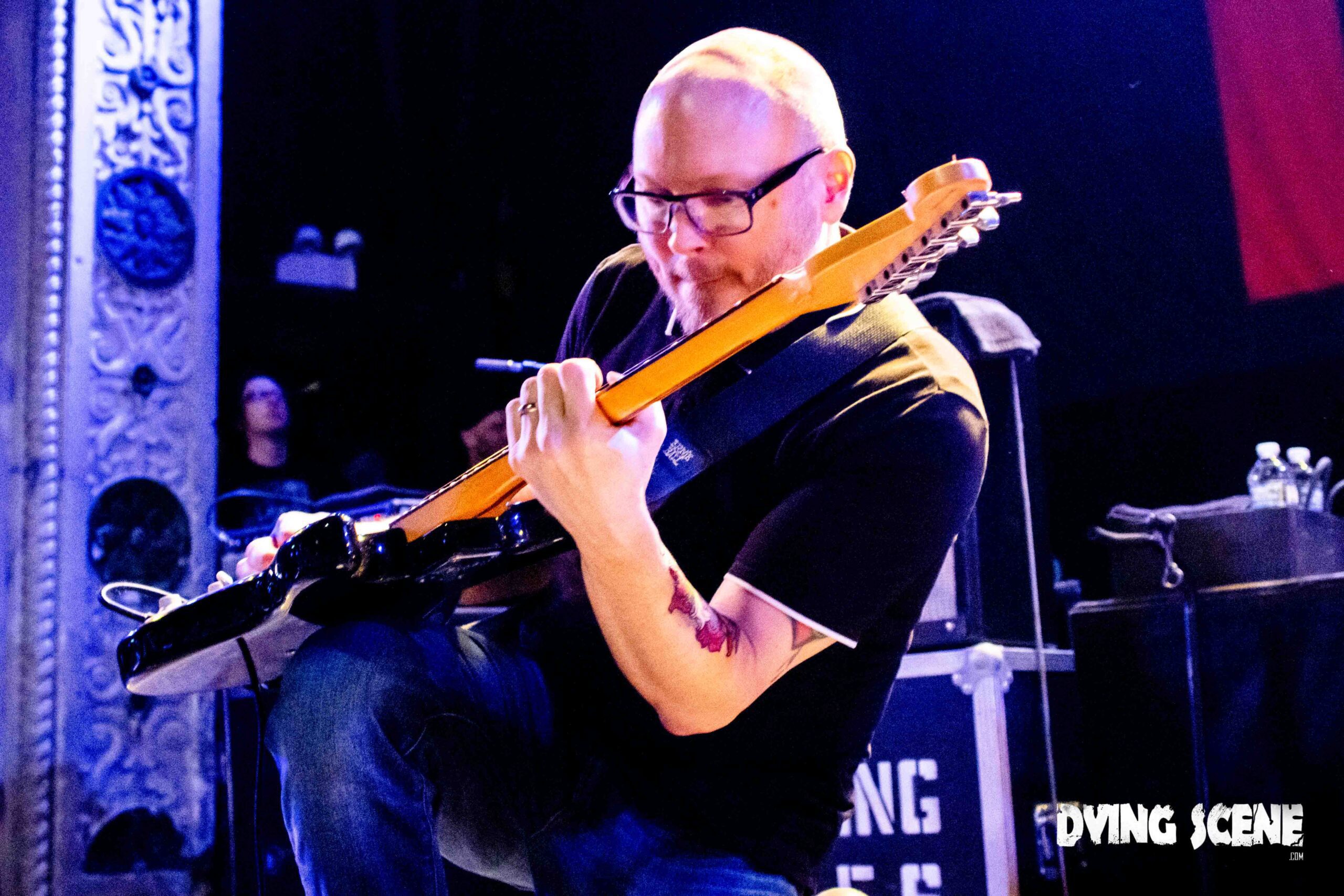
Photos by Meredith Goldberg Last Saturday, Chicago’s Bottom Lounge came alive with ICE OUT: a powerful showcase of Chicago’s vibrant music scene united in solidarity with Minnesota after the murder of Renée Good, a Minneapolis resident brutally murdered by an ICE agent in January 2026. The lineup featured local punk & rock legends, including Deanna […]
Last Saturday, Chicago’s Bottom Lounge came alive with ICE OUT: a powerful showcase of Chicago’s vibrant music scene united in solidarity with Minnesota after the murder of Renée Good, a Minneapolis resident brutally murdered by an ICE agent in January 2026. The lineup featured local punk & rock legends, including Deanna Belos of Sincere Engineer, Josh Caterer of the Smoking Popes, Scott Lucas of Local H and Stubhy Pandav / Pat Gilroy of Lucky Boys Confusion & OneLife.
I sat down with Deanna, Josh, and Stubhy to talk ICE before the benefit show, where we grew to share our thoughts about Chicago, rock music, and how the recent events in Minneapolis are a testament to how we must all come together in trying times.
Anti-ICE: Josh Caterer
When asked what the opportunity to play this show meant to them, Josh Caterer explained that standing in solidarity with Minneapolis felt like extending an arm to a Midwest neighbor. Something so horrible happening so nearby felt so personal, and this show was the amalgamation of all of those feelings.
During Trump’s first term, when “the wall” between the United States and Mexico became a huge part of his campaign, Caterer explained that it felt like our fights could only take place over the internet. Having events like these transpire in our Midwestern backyard felt so close, and they needed to do something about it. That’s why when the chance to play Bottom Lounge’s ICE OUT benefit show arose, Caterer immediately opted in.
Anti-ICE: Stubhy Pandav
Kaustubh “Stubhy” Pandav was alive with passion when speaking about his personal experiences with immigration in his family. He spoke about union, food, and the privilege of growing up in a community with such a vivacious cultural background to share with friends from outside cultures. But from those joys came triumph and hardship, dating back to his own father’s journey to America.
“My father was invited over after the Civil Rights Act passed in the 60s,” Pandav recounted. “What [the government] did was they cherry-picked people from China, India, and the Philippines, and those were the first people to come over. And my father was a part of that. So growing up in the 80s in all of this, it was real tough.” We spoke more. Pandav went on to say, “Back then, I remember there being a lot of ‘go back to your own country,’ and I remember thinking… ‘you fucking invited us’.”
Anti-ICE: Deanna Belos
I wondered if there was any hesitation or anxiety in accepting this opportunity, like the idea that social media comments might turn into real-life hate at this show, to which Belos said, “Honestly, saying yes was a no-brainer. I’m happy to do my part – our part – in something that feels more than just yelling online.”
I asked about the context of Belos, Caterer, and Pandav’s music in reference to the present, or ultimately, whether or not performing these songs that were written in the past became a different experience in the context of the current political and social climate. To which Caterer replied, in perhaps breaking news to the fans of the Smoking Popes (or at least to the room I was in), revealing that “Simmer Down” off of the 2016 EP Simmer Down (and their subsequent 2018 full-length Into The Agony) was written about the excitement surrounding Bernie Sanders’ campaign.
He went on to explain that he had never written a political song until that song was released, noting that the results of the 2016 election certainly played a part in his motivation. We spoke about how the 2016 presidential election changed the political climate entirely, eventually just snowballing into the calamity that ensues daily in the United States, including but not limited to the death of Renee Good.
Anti-ICE: Josh Caterer
“I never realized how much I love America, and how patriotic I felt until this guy came along and started trying to dismantle democracy.” Continuing, Caterer remarked, “We need to protect these precious freedoms. These are freedoms that have been fought for, and now we’ve handed the keys to a guy that’s going to try to burn them all down.” We all highlighted how liberating it was to see Chicago host so many protests about ICE, to which Belos, Caterer, and Pandav all spoke on how beautiful it is for people to come together and to share their voice nonviolently. These protests singlehandedly prove that change can be made peacefully but still loudly and prominently – an act that is attempting to be recreated at a show like ICE OUT.
Anti-ICE: Stubhy Pandav
Pandav expressed, “We’ve seen this shift to extreme madness; some people are always going to be extreme, but there are a lot of people here that we can convince with things like this.” Passionately said, Pandav stated, “Hopefully, people like us can inspire other people to change.”
Anti-ICE: Deanna Belos
A sound like Sincere Engineer’s allows fans to release their energy through the vessel of music, so I decided to ask Belos whether or not she feels like she channels that when performing songs like “Fireplace” or even “Overbite.” Belos explained, she loves to make something that’s an escape for people. She aims to create something that’s “life-affirming and communal”.
Caterer went on to add that he believes that one of the functions of their art is to give people a collective voice, something that is released once but is enjoyed millions of times over, giving a demographic of people a feeling. The amount of money raised from the ICE OUT show would be donated to help people in Minneapolis through these trying times, in an attempt to “encourage participation in a movement that is resistant to what we are seeing in the world right now,” in Caterer’s own words.
“This won’t be the last benefit show that we do for something. I hope that it’s the beginning of many efforts to do that.”
When last we spoke with Smoking Popes frontman Josh Caterer toward the end of 2024, the band were in the midst of what would ultimately be one of their busiest touring years in over a decade (and maybe closer to two). We spoke mostly about the unique re-recording of the band’s seminal 1994/1995 full-length Born […]
When last we spoke with Smoking Popes frontman Josh Caterer toward the end of 2024, the band were in the midst of what would ultimately be one of their busiest touring years in over a decade (and maybe closer to two). We spoke mostly about the unique re-recording of the band’s seminal 1994/1995 full-length Born To Quit which was released last year and about the changes in touring over a career that has spanned three full decades. But there were also tidbits in there about an as-yet-to-be-revealed new full-length record. The record was already in the can and was, as is so often the case, just patiently waiting for a release date.
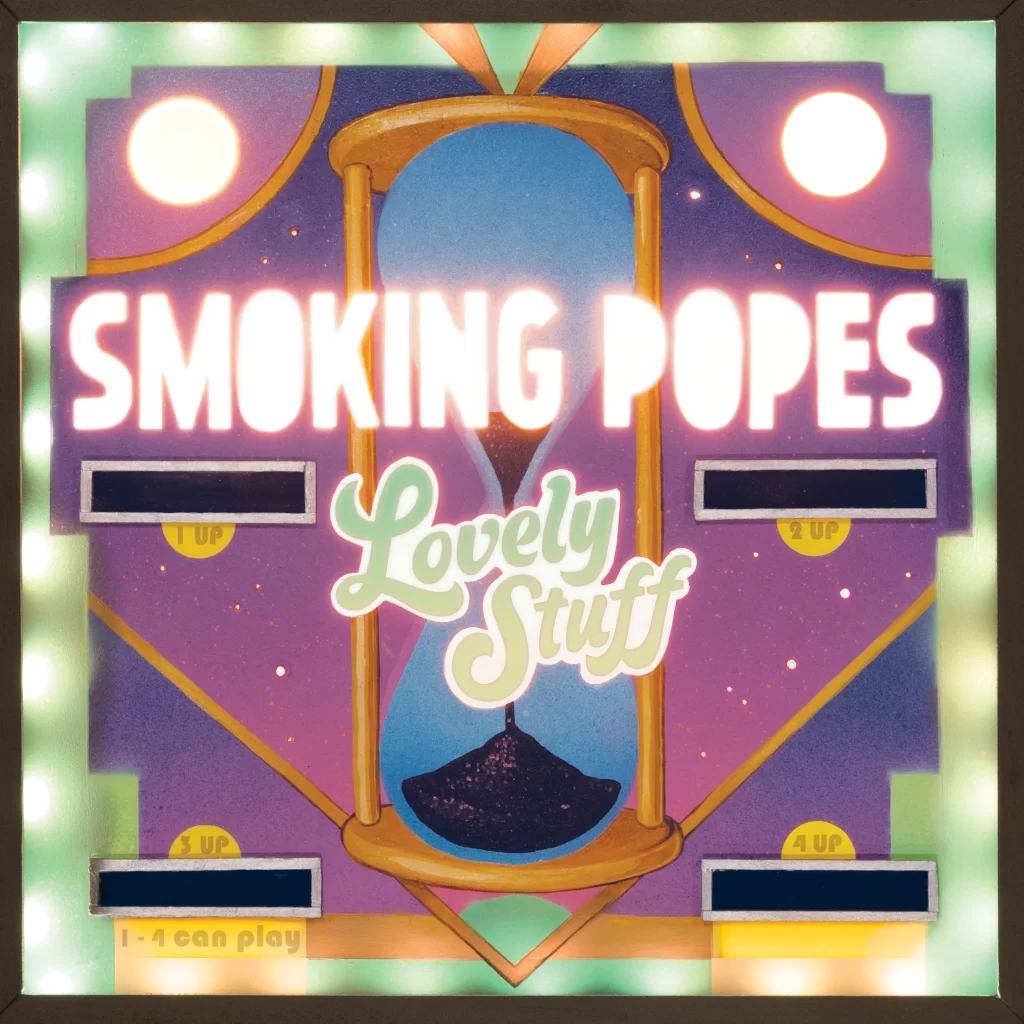
Fast forward six months, and the release date for that then-untitled record is now upon us. The record, of course, is called Lovely Stuff, and it marks the band’s first full-length since 2018’s Into The Agony. On paper, it’s the longest break between full-length albums in the band’s thirty-plus-year career, which is a bit noteworthy given that the band were broken up from late 1998 until early 2005 (for the uninitiated, the band self-released their covers album The Party’s Over mid-breakup in 2003, five years after it was initially recorded). This time, the band never really went away, staying active on the road and in writing and recording music for a variety of projects as time allowed. But we also had a pesky little pandemic in the middle of this most recent break in released music, causing plans to change and change and assumedly change again. But according to the Popes’ frontman and principal songwriter Josh Caterer, the formation for what would eventually become the follow-up to Into The Agony found its genesis from a bit of a unique starting point.
“I was commissioned to write a song for an independent film that has yet to be made,” he explains rather candidly. A friend put Caterer in contact with the director of the film, and the as-yet-unnamed director gave Caterer a loose framework of what he was looking for. “He didn’t give me specific lines or phrases to use,” Caterer explains, stating instead that he was given the loose framework that the movie’s main character has a series of obstacles to overcome in her life and the rough narrative arc that might involve. The rest was left to Caterer, who is of course no stranger to writing songs about pain and anguish and loss and heartache. “The protagonist of the song,” he explains” is determined to not be overcome by darkness, and is determined to not give up. There’s a ferocity in this person that is like “I’m not going to surrender to my circumstances, no matter how bleak they might be.”
Caterer found himself inspired not only by the core of the character of the song, but by the unique nature of the process of crafting the song itself. Because while Caterer has a long history of creating characters and carving a narrative and a set of experiences for them, the characters are all created by him, and thus contain bits and pieces of his real-life experiences. This process – which resulted in the Lovely Stuff track “Never Gonna Break” – meant creating a story from someone else’s character’s story. “I was really inspired by the process of connecting with that part of being a person. The way that that sentiment was expressed in that song really inspired me to keep writing.”
It is fair and not hyperbolic to say that Lovely Stuff contains some of the band’s best material to date, a statement that is not made lightly by any stretch. Few and far between are the bands who’ve been able to successfully navigate the terrain in what I guess is the pop-punk end of the musical landscape for more than three decades, and especially to do so in a way that doesn’t come across as stale or repetitive or, dare I say, cringy. Caterer is conscious of maintaining a fresh perspective on songwriting as a songwriter as he grows as a person. “It should be an ongoing, interesting experience to kind of figure out what’s really driving you in life,” he explains, continuing that “some people seem like they get to a point where they’re just not wrestling with those questions anymore. And that’s a little frightening. I think we always should be.”
That initial burst of inspiration that spawned “Never Gonna Break” also spawned other new tracks, like lead single and already crowd-favorite “Golden Moment.” Other new tracks like “Madison” made their way into the band’s setlist as far back as 2023, part of what has been the band’s busiest touring calendar in decades. Allow me to insert myself into the story briefly by confirming that the live edition of the Smoking Popes circa 2024 sound as vital and important as they ever have, and that remains true from both sides of the stage even three-plus decades into the experience. “The live show is a chance for everybody in the room – artists and audience – to kind of share a relationship with the music,” Caterer tells. “These songs have a place in your life, and they mean something to you. That can all be mutually expressed and shared communally at a show, and it’s a beautiful thing.”
As was the case on previous Popes albums like Born To Quit, much of the new record was written and recorded in small, sometimes two-song batches. As writing continued, Caterer not only drew collaboration from feature-film makers, but found himself co-writing punk rock songs for the first time. A scan of the liner notes shows co-writing credits given to Caterer’s bandmate Mike Felumlee, and his wife, Stefanie. The former track, the acoustic-driven “You Will Always Have My Heart,” was a bit of a peculiar co-write, as it originally stemmed from a Felumlee solo song from two decades ago. The original version was entitled “The Drive Home,” and appeared on Felumlee’s solo record 64 Hours. Caterer fell in love with the song, reworked a few parts, added his own lyrics, and ran the new version by Felumlee. While inspired by the original song, it was different enough to warrant a name of its own as a Smoking Popes track. The latter song, the Stefanie Caterer co-penned “Fox River Dream,” was a bit more of a traditional co-write, where Josh got the process started, showed it to his wife – a writer in her own right – and incorporated some of her ideas. It was a bit of a new experience for Caterer. “I have a pretty strict internal editor” he states. “I feel like it’s cool to push yourself out of your comfort zone sometimes and collaborate with people in a way that makes you feel a little bit vulnerable. I think the thing that I don’t like about co-writing is you have to show people your process and you have to show people things before you’re done with them.”
And then, of course, there’s the album’s cover, the Wizard Of Oz classic “Over The Rainbow.” Made famous in its original version by the incomparable Judy Garland, the song perfectly encapsulates the overarching themes of the album, which involve finding light and resolve in the darkness and turmoil we’re all prone to experiencing. Caterer and the Popes are no strangers to incorporating Judy Garland’s work into their oeuvre – Into The Agony even had an unrequited love ode to Garland herself – but for many years were a little gunshy about attempting the iconic “Over The Rainbow.” “She is, it could be argued, the greatest singer of all time, and so it’s like you’re going to try to climb in the ring with Judy and you feel like your contribution to that song is going to be valid up against hers?” he laughs. “I’ve always been kind of sheepish about doing that – and I still am – but I just kind of developed a different perspective on it where I’m not trying to compete, it’s more of just an homage to the song. It really did feel like there was something written into this song that was perfect thematically and tonally for this album.”
Astute observers will note that the Popes have continued to release new material that isn’t even on Lovely Stuff. The track “Allegiance” was penned late last year and was released early this year as a unique, standalone track that is weighty enough to exist all on its own. It’s yet another track that came together in somewhat atypical fashion. “I wrote that song really quickly, two days after the election,” explains Caterer. Normally one to take his fair share of time parsing over lyrics and song structure, this song was written much more spur-of-the-moment. “I don’t even know how to describe how I felt at that time. I was filled with overwhelming emotions: rage and disgust, and I just had to get it out,” says Caterer. “That’s one of these times when I just picked up the guitar and just or of tried not to overthink it.”
While many – and I’d assume the overwhelming majority – of us were (and still are) feeling similar feelings of rage and despair and disgust about the election results, the feelings cut especially deep for Caterer, who has long since very publicly lived a life of faith and worship, only to see much of that belief system co-opted by a political party as a sinister means to an even more sinister end. “I feel like probably my own personal motivation for feeling like I need to say that has to do with the fact that people know I’m a Christian, so a lot of folks probably assume that I’m also a Republican and that I probably voted for Trump. The thought makes me sick that there would be anybody out there mistakenly assuming that I voted for this monstrosity.” And so, as a means of providing his own personal light in the darkness, Caterer did what he knows best. “I know that it’s possible to feel hopeless and like there’s nothing I can do, but I know there is one thing I can do: I can write a song.”
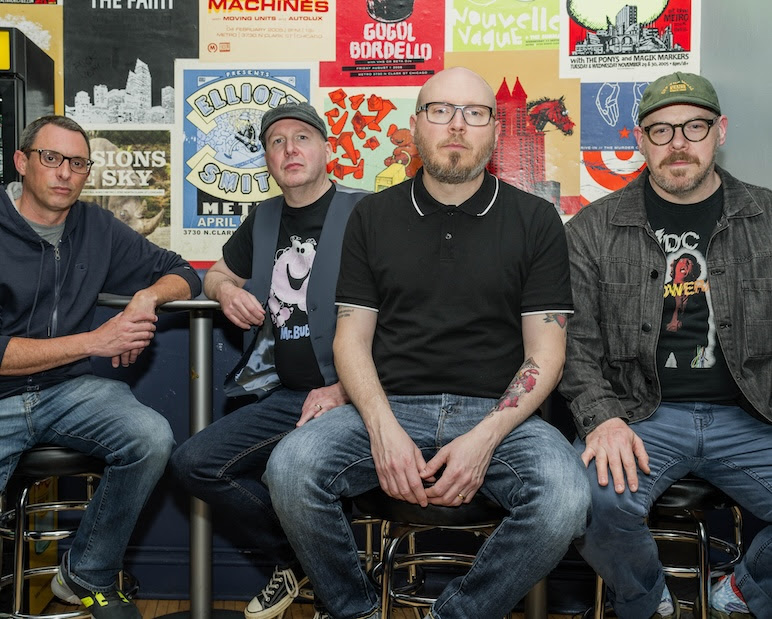
Head below to check out our full and wide-ranging interview with Josh Caterer. We caught up on the eve of Good Friday, arguably the busiest and most important time of year for those who live and work in the Christian faith. From a deep dive on his songwriting process to his last Easter season working as a worship pastor (at least for now) to what it means to be in a touring rock band in the year 2025 amidst all of the horrors we’re bombarded with every day, it is a lengthy and dare we say compelling read due to Caterer’s ever-so-thoughtful answers. (*Editor’s note: Josh was already one of my favorite brains to pick in this little corner of the world before this interview, but that sentiment was only strengthened here.*) Oh and also find out where you can catch the Popes on tour this Spring. They’ll look a little different than in the photo below; Josh’s brothers Eli and Matt have hit the “Pause” button on touring, so he and Felumlee will be joined once again by Reuben Baird (bass) and Jack Sibilski (guitar). They’re playing Born To Quit in its entirety and they’re playing alongside Off With Their Heads, who will be playing In Desolation in full as well. It’ll be a party.
***The following chat has been edited and condensed for content and clarity. Yes, really.***
Josh Caterer (Smoking Popes): Jason!
Jay Stone (Dying Scene): Mr. Caterer, how are you, sir?
Not bad. How are you doing?
I’m well. The sun is finally shining, so I’m well.
Good, yeah. It’s amazing what a difference that makes in your emotional well-being.
It really is. It was dark and cold and rainy for what seemed like months, but was really only probably four days. But the sun’s out, things are blooming now. It’s spring in Massachusetts. It’s good, we’re good.
Excellent.
How are you? How are you? How’s the new year? How’s the Easter season treating you? This is a busy week. I know with touring coming up and Holy Week this week, it’s a lot.
It’s a lot. And, you know, starting tomorrow, things are going to be crazy. I’m leading worship at two Good Friday services and a total of six Easter services, two on Saturday and four on Sunday. So it’s going to be kind of intense. But today is just a down day to rest and get ready for that. So it was a good day to have a little conversation with you.
Yeah, I appreciate that. I appreciate you fitting me into that schedule.
Yeah, it is. And it’s going to be my last Easter as a worship pastor.
Oh, really?
Yeah. I have given notice at this church. And I mean, that’s a long story…There’s a lot that I could say about it, but I think I could put it sort of all under this heading is that I have been doing, like, I’ve worked at churches for the last 24 years in some capacity, either as a worship director or a worship pastor. And I’m just kind of burned out on it. And particularly at this church that I’ve been at for the last six years, I just have been feeling over the past few years that this isn’t a good fit. Which makes it weird to work there. If you stay in that situation, it sort of starts to make you feel like there’s a deep spiritual compromise happening.
Yeah, right, right.
Which is not healthy. And so I finally decided to just not work there anymore. And to not work at churches, at least for the foreseeable future. My wife and I are excited about going to a church that I don’t work at. It’ll just be a simpler and more pure way of being involved in church.
Do you feel that a church would want, like, because they know that you’ve been a worship director, there’s always going to be that pull to, hey, we need somebody to fill XYZ role.
I feel like I would serve as a volunteer on a worship team. I would happily do that, as long as I was not the guy in charge of it. And I’m not doing that as my living.
That’s obviously a hard decision, but it sounds like the right one. And especially for that sort of spiritual compromise to come in what’s supposed to be a place of worship, and is a place of worship, but that’s a tough place to have a spiritual compromise.
It is. It is. And I’m sort of looking forward to sort of returning to, like, you know, when I became a Christian, however many years ago it was now. I started playing music at church just out of an act of worship of God. Like, I just wanted to do it. And it’ll be cool to get back to that. It’ll feel nice.
Yeah, when you don’t rely on it for a paycheck, it’s wonderful how freeing it can be. Which I’m sure is probably true of music at some level, right? Like with you guys, if music isn’t your sole paycheck, then it becomes a little, I would assume, more enjoyable.
Yeah, it’s hard to make a full-time living out of being a musician for a variety of reasons, one of which is that you end up feeling like you have to fill your time with a musical activity that you can monetize, even if it’s not exactly what you would prefer to be doing musically. So there’s always some degree of compromise in it, if you’re doing something as a living. And that’s not to say that everybody who works at a church is compromising. I know people who are pastors in churches, and they’re great, and they feel passionate about it, and they feel called to it. Like, that’s what they’re supposed to be doing, and they’re called to the specific church that they’re at, so they feel like they’re in the right place. I’ve always felt like serving in a church is something that I enjoy doing, but my real musical passion is the Smoking Popes. So working at a church, to some degree, is just a job, which makes it weird for me. I shouldn’t be doing that that way. Man, we got right into it. (*both laugh*)
Yeah! Congratulations on life stuff, but congratulations on Lovely Stuff. What a damn fine record you have made.
Thank you. I appreciate that.
And I was thinking about this as I was listening to it, I don’t know, maybe last week. You’re supposed to think that everything that you do is the best thing that you’ve done and whatever, but at some level it does feel like that. It feels like this is. It also feels like I have grown with the Smoking Popes. And it doesn’t always track that a band’s musical career sort of progresses and mirrors some of the things that you’re going through yourself. Some bands you’ll find at a particular point and they’ll always be a “high school band” or a “college band” for you. But I feel like I have grown alongside the Smoking Popes. And so each album that you put out and each time that we talk, there’s like a new appreciation for what you do.
I think I know what you mean, because I have felt that in my life, and it’s this strange kind of communal or connective power of music and of art. I mean, when an artist creates something, on the one hand, it’s very personal. It’s just them expressing themselves. But once they put it out into the world, it connects people to the artist, and it connects people to each other through mutual appreciation of that piece of work, whatever it is. And it connects the artist to the world at large. And this is something I appreciate more and more, the older I get, the more we do this, is the way that releasing recorded music and playing shows kind of are interwoven in this way where the live show is like a chance for everybody in the room – artists and audience – to kind of share an experience of having a relationship with the music, whether you’ve created it, or whether you’re just listening to it. These songs have a place in your life, and they mean something to you. And that can all be mutually kind of expressed and shared communally at a show, and it’s a beautiful thing.
Yeah, and I grew up in the Catholic Church, which for a lot of people in your mid-40s means that you no longer go to the Catholic Church. (*both laugh*) But I have long thought that for myself, the music community and live music, live shows, whatever, that was sort of my version, and a lot of people that I knows version of worship, or a version of church, or a version of communal celebration. The music was our church. The live shows, whether they were in basements or stadiums, that’s our form of coming together and celebrating together in worship.
There are definitely similarities between going to a show and going to church, and it definitely is something that contains a transcendent element. Music can do that in a way that’s even hard to define. It connects emotionally with people in a way that feels cathartic, and it feels like you’re plugged into something bigger than you, which is definitely what’s happening when you’re at church. I don’t really think that live music is a truly satisfying substitute for having a relationship with God. But it does scratch certain itches that are very important.
This is the longest, I think, that the Popes have gone between studio albums, which seems weird on paper, because it doesn’t feel like you went away for the last seven years. Into The Agony seven years ago, six and a half years ago, something like that.
Yeah, it came out in 2018.
That’s wild. But like I said, it doesn’t seem like you went away. Obviously life happened in between there, and COVID and whatever happened in between there, so that skews a lot of people’s release histories.
Now that you mention it, it’s true, but there’s a strange caveat to that, which is that we were broken up for seven years between 1998 and 2005. And so we weren’t creating any new music during that time. But I guess we did release an album a couple of years into the breakup, which ended up shortening the time between releases. And so that creates an illusion of activity when there wasn’t really any. And in this case, even though we’ve released the new album in 2025, we started releasing singles from the album a couple years ago.
Was it that long ago?
Yeah, I think “Madison” was released as a single two years ago.
Oh, wow. I know you were playing live last year.
Yeah, “Allegiance” actually came out in January of this year. “Golden Moment,” 2024. “Madison” was in 2023. And “Don’t You Want Me” was in 2023 also. We considered putting that on the album. But then we recorded “Over the Rainbow,” and we didn’t want to have two covers.
Well, so let’s talk about “Over the Rainbow,” because what a perfect way to sum up the album, I think sonically and more importantly, thematically. So I guess, where did the decision to record “Over the Rainbow” come in? Because I could see a situation where you had that song like in your brain, like it’s been in all of our brains for probably since the first time we saw Wizard of Oz. But thematically, so much of the album sort of relates to that. Did that dawn on you at the beginning of the process, or at the end of the process, that that song just fit so perfectly?
I think toward the end of the process. It’s a song that we started playing on tour last year. At some of the shows, we would come out and do “Over the Rainbow” as an encore. And it was surprising to us that we hadn’t done that before.
Yeah, it was surprising to me.
It seems like such a no-brainer. Having done “Pure Imagination” so many years back, you would think that we would be looking for those kind of songs to keep sprinkling throughout our catalog. There aren’t a million songs that are like “Over the Rainbow” because it’s not only a show tune, but it’s like a certain kind of show tune. It’s a show tune that has a certain kind of yearning, transcendent quality to it. But it’s also a show tune that is not associated with Broadway as much as it is with film. So I think if I’m to be honest, I’ve always kind of avoided “Over The Rainbow” because I was intimidated by Judy Garland’s version of it. And I’ve done her songs before. We did an album that had “Zing Went The Strings Of My Heart” on it.
That was almost my wedding song, by the way.
Oh, nice. But there’s something about “Over the Rainbow” that is so closely associated with Judy. She owns the song, no matter who covers it. And I know there have been a lot of versions of it, but she owns it and every version of it will be compared to her version of it. And she is, it could be argued, the greatest singer of all time. I would put her in that category. And so it’s like you’re going to try to climb in the ring with Judy and you feel like your contribution to that song is going to be valid up against hers? (*both laugh*) I just think I’ve always been kind of sheepish about doing that. And still am! But I just developed a different perspective on it where I’m not trying to compete, it’s more of just an homage to the song. It really did feel like there was something written into this song that was perfect thematically and tonally for this album. And, you know, if I feel like I can’t compare to Judy! (*both laugh*)
Yeah, right. You’re not going to get closer to Judy, right?
Yeah! (*both laugh*)
And to know that that song was written for her, too, and for that specific scene in the movie. I feel like I read something like the guy who wrote it, Yip Harburg, I think, he wrote it like on the side of the road. He was struggling with needing something for that Kansas scene in the movie and just like pulled over on the side of the road while his wife was driving and wrote it out in front of like Grauman’s Chinese Theatre or something like that. For some reason, that song came to him. One of those classic examples of like the song came to you in five minutes but you had really been working on it or thinking about it forever. But yeah, I feel like tonally that song perfectly encapsulates the album. The album is obviously called Lovely Stuff. And at least to me, there’s an awful lot of focusing on like the light in the darkness and focusing on like the good memories and the positive and that, like, this is all fleeting, so let’s focus on love and lightness and things like that. And that’s exactly what that song was written for. It’s exactly like where it fits in the movie. Like, that’s a perfect choice.
Yeah, it is.
Is that a fair read of the album and sort of what you were going through and going for, lyrically especially? Not to peel back the curtain too much, because I like when people have their own stories of what the album means to them, but to me, it sounded like, “boy, this is a bright album. The album cover is like, is bright and rainbowy. Jennie (Cotterill) did an an awesome job, as she always does. And then listening to it, it’s like, well, there’s still some darkness here. But then it’s also like we’re going to focus on the cracks, like where the light gets in.”
Well, I’ll tell you how this album started. I was commissioned to write a song for an independent film that has yet to be made. And I don’t know if I’m at liberty to discuss the details of it. But I had a conversation with the director of this movie. Some friends of mine put me in touch with the director and he sort of shared with me some ideas that he had about the main character. It’s about a young woman who is struggling with some stuff and wants to kind of overcome certain obstacles in her life. And he sort of described to me the trajectory that he saw her taking and just said, “OK, let this serve as kind of like (a guide).” He didn’t give me specific lines or phrases or anything to use or any specific parameters of what the song would be. He just talked to me about the narrative journey of the main character and said, “OK, now that you know that, whatever you come up with is good. Just sort of like write something that seems to go along with that.” And the song that I came up with was “Never Gonna Break.”
I love that song.
Thank you! Yeah, it was an interesting challenge for me as a songwriter. I hadn’t done that before where I was commissioned to write something about a specific character in a film. And so I sort of had to get into the headspace of the person that he had kind of painted a mental picture of for me and in ways that I could relate to, because, you know, there were things there that sort of reminded me of elements of my own life, especially when I was starting out as a younger musician. And so I ended up writing that song. And there is a quality to the song that really acknowledges the darkness around us. But the protagonist of the song is determined not to be overcome by that darkness and determined not to give up. And there’s like a ferocity in this person that is like, “I’m not going to surrender to my circumstances, no matter how bleak they might be. I’m going to go somewhere and I’m going to accomplish some things. And I’m going to kind of believe in my own ability to do that.” And I was really inspired by the process of connecting with that part of being a person. The way that that sentiment was expressed in that song really inspired me to keep writing.
And I do feel like a few of the other songs on the album flowed out of that song. And I was plugged into the same outlet to produce some of the other songs on that album, like, for example, the first song, “Golden Moment,” I think has a bit of that sentiment in it. And I feel like “Never Gonna Break” was sort of like the seed from which the entire album grew. And now looking back on it, listening to these songs as a complete collection, it does seem like there are strands of positivity and hope running through this album that haven’t been as evident on other albums of ours. And that’s kind of cool. I’m enjoying that. And that also pertains to maybe it’s a stage of life for me, you know, having turned 50. I started to think about time and mortality in a new way. Like there’s a finite amount of viable time in front of me.
Right!
And what I find in the face of that is that I have a certain determination to maximize that time and to use it for that which is important to me.
I think that more eloquently sort of sums up the thought that I had when we started this conversation about that I feel like I have grown with the band. I was thinking about the idea of sort of love songs and writing love songs and what that sentiment even means at different stages of your life. Like, what love even means when you’re in your 20s writing a song or listening to music versus in your 30s versus in your 40s and versus when you have children and like how much that changes the equation and how difficult it can be. This is not to take a shot at other songwriters, but I think it is difficult for other songwriters to sort of move through that space eloquently, if that makes sense. Like there are obviously there are songs, bands, whatever that we listen to when we’re 14, 15, 17 and that music is still good when you’re 14, 15, 17, but it’s different for those people to write songs when they’re in their 40s or 50s now if they haven’t sort of matured along and if their fans haven’t matured along with them. I think that the way you put it, as you would imagine, is more eloquent than I would fumble through it. (*laughs*)
There is something about the kind of yearning that you have when you’re young that really serves as fertile ground for artistic expression. So the key then is how do you keep tilling that ground as you move forward in life? Because you don’t want to fall into certain traps. You don’t want to like be 55 years old, still writing teenage love songs.
Yeah, right.
But you also don’t want to completely let go of that fire that was burning and whatever was inspiring that sense of longing. Because when you’re young, you have this yearning about life and you’re convinced that if you just hook up with the right person, that’s going to answer all those questions and solve all those problems. You later discover that it doesn’t. But the key is to sort of look at that fire and that yearning and see what it is. And maybe it’s not entirely ever satisfied by one thing; it’s a growing collection of things that kind of address that issue. Or maybe it’s something bigger than you thought you were looking for. So it should be an ongoing, interesting experience to kind of figure out what’s really driving you in life. I don’t know, some people seem like they get to a point where they’re just not wrestling with those questions anymore. And that’s a little frightening. I think we always should be.
Oh, I agree with you. Yeah, I agree with you. There was something you just said about “Never Gonna Break,” and trying to get in the headspace of a character that somebody else created as an exercise. But I wonder like when you write, obviously, there are threads of your own life, even if you’re not necessarily writing everything in first person has happened to Josh Caterer. But when you write songs yourself, do you craft a character in your head and then put them in these situations and write from that?
I often do that, yeah.
That’s interesting.
It usually is some version of myself. I create a character that has elements of me in it. It has to be someone that I can relate to, who I can understand emotionally, so that I know their heart and I know where they’re coming from, even though they might have a different set of circumstances than me.
But it could be like if you had zigged instead of zagged one day, this is where that person ends up versus where you ended up. But it still started out as you.
Exactly. I think if you have any maturity, you will recognize that you can’t really look down on anybody in this world because you were maybe a few decisions away from ending up just like them or however they are.
I have to tell you, I work in public health now, but for many, many years I taught groups in an alternative sentencing program, for people who are on probation or parole. I have not been on probation or parole myself, and so I have said a thousand times in front of both groups and in professional conferences, that one of the ways that you build a rapport with your clients, if you have never walked specifically in their shoes, is to remember that if a couple nights or one night in particular in your life had gone a little bit differently, then you’re sitting on the other side of the table in the crowd instead of being the one teaching the class. I have said that a thousand times, so for the fact that you just said that, that is very self-reassuring to me.
Sometimes songwriting is like, well, what if I had made a couple of those decisions differently? What if I got caught?
What if I didn’t run fast enough? What if I wasn’t like a middle-class white kid, truthfully?
What if my circumstances were a little more desperate than they seem to be right now? There’s part of that even in imagining yourself to be a younger person or a single person rather than a married person or someone who’s kind of trapped in a relationship that’s different and more difficult; more extreme than any relationship that I’ve actually been in, but I could feel the potential of being there. Some of the first songs I ever wrote for the Smoking Popes were songs that had this kind of extremist approach to romantic love. I think technically the first Smoking Popes song – the first song on the very first EP that the Popes ever put out was a song called “Sandra,” which is about a person who is stalking Sandra Bernhardt.
Oh, right, right, right.
And at that time I was watching a lot of Martin Scorsese movies. So, I was kind of taking elements of Taxi Driver and The King of Comedy and like wrapping them together and really imagining myself stalking another person and like, you know, parking outside their house, monitoring all their activities and keeping track of what they do and, you know, trying to furtively take photographs of them and all that. And I never did that (in real life)
Oh, no? You didn’t? (*both laugh*)
I had to recognize that there was a part of me that would definitely have considered following through on that. I almost did just for artistic purposes. I was like, “well, maybe I should try stalking someone.”
That’s dark. (*both laugh*)
I’m glad that I didn’t.
Yeah, right.
I can think of a couple other artists who kind of seem to explore these things. I feel like the work of David Lynch, for example, is like, from what I know about him personally, he wasn’t that dark in real life, but his films certainly were.
Oh, sure. I have had a similar conversation, actually a couple of times, with Brendan Kelly, your fellow Chicago area person, about how, like, the thing we do with songwriters where, because they’re, especially if they’re the one singing the song that they’re writing, that, like, we assume that it’s always first person. Brendan has written some really dark stuff, especially with The Wandering Birds. And he’s like, “I clearly don’t have, like, dead hobos under the front porch of my house. Like, that’s clearly something I have never done.” (*both laugh*) But we put this weird thing on songwriters, lke, they’re writing these things first person so it must be about them, but we don’t put that same sort of thing on film writers or directors. Like, we clearly know that David Lynch wasn’t writing documentaries, so why do we do that to songwriters sometimes? I don’t know…that’s an aside.
I don’t know. It’s a good question. A lot of songs are written in first person. And I think there’s something about the format that invites the listener to participate in it in a first person way. Like, if you hear a song, you sing along the lyrics, and then you feel like they’re coming from you. And when you’re singing a song, you feel like it’s supposed to be an expression of how you feel when you’re singing it. And so I think you experience music in a different way than you do the other.
Whereas you don’t put yourself in the first person of, like, Mulholland Drive or whatever.
Exactly.
That’s a good perspective. I don’t know why I never quite dawned on me that way. That’s a good perspective.
I’ve never thought about it either. Spitballing here. (*both laugh*)
No, that worked! But I do also wonder, and I have asked actually numerous songwriters this over the years because it’s a thing that I’m fascinated by, in the ability to write a song that is either a song of unrequited love or a breakup song or a heartbreak song, things like that, when it is not pertinent to your situation right now. And so I was fascinated to see that “Fox River Dream,” – which obviously talks about love lost and choosing to remember what was versus how things ended up – was co-written by your wife. I think that’s awesome. Because I think that that’s an interesting needle to thread sometimes as a songwriter, to write a song about heartbreak and love lost or unrequited love if you’re in a happy and committed relationship and how awkward it can be at times for your partner, your spouse, and how much you have to fill them in ahead of time. Like, “hey, you’re going to hear a song. It’s not about you, I promise.” So it’s cool that “Fox River Dream” was co-written by your wife. Is that math that you have to do in your head sometimes if you’re writing a song? Do you have to say, “no, this song isn’t about us? You’re not the unrequited love. We’re good.”
Well, she kind of knows. She is a writer herself. And so she understands the parameters of creating characters and finding inspiration to write that isn’t autobiographical. That probably helps. And several of the songs that I’ve written are about her. And I think she’s developed a kind of sixth sense in order to tell, “ah, here’s another one about me.” So she can discern those from the ones that are not about her.
Right.
In the case of “Fox River Dream,” I think I had written the chorus. And I had a melody. So I had lyrics for the chorus. And I had a melody for the verses. And I may have had one or two lines for the first verse. And the rest of it, I just played it for her. And I hummed her the melody that I had in mind. And I said, “what do you think? When you hear this, what does it inspire in you?” And I didn’t have a conversation with her about motivation or who the people were that were supposed to be involved in it. I just said, “here’s what I got. See if you can come up with any lyrics for it.” She ended up writing a couple of stanzas of poetry inspired by what I had played for her. And I grabbed some of those lines and put them into the second verse of the song. I don’t know if this is going to ruin it, showing people how the sausage is made. (*both laugh*) In this case, the first verse ended up being written entirely by me. And the second verse is collaborative. And I think there are three or four lines in there that I took from her writing that she had given me for this song. But then I finished verse one, and she was like, “man, if I had known that you were going to reference Jeff Goldblum in there, I would have written some different stuff.” (*both laugh*) “I just didn’t know you were going to talk about The Walking Dead and The Fly.” I was like, “well, too late! I like what you wrote, so I’m going to keep it.” (*both laugh*)
That’s funny. And how was that process? Is that the first time you had written or that you have lyrics that were written with somebody else? I can’t think, top of my head, of another one.
Let me think. I think for The Popes, it is the first time I’ve done that. I have co-written songs with people for church. I’ve been involved in a lot of collaborative songwriting situations with people. Worship songwriters do that a lot. I’ve never been entirely comfortable with it, but I’ve tried. I feel like it’s cool to push yourself out of your comfort zone sometimes and collaborate with people in a way that makes you feel a little bit vulnerable. I think the thing that I don’t like about co-writing is you have to show people your process and you have to show people things before you’re done with them. I have a pretty strict internal editor. By the time the public hears a song, I have gone over these lyrics with a fine-tooth comb countless times and I have rooted out every single word that I didn’t want there. It looks vastly different than whatever I was coming up with off the top of my head when I was first writing it. You have to trust somebody enough to show them. I’ve had this where I’ve tried to write a song with somebody and the thing that I come up with off the top of my head really sucks, and if it was just me, I could have found something in there that I could have refined it and polished it and turned it into something. But when I first do it in front of somebody else, I’m like, “this sucks, and now this person is convinced that my entire songwriting ability is a hoax.” (*both laugh*) Either I didn’t really write those songs or I’m washed up now. Whatever I had is gone and now I just write crap.
And then add to that layer the fact that you co-wrote with your wife. That’s got to be an interesting dynamic too that’s different than if you’re co-writing with your brother or another songwriter or a hired gun or whatever.
Right. The sort of collaborative songwriting that I’ve done in worship situations has been like multiple people sitting in a room with a guitar. Like, “let’s just hammer this out right now.” But that’s not how I would choose to co-write. The way that I did this with Stef is like I had written something when I was by myself and it just wasn’t finished. But I played it for her and then she sort of went off and days later she showed me some lyrics that she had written. So it’s still a sort of private affair to be writing. You’re taking something that somebody else wrote by themselves and you’re fleshing it out. And that’s the way that it has worked with some of the co-writes that I’ve done in the band. There’s another song on the album called “You Will Always Have My Heart.” It’s listed as being co-written by me and Mike Felumlee, our drummer. But what that means is that he wrote a song that he actually released years ago on one of his solo albums. It’s a song called “The Drive Home.” And I heard that song and just fell in love with it. Some of the lyrics in it inspired me to think about certain specific experiences that I had had. So what I did is I kept the first couple of lines from his version of it, and from there I just wrote a new set of lyrics and I changed the chorus. So the chords and melody in the verses are exactly what he wrote with 85% new lyrics in the verses. And then I completely changed the chorus. So again, it’s something that he wrote by himself a long time ago. And then I took that and added to it by myself. So it’s not like at any point he and I were sitting down together trying to decide anything.
Did you tell him you were doing that? Or did you present it to him afterwards?
I presented it to him afterwards and I just said, “what do you think of this? Do you like it? And are you upset that I changed your song?”
Yeah, right, right.
And he said, “no, this is great.” And for a minute there, the idea was to turn it into an uptempo, fast, punky song. Because his version, if you listen to the drive home off of his album, it sounds like a smoking punk song with guitars and drums. That’s what we were going to do with it. But I sent him this acoustic demo of my new arrangement of it. And the more we listened to it, we just sort of mutually agreed that this has a nice quality as an acoustic song. And then it was Mike’s idea to try to put some strings on it. And also for a while we were still calling it “The Drive Home.” But then as we got closer to finalizing the album, I was like, “Mike, I feel like this is different enough from your original version of the song that we should change the name of it. Like your song and this song can coexist in the world. They’re not the same, they’re distant cousins of each other.”
Yeah, and it might be confusing for people that were familiar with Mike’s.
Exactly. So that’s what we did. Collaboration is interesting. Even if I had to sit down in a room with somebody and write a song, I still think every so often, I’d be like, give me 10 minutes and I would go downstairs. I would need to be by myself. I heard this story about The Doors. Stop me if you’ve heard this one.
I probably haven’t, because I don’t like The Doors.
Oh, you’re one of those Doors haters?
I’m one of those Doors haters. I went through a phase when I was 14, and later I was like “Oh, no, wait, I don’t think Jim Morrison was a poet, I think he was just a drunk asshole.” And yes, you can be both, I understand that.
Okay, yeah, a lot of people are both.
Yeah, for sure.
No, it was the story of Robbie Krieger. I heard a little interview with him and he was saying that they were at band practice one week and they all decided, “okay, everybody write a song this week and bring it back next week.” And next week, Robbie Krieger showed up with “Light My Fire.” But he only had one verse, which is, “You know that it would be untrue. You know that I would be a liar // If I was to say to you, girl, we couldn’t get much higher. Come on baby, light my fire.” That’s what he had. And so he shows that to the band and they all thought it was pretty good, but they needed a second verse. So he says that Jim Morrison said, “okay, give me a minute.” And he left the room and he was gone for about 10 minutes. And then he came back in and he said, “okay, here’s what I got. ‘The time to hesitate is through, no time to wallow in the mire // Try now, we can only lose and our love become a funeral pyre.” And Robbie goes, “so I said to him, well, it’s a little dark, Jim, but okay, let’s try it.” (*both laugh*)
That’s funny.
I love that story, especially because Jim Morrison, he couldn’t have done that in the room with other people. He just had to go off by himself for a few minutes. There’s something very private. It’s almost like a bodily function or something that you can’t really show people is when you’re writing lyrics.
Do you think it would change if you were forced to be in a room with somebody like passing around an acoustic guitar or whatever? Would that be how you write or do you write all sorts of different ways, so that being in a room trying to actually physically write with somebody in and of itself is like foreign, right?
Oh, it depends. Different ways. It’s interesting that you said that when “Over the Rainbow” was written, he was in a car and he pulled over because I’ve definitely had that happen where I’m driving along. And there’s something about driving, looking out the window and thinking and you’re getting all meditative and contemplative. I’ve written a lot of lyrics that way. I wrote “Need You Around” that way. I was driving in my car listening to Frank Sinatra on cassette. And I just, I was in the zone, I just pushed stop on the cassette and started singing to myself and came up with “Need You Around” and then I drove home and put chords to it.
I was going to say, so what was the process back then? Because now everybody has an iPhone or a smartphone, whatever, and you have a voice notes app and if you get those moments of inspiration, it’s probably second nature to people now to just hit the voice notes app and record whatever you have and then go back to it. But what was the process before cell phones?
The only thing about that that has changed is that now if you record it on your voice app, then you can forget about it because you know it’s there. It used to be, if you had something going in your mind, you had to keep it going until you could get home, or you could get somewhere where you could write it down or you could get to your little dictaphone or whatever. So you had to be like, “all right, don’t talk to me and don’t go anywhere where there’s music playing or I’m going to lose it. I’m going to lose the thread.”
That’s funny. I realize we’re at like the hour mark right now, which seems like it’s been quick, but I did want to talk about “Allegiance” because I love that song. I find that song so incredibly… inspirational I guess is probably the best word for it. Particularly for this point in time and what we’re going through. And so I sort of said before that the album itself is a lot of trying to find light in the darkness. A lot of that is interpersonal relationships. But “Allegiance” does that sort of on a bigger level. I love that song. I see why it wasn’t included on the album because like it’s a little more macro versus micro, I guess. But I guess, where did that song come from?
I wrote that song really quickly, two days after the election.
Wow. That tracks, yeah.
Usually when I write a song, I’ll write the music quickly and then it’ll take me weeks to hone the lyrics and change them and rework them. But in this case, I wrote that song on November 7th. I don’t even know how to describe how I felt at that time. I was filled with a lot of overwhelming emotions: rage, disgust. And I just had to get it out. And that’s one of these times when I just picked up the guitar and just sort of tried not to overthink it, just get it out there. And by that time, the rest of the album was written and recorded and mixed and mastered. So I guess technically we could have added another song, but we would have had to jump through a couple of hoops to add it. And we already had 10 songs, so it would have made it an 11 song album. And it was just like, “this feels like a different thing. It feels like the album’s already done.”
A thousand percent, yep.
And this is its own entity. So that day I recorded an acoustic demo and I sent it to Mike. And I was like, “I don’t know if we want to do anything with this, but I just wrote this song.” And he was like, “I love it and we should record it as soon as possible.” So we set up a studio session for a week and a half later and went in and tracked it. I called Jamie Woolford, who had mixed our album, and said, “hey, we got another song. Can you mix it real quick for us?” He was like, “yep.” And I don’t know. It felt like it was one of those things where I was just so upset and horrified at the prospect of what was going to be unfolding as a result of this election that I needed to, like before any of that stuff even started to happen, I felt like I need to make this proclamation that I’m not on board with any of this.
Yeah, right.
And I feel like probably my own personal motivation for feeling like I need to say that has to do with the fact that people know I’m a Christian.
Yeah.
So a lot of folks probably assume that I’m also a Republican and that I probably voted for Trump. That thought makes me sick. The thought that there would be anybody out there mistakenly assuming that I voted for this monstrosity. I have to set the record straight. Let the record show I did not vote for this man. I never voted for him once.
Right.
I had three opportunities to vote for him, and I voted against him all three times.
Right. And it is sad. It’s a sad reflection of how that particular party has co-opted not even just religion in general, but especially has co-opted Christianity, has co-opted the evangelical wing of Christianity. It’s sad.
It is sad, and it’s very, very upsetting to me. I feel like, I don’t know, this is a tricky comparison to make. I’m not actually trying to compare myself to Jesus Christ.
Right, right, right, right, right.
Because I fall short on every level. (*both laugh*)
Yeah, right.
But I feel like that thing that motivated Jesus to flip over the tables of the money changers in the temple, he was angry about something specific there. He was angry that people were coming in and trying to take advantage of God’s people.
Right.
And that is the exact sense of anger and outrage that I felt when Trump got re-elected. I was like, “this has happened because Christians in America have been targeted by decades of propaganda from the political right wing.” So, because the people that I know, like my experience of going to churches where the majority of people who attend these churches that I’ve been a part of voted for Trump. But I know these people. It’s not that they’re horrible people. It’s not that they’re racists. It’s not that they are hateful bigots. It’s that they have been conditioned to believe that they are under attack. And that all that we hold dear is under attack. They’re all listening to these voices, these right-wing voices that tell them every day over and over, “the left is trying to destroy families. The left is trying to destroy our freedoms. The left is trying to destroy this country. And the left is trying to destroy the Christian faith…”
Right.
“…and they’re coming for our children.” And that’s like all these things where you just have this like perpetual fight or flight response that is being activated in people so that they become genuinely convinced over time that voting for Donald Trump is like the good and right thing to do. And that is so deeply ingrained in them that I cannot, through argumentation, make them see otherwise.
Right, right, right.
Even though it seems like obvious hypocrisy to anyone outside of the sphere of influence of like right wing media. Like the entire rest of the world looks at that and is like, “how can you follow Jesus and support Donald Trump?” Those two things are polar opposites.
Right, they are a Venn diagram that doesn’t overlap.
There’s no overlap! It’s sort of like, I don’t know, have you ever tried to talk to someone who was like, had actually been brainwashed?
Yeah, yeah. There’s a writer, he’s a national writer, but he’s from here, Luke O’Neill, who has written a couple of books and this may be in one of his books, but he wrote a big long article about essentially like losing your parents to the cult. It was sort of a little bit pre-Trump, I think was the origins, but at least the Fox News sort of thing. And losing a loved one to that being brainwashed and that there is no sense of like reason or rationale or conversation that you can have with them. It is quite literally the same as being like brainwashed, like whether in a cult or however.
It’s really upsetting to me because I feel like a lot of the people around me in church world have been subjected to this. And these are wonderful, loving people. Just who, when it comes to politics and specifically the relationship between faith and politics, they have been systematically just programmed to hold religious beliefs and political beliefs that are completely contradictory to each other. And there’s an elaborate web of like justification that they have built up in their minds as to how both of those things can coexist.
Yeah, right.
I don’t even know what to do about it.
Yeah, I mean, it’s demoralizing in the both figurative and I guess literal definitions of that word, right? Like it’s a lot. It’s a lot. And I don’t know how we combat it. I mean, like what it takes for light to dawn on Marblehead and for folks to realize that they’ve been brainwashed, like being in a cult or whatever. There’s no one right answer, but I think the only way out is through, right? And focusing on the good and the positive and the love, as naive as it can sound sometimes, focusing on the love and the positivity and the communication between us and the relationships. I think that’s the only way we pull out of the tailspin. But I use songs like “Allegiance” as sort of like a way to pull myself out of my tailspin. Like I said earlier, I work in public health and public health is being run by RFK Effing Jr. right now. And so every day is having to combat like pulling yourself out of a tailspin because, like, what new fresh horrors are we going to have come down the pike today?
Right. And I feel like we are all of us being subjected to this psychological and emotional endurance test where every day there are things happening that we should be outraged about. But if you’re outraged afresh every day, you just become exhausted. And you get to this point where you’re like, “you know what, I just can’t do it anymore.” And so you check out and you’re like, “you know what, I don’t care anymore.” But then they’ve won. So if you’re not outraged and you’re not paying attention anymore, they’ve won. But if you’re constantly paying attention, then they’ve won also because you’re so frazzled about it that you can’t really function. There’s got to be some in between where it’s like, “OK, we see what’s going on. We’re tracking it. We’re not responding emotionally to everything. And we know that what’s happening here is that they’re flooding the zone.” I’ve heard that expression a lot lately.
Yeah, that’s the Steve Bannon playbook. Everything, everywhere, all at once, knowing that not everything’s going to stick, but you at least create enough chaos that something will get through.
Right. And so it causes us, the rest of us to go, OK, well, are we supposed to respond to everything? Or are we supposed to stop responding to any of it? Are there people out there who are responding to all of it? Because it seems like any attack on due process or any attack on the law or the Constitution, all of it should be addressed. I don’t have to personally be outraged about it. But I am sort of like paying attention to the people who are supposed to be responding to that and trying to support, you know, the Bernies and the AOCs of the world.
Yeah, right, right. Yeah, I think I find myself being outraged by all of it. But at the same time, knowing that some of that isn’t for me to deal with. I have to focus on the things that I can do to make my little world, my little community better. Because somebody has to, right? So if you’re in a position to do that, why not you?
Right. And I think that’s kind of part of the reason why I wrote “Allegiance.” Because I knew that it’s possible to feel hopeless and like there’s nothing I can do. But I know there’s one thing I can do. I can write a song.
Yeah, yeah, yeah. Right.
And I can put that out there into the world. And so if that’s what I can do, that’s what I’m going to do. And so I think that’s true of anybody. Maybe you can’t single-handedly change the situation, but there’s going to be one thing that you can do. Whatever that is, you should do it. Maybe you’re going to send 50 bucks to the ACLU. Or you’re going to go to a demonstration. Or you’re going to sign a petition. Or you’re going to put in a phone call to your congressperson or something. You’re still going to do one thing. And maybe you’ll do more things in the future. But I just started by saying, you know what? I do have a voice. And I’m going to raise it to say “no to Donald Trump.”
Yeah, right, right. I’m glad you did. I’m glad you wrote that. I’m glad you’ve written dozens of songs. But I’m glad you wrote that song. That song means, like, it’s one of those sort of, like, keeps your barometer on true north when you kind of get stuck in the mire sometimes.
If you’ve even casually perused the Dying Scene archives at any point over the last fifteen years, you’re no doubt more than a little bit aware of the significance of 1994 in the annals of history. As a cultural touchstone (or more accurately a punk rock subcultural touchstone), it’s probably second only to 1976. While […]
If you’ve even casually perused the Dying Scene archives at any point over the last fifteen years, you’re no doubt more than a little bit aware of the significance of 1994 in the annals of history. As a cultural touchstone (or more accurately a punk rock subcultural touchstone), it’s probably second only to 1976. While the latter saw bands like Ramones and Sex Pistols open the door for bands like The Clash and the scenes in the Lower East Side and London and eventually LA; the former blew the roof off the building, with bands like Green Day and The Offspring changing the sound of what qualified as ‘popular’ music and allowing the Rancids and the NOFXs and the Bad Religions of the world to not only create decades-long careers for themselves but to create exposure for another tier bands who have truly provided the life’s blood to the scene in perpetuity.
Enter Smoking Popes. The Chicago-based foursome centered around the trio of Caterer brothers (the golden-voiced Josh on vocals and guitar with brothers Eli and Matt on guitar and bass, respectively) and Mike Felumlee on drums released their sophomore record, Born To Quit, on their hometown’s Johann’s Face Records into the maelstrom that was 1994. Thanks to the modest radio success of lead single “Need You Around,” the album was picked up by Columbia Records and rereleased the following July, spawning even more modest success, the release of the now-classic “Rubella” as a single, and the use of a bunch of album tracks in movies like Tommy Boyand Angus and Boys.
This year, the Popes marked thirty years of Born To Quit with a celebratory reissue of sorts. I say “of sorts” because this isn’t your basic “remastered” or “remixed” or “repackaged with bonus content from the archives” edition. Instead, since control of the original record still lies in the corporate clutches of Capitol Records, the Popes decided to take a page from the Taylor Swift playbook and rerecord the album for release on a new label, Ryan Young of Off With Their Heads‘ Anxious & Angry. Earlier this year, the band gathered at Bombsight Recording Studio in Bloomington, Illinois, to update and redo the record. Rather than rework each song track by track or turn it into an acoustic record or something of the like, the band actually compiled a studio audience of a few dozen people, hit the “Record” button, and pulled it off live on the floor, sans overdubs or modern studio magic.
Because the original was largely recorded live on the floor in studio three decades ago, the two releases have a largely similar feel. The new one sounds a tad crisper and cleaner, but it’s still punchy and raw in all the right places. Plus, it features a cameo from the one-and-only Deanna Belos (Sincere Engingeer) on “Gotta Know Right Now,” whose vocal take in the second verse and chorus give the song an interesting wrinkle of immediacy. Despite being recorded live in front of a studio audience (unlike Josh Caterer’s two quarantine-era solo live albums, each recorded effectively in empty bars), the lack of banter or improvisational moments still create the feel that you’re listening to a studio record and not a traditional live album.
Always one of our favorite music scene folks to chat with – you can still see our (*both laugh*) Quarantine Chat episodes here and here – we caught up with Popes’ frontman Josh Caterer via Zoom from a hotel room in Worcester, Massachusetts, before the sold-out Boston stop on the band’s lengthy – and now completed – US tour opening for The Get Up Kids (editor’s note: here’s what the aforementioned show looked like!). We spoke at length about the recording – and re-recording – processes behind Born To Quit, embarking on their longest tour in decades, navigating what it means to be a working punk rock band circa 2024, and, perhaps, a sneak peak at what the band has in store for next year…tours? Music? Find out below!!
The following interview has been edited and condensed for content and clarity. Cover photo credit: Chris Tracy
Dying Scene (Jay Stone): Thank you for doing this. It’s been a while.
Josh Caterer: Yeah, and it worked out today, time-wise, because it’s a day off for us. And so we drove from Asbury Park. We’re playing in Boston tomorrow.
You certainly are. I’ll be there.
Oh, good, good, good. But we’re staying in a place that I’m told is pronounced Wor-ster.
Worcester.
Worcester.
Worcester, yes.
But it’s spelled Worchester.
Yeah, like Worcestershire sauce.
So there are syllables in there that you just ignore.
Yes, it’s very Massachusetts.
Who has time for three syllables when you can just use two instead?
Yeah, and then you actually got to cut the R off the end, so it’s Woostah
Woostah!
Yeah, Worcester… W-O-O-S-T-A-H…Worcester.
But so yeah, we checked in here a little while ago and just kind of chilling for the evening. Perfect time to do an interview.
How’s tour going so far? It seems like a long one for you guys comparatively, at least since COVID.
It is, especially if you include the two weeks in Europe that we did starting at the end of July. We were over there for two weeks, home for 10 days. Then we started the Get Up Kids tour, the first leg of which was three and a half weeks, home for 10 days again, and then started the second leg. So it all feels like one big tour. And it’s pretty cool. It’s been going great, but it feels long. It’s long enough to where we feel like we just live out here now.
Does it feel like the old days in some speaking? Granted, touring has changed a lot since like 94, but…
Yeah, I mean, we have not done this much touring in this short amount of time since the 90s. So, yeah, it’s old days for us. But better.
I was going to say, how has that part changed in 30 years?
Back then, there was a lot of substance abuse and general destructive behavior going on. So we weren’t really enjoying it…we thought we were enjoying life, but in reality, we weren’t enjoying life as much as we are now.
Who’s in the touring lineup now? Is it the three brothers, Caterer and Mike in this edition or is it you and Mike?
My brothers are not touring right now because they both have little kids. So it’s me and Mike. And then on guitar, we have Jack Sibilski who plays in a band called Telethon.
Sure.
So we’re kind of borrowing him. And then on bass, we have Reuben Baird, who’s been playing with us on the road for a few years now, because even before they had kids, my brother Matt decided that he didn’t want to tour anymore. Like basically, he got married. He wasn’t in being away from home. So we started asking Reuben to fill in and he’s officially our tour bass player.
I feel like I have seen Reuben live. I feel like one of, I can’t remember the last time you were in Boston or where the last time I saw you was because I’ve sort of seen you all over, but I feel like Reuben was there last time.
Yeah, he’s been with us for, I wish I knew the exact number of years, but I don’t. But it’s funny because on the road, people will give Jack kind of a hard time for being obviously the new guy, the fill-in guy. People come up to him and ask him, where’s Eli? What are you doing here? But nobody says anything to Reuben because he looks like a Caterer. He’s got the Caterer hairstyle for sure. (*both laugh*)
You know, I feel like that actually sounds familiar now from the last time I saw you. I know that that’s not Matt, but maybe that’s like the cousin.
Yeah, maybe they put Matt into some sort of a stretching (machine), put him on the rack. (*both laugh*)
So let’s talk about Born to Quit, the live session. So when we have talked the last couple of times, we’re about live albums that you did solo, essentially in front of nobody during COVID.
So this was a chance to do a live album with the actual four, the three Caterers and Mike who were on the original album, but with a little bit of a studio audience. We had about, I think there were 60 people in there.
It’s at a studio studio, right? It wasn’t at like a live performance venue.
Yeah, it’s at a recording studio where we recorded most of our new album that’s coming out next year. A beautiful studio called Bombsite in Bloomington, Illinois, which is pretty close to where Mike lives. And so, you know, the idea was to kind of do, in essence, a “Taylor’s Version” of Born to Quit. But then that evolved into, well, let’s get some people in there and do like a small studio audience. So it’s sort of a live album, but because it’s in a recording studio, it has the production quality of a studio album. It’s sort of the best of both worlds, I think. And, you know, we got to do like most of what ended up on the album was just a single take of things. But there were three or four songs that we did a second take of because we felt like there was a little something wonky in there that we could do better. But as Mike pointed out after, we ended up, even in those cases, using the first take for most of those. And there were no actual overdubs. I know like a lot of times on a live album, the live will be in air quotes and all the vocals have been re-sung and the guitar solos have been redone. But now this is actually as it happened, warts and all. And it was pretty cool because the crowd that had assembled there were people who were really passionate about that album and many of whom had like flown in from different parts of the country. There was even a dude from Ireland there.
Wow!
And so it just felt really special. It felt to everyone, including us, like we were kind of showing some reverence for the material and trying to do it tastefully and sort of not change it too much. There are a couple of moments where we veer from the original arrangement. For example, we did a duet. We did “Gotta Know Right Now” as a duet with Deanna from Sincere Engineer.
The wonderful Deanna Belos.
Yeah, she’s just great. So we had her sing the third verse, but we had to change the key. So we had to like modulate coming out of the guitar solo from D to G. And so that kind of changes the flavor of the song.
But to have her vocal on it, it brings a whole new element to the song. It’s pretty great.
Yeah!
And she sort of gets after it, too. She’s capable of doing harmonies, but she really made that gritty, I think. That’s an interesting element to add to that song.
If we had kept it in my key and that was her original suggestion, just like leave it where it is and I’ll just sing in your key. But it would have been really low for her. And so she wouldn’t have been pushing her voice up to where it really sounds great. You know, when she kind of starts getting screamy and her voice shreds a little bit, it’s really awesome. So we wanted that to happen.
Sort of changes the context of the lyric a little bit, too. Like people say, “it’s not what you say, it’s how you say it.” There’s a certain sort of like delicacy and earnestness to the way that you sing it. But then when she sings it, it’s like grabbing you by the throat. It’s like, hey! This is time sensitive! I need to know right fucking now!
Yeah. She brings a kind of a manic quality to it.
Right. It’s great.Sort of a two-part question, but a lot of those songs that you have played, you’ve played for quite a while and they have been sort of staples in the set. Are there songs that sort of grew as you played them live over the course of the last 30 years that you had to sort of cut things out of to make them more like the studio record, like extended solos that you might do during “Rubella” or something like that? Are there songs that sort of you had to morph back into the original because of the way that they’ve changed in the live setting over 30 years?
No, we weren’t thinking in those terms. Like a song like you mentioned, “Rubella.” We’ve always played, we have not changed the structure of that over the years. And so Eli is doing the leads that lead into every verse. And I think he kind of improvises a little bit, but they’re fairly similar to the original. And I think some of Mike’s drum fills are different than the original recording. And I’m not sure about the tempo. He might play it faster now, but it’s not significantly different. Same with “Midnight Moon.” I mean, I think the two songs on this album that are different, like noticeably different than the original studio versions are “Gotta Know Right Now” and “On The Shoulder.” And usually when we play “Gotta Know Right Now” and Deanna is not with us, we do stretch out the solo and make it this kind of call-and-response guitar solo thing. And then I’ll kind of like sing other things over that part of the song and just kind of just have fun with it. But yeah, we didn’t do that. But we weren’t getting it back to the original. We were doing a completely different thing. But then with “On The Shoulder,” we haven’t played that song much over the years. It’s not a regular part of a live set. So it was cool. And it has been cool since we re-recorded the album to start bringing that back into our set. That’s one of the songs that since we haven’t played it that much, it still kind of feels fresh to us. And there were a couple of songs on the album that are like that, like “Can’t Help The Teardrops From Getting Cried.”
I love that song, but yeah, I don’t think I’ve ever heard it live.
I think we played it three or four times in front of an audience. And now I’m not even sure why. I think we had an idea that it just wasn’t going to go over well with audiences or it didn’t rock enough or something. But now that we’re playing it again, it’s like, “oh, this is really fun! This feels good to play!” Especially the guitar in there is fun. So it’s good to dust off some of those. And it’s like, “hey, old friend, welcome back into the fold.”
Yeah. And it does, I mean, it sounds like a live album, but then so I’ve gone back and listened to the original. Obviously, we’re in an age where people don’t listen to albums straight through as much anymore. And much to my chagrin, I’m as guilty of that as anybody. But I’ve been going through and comparing and contrasting the original album with the live session. And A, it’s been really fun. But B, it sort of made me wonder how much of the original was recorded live in studio? Meaning like, how was the original tracked? Because there are parts of it where it almost sounds feel-wise similar, like you record it live and then maybe just overdub the vocals.
That is typically our approach to recording is that all the rhythm tracks are recorded simultaneously. So all the drums, bass and rhythm guitars on that album were recorded at once without really any fixes or overdubs or anything. And then we would go back in and I would do my vocal take and any guitar solos. And I feel like we only ever did a few takes of any song. We’ve never been a band that’s going to do 10, 15, 20 takes of a song.
Yeah.
You know, we go in and we’ll do two or three takes. And if you do three takes of a song and it’s not feeling good, you’re not going to get it by doing more takes. Take a break.
Yeah, right.
You know, go and have a burrito and come back to it later because it’s not clicking.
And you weren’t writing in the studio, right? Everything had been written ahead of time and worked out ahead of time. So when you go in, it’s like hit record and go.
So all the arrangements were already set by the time we went in. We couldn’t afford to write things in the studio. Back then we were saving up money from our little minimum wage jobs until we had enough for a studio session. So we didn’t have time to mess around and go in and record two or three songs and mix them all in one 12-hour session.
Oh, wow.
Which is a fun way to do it. And one thing I do remember, though, is that on the song “Gotta Know Right Now,” on the original studio version, I went back and redid my vocal takes or did what was supposed to be a real vocal take. But I remember Phil Bonnet just kept saying, “I don’t know, guys, I really like that scratch vocal track. There was just something about it. And I think you should consider using that, even if it wasn’t EQ’d properly and it’s a little bit distorted.” So you can hear that, especially on the higher notes, like, “I gotta know RIGHT now!” It’s a little distorted and that wasn’t me roasting my voice. That was like overloading the track because it wasn’t EQ’d properly.
Oh, wow. I’m going to have to go back and listen for that again. Something I’ve probably heard a thousand times, but not realizing what it was.
Well, yeah, I know that was a Phil thing. He was amazing to work with because he was always more interested in how something felt than perfect. So on our recordings with him, there are these mistakes that we left in that just had a certain, they brought a certain character to it that he always really liked. But then when we got around to doing Destination Failure, working with Jerry Finn, who I have no complaints about because he was a genius in his own right. But he was much more meticulous about making things perfect. And if one of the strings on one of our guitars was slightly out of tune, he would stop the song, go over there and we’d have to plug into this huge chromatic tuner that was mounted into the wall and get our things had to be perfect.
That’s awesome. The way you record now, is it sort of an amalgamation of the way that you’ve recorded on those early records or have you just sort of figured out your own way of doing things now?
Yeah, it’s just a continuation of the way that we were doing Born to Quit, really, especially on this album that we just finished recording that’s coming up here. Because we’ve recorded this one like two songs at a time. And so it has taken us a really long time to make this record. I think, you know, Born to Quit only took us maybe, I don’t know how many months, it says so on the album, but maybe six months or so to start to finish. But this new album, it has taken us well over a year, just because we’d go in and record two songs. And then I would keep writing and we would get together very occasionally to work on arrangements. And then maybe three or four months later, we’d go in and record two more songs. So the process is just stretched out. But it’s basically like the same approach that we had on Born to Quit, where just all the basic tracks, rhythm tracks, are live simultaneous, and I overdub my vocals. I think the difference now is that we tend to put more layers of things on our music, especially with Eli in the studio. He is very creative and nuanced and will get ideas about little atmospheric things that can be added to the track. And so on our last couple of albums, he’s been really inspired about that and done some great guitar work that I don’t think we were capable of when we made Born to Quit.
Yeah, he used to post stuff like that. I feel like pre having a little one, he used to post a lot of stuff like that on his Instagram, a lot of like atmospheric things he was sort of creating, just not folks related, just like stuff he would put together in a studio or in his house.
Yeah, he’s great at that.
I forgot about that until you just mentioned it.
Yeah. And I’m always delighted when he brings some of that to the Popes recording sessions.
You put this live session out on Anxious and Angry, and I know that Ryan is a very big Popes fan and has been forever. Who approached whom about doing that? Because he doesn’t necessarily put out a lot of records as anxious, like he does a lot of merchandise and things, but he doesn’t necessarily put out a lot of records as Anxious and Angry.
Right. Well, he not only does our merch, but he just has a close working relationship with our drummer, Mike. Those two guys are really good friends. And so I don’t know who approached whom, but somewhere in their relationship, they were talking at one point and got the idea that we would do our album on Anxious and Angry, which seems great to me. Ryan’s been great to work with. And we’ve played some shows with Off With Their Heads. And not only are they a great band, but they’re cool people to be around. So I’m all for exploring that. I’m not sure that that means that we’re necessarily done putting things out on Asian Man Records. We’ll probably release, hopefully, more stuff on Asian Man in the future. It just sort of depends on what we’re doing.
I was going to say, are you allowed to spill the beans about where next year’s new album is going to come out or is that to be revealed?
Oh, I think I should wait on anything else about that. (*both laugh*)
I really dig the live records that you were doing during COVID from the sort of empty bars and that whole atmosphere. But I like this new version of Born To Quit. It’s an album I’ve listened to, like I said, a thousand times. And it’s enough like the original that it’s not like bands obviously will do complete reimaginings of records and strip them down. That has its place, but I don’t necessarily want that.
These are songs I’ve sung a thousand times. “Need You Around” wouldn’t sound the same. And that was part of the discussion, too. We knew we wanted to do something for the 30th anniversary and that it would be too much of a pain to try to license the album from Capitol / Universal.
Do they still have it?
They still have it. We get it back in a few years, but we don’t have it back yet. And so we needed to create a different version of it. And early in the discussion, we were thinking of doing the old acoustic version, which I mean, there are a lot of pretty cool examples of that. First that comes to mind is Superchunk did an acoustic one of their albums recently, and that’s cool. I know Bayside has done that. A lot of bands have done that and we considered it. But I don’t know, just the more we thought about it, the more it seemed like at least my feeling about it was that a couple of the songs, particularly “Need You Around,” is so dependent on the drum beat that any attempt to soften that or diminish that is just going to defang the song. And so it needed to be a full volume rock and roll version of it. And so that’s why we ended up doing it the way that we did.
Yeah, and I feel like it sort of changes when bands do that. It sort of changes the way that you tour about an album, because if people get into the acoustic versions, then they’re going to want to hear you play the acoustic versions. But if you go out with Get Up Kids and they’re not doing an acoustic set, then it seems sort of weird to have an opening Smoking Pope set with a mini acoustic set in the middle. To me, it messes with the flow of it. Not that it’s inherently bad.
It just sort of changes the whole approach, I would imagine, to how you perform those songs. Yeah, I agree.
Not inherently bad.
Right. And I feel like a lot of what we’re doing live as a band depends on there being a certain energy and a certain momentum to the set as much as I love doing acoustic shows, those are those are a different thing than going Smoking Popes live.
Yeah, I think increasingly, like every time I see Smoking Popes, I’m like, you know what? That band rocks. And that increase, that amplifies itself over the years too.Sometimes obviously bands will lose a step or three with age and with a lot of miles on their tires, but every time I see the Popes, I come away thinking “they just keep getting better, and they just keep rocking harder.” More shreddy guitar solos! It’s awesome. The pendulum usually swings the other way so I’m glad it isn’t.
I’m glad it isn’t too. Maybe eventually it’ll have to swing the other way because we physically won’t be able to rock as hard as we do now,
See but I think with your voice especially, you can still “rock” for longer than some people. You don’t have a screamer’s voice. Bands like Strung Out or whatever have put out acoustic record and Jason has put out side projects because he’s like “I can’t scream when I’m 60 the way I can when I’m 30 or 40.” I feel like as long as the voice is in place, the rest of the music is going to be there.
Thankfully I have a singing style that doesn’t overly strain my voice and it doesn’t shred my vocal chords. I don’t smoke anymore, I don’t even drink anymore, so that effect that alcohol can have on the voice, from the acids or whatever
Whiskey and cigarettes sound great on a voice but they do shorten the shelf life a little…
But then you end up sounding like Bob Dylan (*both laugh*)
Yes! And as much as I like and respect Bob Dylan…I’m sort of glad I haven’t seen him recently.
Yeah, I’m a huge fan, how could you not have tremendous respect for him? But his voice has been shot for a couple decades at this point!
Whereas Neil Young, who’s basically a contemporary…his voice has been shot since the beginning so it didn’t matter.
Exactly! It’s only as shot now as it was before! (*both laugh*)
We didn’t really have a mechanism of covering the story since the site was still broken at the time, but I’m sure you all know by now that Pierre Kezdy, bass player for Naked Raygun (and Pegboy and seemingly countless others) died of cancer back in October 2020. It was a super bummer for us […]
We didn’t really have a mechanism of covering the story since the site was still broken at the time, but I’m sure you all know by now that Pierre Kezdy, bass player for Naked Raygun (and Pegboy and seemingly countless others) died of cancer back in October 2020. It was a super bummer for us and for his family and for the incredibly tight-knit Chicago scene, and his loss is still felt by many.
As a way to try to turn the situation into a positive, however, details have been announced for a new compilation, and let us tell you…it sounds pretty awesome! Entitled Godspeed: A Tribute to Pierre Kezdy, the fourteen-song compilation features appearances from the likes of Hot Water Music, Face To Face, Swingin’ Utters, Pegboy, The Bollweevils, Josh Caterer (Smoking Popes) and more! And the best part is that all of the proceeds go to Pierre’s family!
You can pre-order the album and check out the tracklist by going here, and there is a bunch of merch and other goodies available here!
The War on X-Mas continues. No, not the fictional War on Christmas some people peddle as a political weapon. Here we refer to the 8th Annual War on X-Mas weekend stand, held at Reggies Rock Club this year and featuring The Falcon, The Dopamines, Tightwire; and Won’t Stay Dead on night two. The second night […]
The War on X-Mas continues. No, not the fictional War on Christmas some people peddle as a political weapon. Here we refer to the 8th Annual War on X-Mas weekend stand, held at Reggies Rock Club this year and featuring The Falcon, The Dopamines, Tightwire; and Won’t Stay Dead on night two. The second night was a plugged-in evening with full bands but night one showcased singers performing alone with their acoustic guitars and a microphone.
Night One
As Sincere Engineer, Deanna Belos typically has a full band with her on stage. On a very chilly Friday night, Belos delivered a set full of warmth and humor. She set the tempo for the low-key enjoyable evening with a setlist including “Bottle Lightening Twice,” Shattering,” “Out of Reach,” “Overbite, and Trust Me.”
English singer-songwriter Sam Russo recently participated in our World Cup coverage and on this weekend, his own national football club was still in the hunt. As I write this, it still is. But his own performance was just as is strong, albeit on a smaller stage, as those of his fellow countrymen. Running through “Runaways,” “Letting Go,” “Small Town Shoes,” “Young Heroes,” Sometimes,” Russo most surely earned new fans. Oh and playing “Merry Christmas, Baby, I’m Sorry,” was a nice nod to the holiday known for its nog.
Josh Caterer performed a setlist mostly comprised of songs by his band The Smoking Popes. He started with “Simmer Down,” then followed it with “Let’s Hear It For Love,” “Rubella,” “Paul,” and “First Time.” Caterer ended his set with a cover of the Nick Lowe penned, made famous by Elvis Costello classic, “(What’s So Funny ‘Bout) Peace, Love and Understanding.” He was joined by what seemed to be most of those in attendance. If it wasn’t quite Christmas caroling, it was close enough for this holiday season evening. It was also lovely.
Brendan Kelly, unlike years of X-Mas past, wasn’t fronting The Lawrence Arms. However, his X-Mas present to the crowd was a set full of the aforementioned group’s songs, including “The Devil’s Takin’ Names,” “Demons,” and “Quincentuple Your Money.” Kelly added “Suffer The Children Come Unto Me,” from another of his groups, Brendan Kelly and The Wandering Birds. In a tip of the hat to one of the night’s earlier performers, Kelly performed “Young Heroes,” by Sam Russo. Neil Hennessy, Kelly’s bandmate in The Lawrence Arms and in The Falcon, as well as a member of The Smoking Popes, joined Kelly onstage for “Old Mexico Way.”
Night Two
Won’t Stay Dead might seem well-suited for Halloween shows, with its spooky aura and members dressed in all black, in what might be called “punk rock semi-formal.” Not to mention the fact that the band page describes the group as “Grungy horror pop punk from Chicago.” However, the band composed of Saffron Lair, Violet Staley, Tyler Palermo, and Will Lange, fit in perfectly as the Saturday night kick-off band. After all, it was the War on X-Mas. They band was as sharp as a “Rivers Edge,” which was also the first tune they played. This was followed up in quick succession by the rest of the set, including “Wicked Plans,” “Hack To The Bone,” “Somebody Put A Cross On My Head (And It Burned)” and “Sink Your Teeth.” Won’t Stay Dead closed out its spirited set with “Damaged Brain.”
Tightwire from Minneapolis, MN delivered a fierce set including “Party,” “Six Feet Deep,” ”Body Language,” “Spell on Me,” and “Pentagram Tattoo,” “Bitter Pill.” Group members Tane Graves, Paul Mullaney, Noelle Stolpe, and Parker Thompson brought the energy and the fun as they tore the stage up. The crowd was there for it.
The Dopamines, from the Queen City aka Cincinnati, OH, had the weekend’s penultimate time slot. The band, comprised of Jon Lewis, Jon Weiner, Josh Goldman, and Michael Dickson, roared through its set, injecting the atmosphere with a heavy dose of adrenaline. Included in said set were “You’d Make A Good Horsecop,” “Straight Papers,” “Cincinnati Harmony,” and “Heads Up Dusters,” as well as “The King of Swilling Powers Part I, II, III,” “Ire,” and “Dan Teets Runs a Marathon.” Frenzied done right.
The Falcon closed out the weekend with a forceful set and a dash of cheeky humor. band members Brendan Kelly and Neil Hennessy were, on this night, joined by Joe Principe (Rise Against) and Kody Templeman (The Lillingtons). All four were sporting matching black t-shirts with The Lawrence Arms logo, except in this case, the logo was covered over by the iconic red “NO” symbol. A wink and a nod to the fact that The Lawrence Arms was unable to make this year’s show. The setlist included a collection of some of the most unique and colorful song titles you’re bound to come across over a stretch of time. The Falcon performed, among others, “The Celebutard Chronicles,” ”Huffing The Proverbial Line Off The Proverbial Dong Or The Blood and the Frog,” ”Hasselhoff Cheeseburger,” “The Fighter, The Rube, The Asshole,” ”Feed The Monkey, Drown The Worm Or Goin’ Home,” “Building The Perfect Asshole Parade Or Scratching Off The Fleas.” The Falcon surpassed the already-high expectations. So did the weekend as a whole. Looking forward to next year’s event already. Maybe The Lawrence Arms will be on the bill?