Recently, Good Riddance released Before The World Caves In. While the album turned out great, the recording process took a toll on vocalist Russ Rankin. Bringing your art to a collective project can be daunting, even when everyone is on the same page. It’s still possible to still be vulnerable with people you’ve been working with for decades. The process for putting Good Riddance’s latest record together greatly affected Rankin, as you will read below.
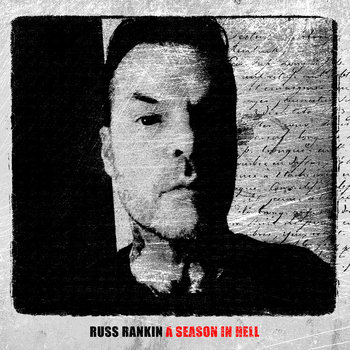
From time to time Rankin has released solo material. The previous two solo releases, Farewell Catalona and Come Together Fall Apart, have mostly kept with the same themes of Good Riddance albums with a much more personal flair. While those records don’t go as hard, this doesn’t make them any less impactful. It’s just a different route to get the same sentiment Rankin has been preaching in all his years of punk rock. This week Russ Rankin releases an EP of solo material, A Season in Hell on Indecision Records. The record consists of six songs, three originals and three covers that give us an idea of where Rankin is at and what’s influencing him these days.
(edited for clarity)
Dying Scene (Forrest Gaddis): The record’s called A Season in Hell. Is that an Eddie and the Cruisers reference?
Russ Rankin: Good for you for picking up on that, but have you seen the sequel? The first one is a decent film; The sequel is pretty faulty, but worth watching just for that experience.
Dying Scene: What does A Season in Hell mean in the context of where you were emotionally when you wrote this album?
Russ Rankin: I’ve just been having a really tough time with music. The most recent Good Riddance album is a solid release. So far, the reviews and feedback has been incredibly positive. The actual process of getting the album together, on my end, was not super fun. There was a point where I even wanted to stop playing music at all.
A Season in Hell makes it sound overly dramatic, like something crazy happened. It wasn’t nothing like that. It was a long process. The album came out almost a year after it was recorded. Then there’d been about a year before that when we first began writing for the new album. It was a really long period of work on it. For some reason, I was just thinking about the movie Eddie and the Cruisers.
In the movie, there are rumors that he recorded this lost album, but it never came out. Where did he record it? What happened? I was just thinking about that, and I thought it was a cool-sounding title. It coincided with how I was feeling at the time: really divorced from any kind of joy around creating music, which is something that, for me, is foreign. I’ve been doing it for a long, long time, and I generally enjoy the studio process, as difficult as that can be sometimes. For whatever reason, I just was not feeling it. I didn’t pick up a guitar for almost a year after that album was recorded. So, in a way, it was a little cathartic, I guess.
Dying Scene: Do you feel these songs were a response to recording that album?
Russ Rankin: These were songs that I had written and really thought were strong, but they were sort of in conflict with the overarching theme of the stuff Good Riddance was coming up with for the album. I kind of knew they wouldn’t have a place there. Yet I’d spent a lot of time crafting these songs, I believe in them, and I’d like to do something. I battled internally for a long time with recording them on my own, and part of me was like, “I don’t want to bother; what’s the point?”
Then it was my therapist that convinced me to do it. She thought that it might sort of have some measure of mending my relationship with music, and that ended up being true. The experience in the studio recording these songs myself was joyful and productive. I remembered all the reasons why I liked doing music again, so it was really cool.
Dying Scene: Do you feel there is a difference between your solo voice and the voice you use with Good Riddance?
Russ Rankin: Like, my delivery?
Dying Scene: Not delivery, like the songs you’re writing.
Russ Rankin: I don’t think so. There’s a universe that exists where those could have been Good Riddance songs, and it wouldn’t have ruffled anybody’s feathers. A Good Riddance fan wouldn’t have heard them and said, “Oh my god, what is this?” We put out a record called Operation Phoenix a long time ago, and it was very different from what had come before it. It ruffled plenty of feathers, but it also got us some new fans. It also established us as a more diverse band than a harder band. I think that it’s not a different voice; it’s still me. It’s still lyrically definitely some things that would be at home on a Good Riddance album.
Dying Scene: Did you play all the instruments on the record?
Russ Rankin: Except for drums, it’s Adam Gomez; he plays in the Dickies and D.I., and he’s played for the Adolescents when Mike couldn’t.
Dying Scene: Did any of the songs go through different versions before landing where they did?
Russ Rankin: They did, but it was a long time ago. By the time I was in the studio, there was almost no revision of the three originals. So Paul Miner, who was the engineer that did the recordings, would offer some subtle suggestions here or there, but very little. They were fleshed out. I knew exactly how they were going to go, and there wasn’t a lot of experimentation, if that’s your question. I got into the studio with these loose ideas, and then with Paul, we sort of molded them into songs. Actually, no, they were pretty well intact front to back, and it was a matter of just performance, recording, and getting the right feel.
Dying Scene: Had you worked with Paul before this?
Russ Rankin: Yes, I want to say he engineered, I cannot remember exactly, but I used to produce bands in the early 2000s, and I produced a band whose session Paul engineered, and he definitely recorded my first solo album, Farewell Catalonia, in 2012.
Dying Scene: Was the experience of working with Paul on the first album what made you want to work with him on this new one?
Russ Rankin: I wanted someplace that was relatively close, and I had a really good experience recording my first solo album with Paul. Neither one of us had done a solo acoustic album before, so neither of us knew what we were doing. He was so great at steering the ship and coming up with ideas, although that level of oversight and guidance wasn’t really necessary this time. With his demeanor in the studio and his engineering acumen, I felt really comfortable doing it with him. It was down in Orange, California; I could fly down there, get a hotel, and knock this out. We didn’t think it would take very long. He had worked with Adam before, and I think it was a combination of things. I felt like he was a good candidate to do it. I hit him up, and he was available and happy to do it.
Dying Scene: There are three original songs on here. Did you have more original songs you wanted to put on the record?
Russ Rankin: I wrote a massive amount of songs in the process of putting together the last Good Riddance album. I wrote a pretty good amount of songs that were rejected by one band member or the other during the demoing process that I felt were strong. There were extra arrows in the quiver. I thought, well, for my purposes and the free time that I have, this would probably be a pretty good amount of songs to do. These are three of the strongest songs I have written in a long time. I think there is a world where they are maybe a little too on the harder side for what Good Riddance was going for. Although I want to say that the most recent Good Riddance album does have a pretty dark and hard feel to it, and that was by design. These songs were just a little too much or would stick out as being just too different.
That said, I feel like they were really strong, which is why I held on to them and kept thinking, even if these aren’t going to be Good Riddance songs, I would kind of like to see them recorded and finished, just to have them, even if nobody was going to put it out or anything. If I just had them, I would feel some sense of closure, maybe. Look at them as finished products rather than just these demos I had sitting on my computer. I really felt they were strong. I still do.
Dying Scene: I agree. I enjoyed “Rising Tide.” It reminded me of a Dag Nasty song in some parts.
Russ Rankin: That’s a huge compliment. I’ve been on a big Dag Nasty kick lately. I feel like Dag Nasty might be the perfect band, as far as a band that lived in a melodic world and a hardcore world. I love Dag Nasty.
Dying Scene: I feel like every time I listen to a hardcore album, I can feel their fingerprints all over.
Russ Rankin: Their influence is infectious, and it’s everywhere. It’s not the first band that a lot of people would come up with as, like, “Oh, I can sort of hear some of so-and-so in this,” but I think it ought to be. They’re not like a secret. They’re not some band that no one’s ever heard of. They were a pretty popular band. Even now, their music stands up to today’s music, but they’re not the first band off the tip of people’s tongues.
Dying Scene: The other half of the record consisted of cover songs: an Avengers song (“Cheap Tragedies”), a power pop song (“Starry Eyes”), and “The World Turned Upside Down.” The last one feels like a Billy Bragg song.
Russ Rankin: Leo Roselson wrote the original, but I covered Billy Bragg’s version. He arranged it and popularized it. It’s much more stripped-down. I was covering a guy covering another song.
Dying Scene: It’s good, though. It’s very appropriate for the times that we’re in. How old is the original?
Russ Rankin: From the 70s.
Dying Scene: It’s a song that feels relevant fifty years later.
Russ Rankin: I totally agree with you. I’m a huge Billy Bragg fan, and a lot of his songs that give me all the feels for reasons like you said; it’s prescient, it’s valid now. It’s really a song about classism, about property rights. A lot of the things that ail Western culture today. I think it was relevant. The way that it’s delivered in the Billy Bragg version particularly is just so direct and emotional for me. That song has always sort of given me chills whenever I heard it. I thought that’s definitely one I would love to take a run at.
The Avengers: I heard “Cheap Tragedies” on a comp when I was probably like early high school, when I was first diving into punk rock. When I first was getting into it, I would buy compilations because it’s a cheap way to find out bands you like. I heard that song, and then when I found out they were from the Bay Area, I thought that was cool. Then I learned that they were one of the bands that opened for the Sex Pistols at the very last Sex Pistols show that I acknowledge.
Starry Eyes: I listened to a lot of First Wave on SiriusXM because it’s my jam. It’s my generation, like all those songs from the 80s, and what’s funny is so many bands on First Wave are bands that I couldn’t stand when they were relevant, like when I was in high school. I’m like, “This isn’t punk,” like Depeche Mode, The Cure, The Smiths. I just wrote it off. Now I listen to it, and I’m like, “This is fantastic.” I don’t know whether I’ve grown musically and opened my mind up enough, or whether it’s just nostalgic for me.
People seem to gravitate towards music from a time when they were teenagers, before they were weighed down by responsibility and adulthood. So I think it might be a combination of that, and then I heard this song “Starry Eyes”, and I was like, I had never heard of the band (The Records), and I thought, this song has so many hooks. This is fantastic songwriting, whoever this is. I looked them up, and they really never had any other hits. They weren’t around for a long time. That song kept coming on, as if it was telling me, “Hey, don’t forget about this song.” When I hear a song like that, a lot of times, just for fun, I’ll try to cover it on my computer at home. I’ll learn it in lyrics, I’ll learn it on guitar, then I’ll record a version of it, just for my own entertainment.
That’s a song that I think I actually petitioned the band to cover on this last album. There I was, just humming this song by the records over and over again by myself. It’s got tons of hooks. It’s a great, well-written song, but it just sounds too slow to me. The guitars are too twinkly for me; I want some oomph in it. I thought, “What would it sound like if Generation X played this song?” This sounds like it should be a Generation X song, and that was the road I went down when I decided to cover it. Bring up the tempo, make it a little bit punchier, and try to make a Generation X song.
Dying Scene: Were there other covers you considered?
Russ Rankin: I don’t think so; I can’t remember any right now. Those three were the main ones. I just couldn’t escape them. They were in my head. I listened to that Billy Bragg version of that Leo Russell song many, many times and just thought the story was brilliant. It was timeless. Politically, it spoke to me. Made it somehow even more urgent and angry-sounding. A million other people have covered Billy Bragg, and that’s fine. I thought it was interesting that it’s not his song, but I thought his arrangement of it and his delivery of it kind of made it his song. When I’ve done press, it’s always been important for me to acknowledge that this is a Leo Russell song. He is the guy that wrote it.
Those three songs I just couldn’t escape. There’s other Avengers songs that I love, “The American in Me”; there’s a bunch, but I love “Cheap Tragedies” because it was so melodic for the time. I write a lot of songs and listen to songs from not a critical place. I put my songwriter hat to unpack it. “Here they’ve got a half bridge here, they’ve got a chorus here, then they do this, then they do that.” I’m always breaking songs down that way. It’s a really well-written song, especially for kids in the late 1970s. I thought the Avengers were ahead of their time, seminal band, and fantastic that they’re from the Bay Area.
Dying Scene: Does The Season in Hell feel like a standalone moment, or the start of something new?
Russ Rankin: I think it’s more of the start of the end of something. It’s me putting to bed the what-ifs, and actually having something tangible. Fortunately, Paul and my relationship is good; his rates were reasonable, and it got done quickly. Even if every label had said, like, this is garbage. If it never was going to get released, I wasn’t bothered with that. I just wanted to record it. I just wanted to have it. I wanted to see if I could have a pause to bring my mindset back to looking at music positively. As I said, I hadn’t picked up a guitar in over a year, and I was thinking about never wanting to play music again; that’s never happened. I think it was cathartic, and it was a way to get me back in love with music again.
Russ Rankin’s A Season in Hell is out tomorrow on Indecision Records.
Discover more from Dying Scene
Subscribe to get the latest posts sent to your email.