Welcome to Four Records! Each episode we feature one guest as they go over four records at four different times in their life. This week, Forrest speaks with Jim Ruland, co-writer of Keith Morris’s My Damage, Bad Religion’s Do What You Want, and most recently The Rumors of My Demise with Evan Dando. Jim has […]
Welcome to Four Records! Each episode we feature one guest as they go over four records at four different times in their life. This week, Forrest speaks with Jim Ruland, co-writer of Keith Morris’s My Damage, Bad Religion’s Do What You Want, and most recently The Rumors of My Demise with Evan Dando. Jim has a bi-monthly column in Razorcake Magazine and posts weekly on his Substack, Message from the Underground. For more info please check out his website at JimRuland.net.
I’m a sucker for a good concept album. I know it’s the writer/nerd in me, but anytime you can present a story in a new way, I’m in. Some concept albums can border on being a musical. While I’m very hit or miss with musicals, it’s a genre that is still being reinvented, as tastes […]
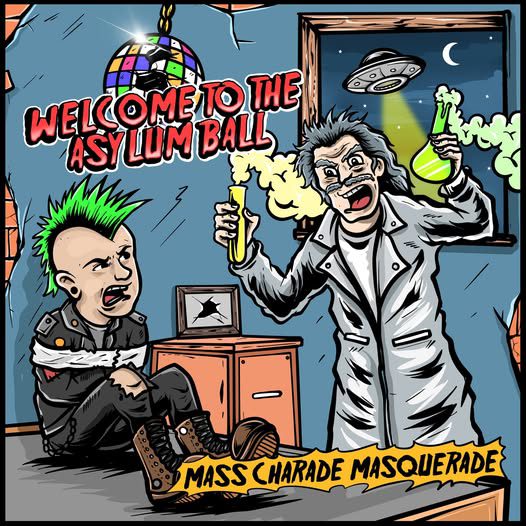
I’m a sucker for a good concept album. I know it’s the writer/nerd in me, but anytime you can present a story in a new way, I’m in. Some concept albums can border on being a musical. While I’m very hit or miss with musicals, it’s a genre that is still being reinvented, as tastes have blended and evolved throughout the years. Whether it’s taking an album like Green Day’s American Idiot and putting music to script or fully writing a punk rock musical like Fat Mike’s Home Street Home, punk rock has rubbed elbows with musicals a few times. This is why Mass Charade Masquerade’s Welcome to the Asylum Ball isn’t too out of its lane.
From what I can gather from the lyrics, the story seems to be about an asylum where an evil doctor is experimenting on its patients. It’s told from the perspective of one of the inmates navigating the hell scape of his own mind and the evil doctor’s experiments. After the inmate is seemingly killed and his body is discarded, he wakes up in a hole ready for revenge.
Welcome to the Asylum Ball opens with a Ramonesque song, presenting this story to the audience and setting the scene. I say Ramonesque rather than Ramonescore because this song feels closer to “Pet Sematary” than, say, “Gimme Gimme Shock Treatment.” After a couple of songs (“Straitjacket” and “DEADXALIVE”) from the POV of our protagonist, we switch over to our villain momentarily with “The Doctor.” After the protagonist wakes up in a hole and is left for dead, the rest of the songs on the album move the revenge narrative forward.
Some songs incorporate sound effects, which are inserted well. Clinking chains work in time with the beat of the song and give these tracks more atmosphere than just what’s in the mind of the protagonist. The music is well-written and has the hallmarks of the genre. It doesn’t break any molds, but its ambition does, which I appreciate much more. If you’re a fan of darker or more philosophical 1990s punk rock, a lot of these songs will resonate with you.
While I’ve written plenty of stories and tried to write songs, I’ve never been able to spin the plates simultaneously to do both. Mass Charade Masqueradecan sustain a coherent story throughout the album’s eleven tracks, and an enjoyable one at that. One aspect I liked about the lead guitar is that in some parts it takes on a Phantom of the Opera-like organ to give it another layer of eeriness and crossover with a genre not typically mixed with punk rock.
Mass Charade Masquerade’s Welcome to the Asylum Ball isn’t for everyone, but it is definitely worth a listen. It’s a risk that mostly pays off and sounds pretty good while doing so. Big swings like this move any genre forward, which is never a bad thing. If you are a fan of musicals or concept albums, check this out.
Legendary Milwaukee folk punk group Violent Femmes made its annual stop in Chicago recently. This time, The Salt Shed hosted the band’s sold-out stop on its “Grasp and Reach For a Leg of Hope” tour. It was a fun night filled with classic tunes and good vibes. Violent Femmes had this night all to its […]
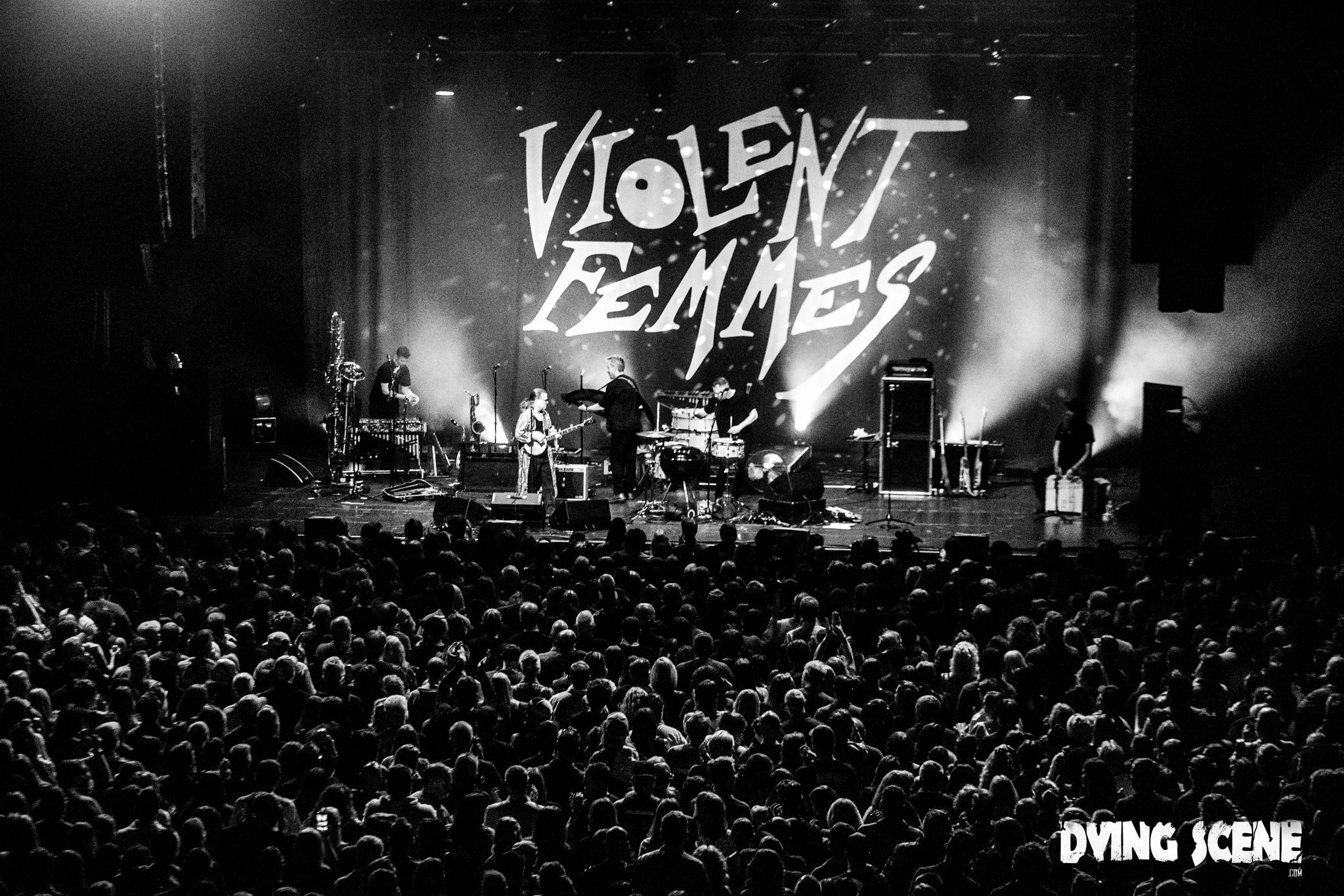
Legendary Milwaukee folk punk group Violent Femmes made its annual stop in Chicago recently. This time, The Salt Shed hosted the band’s sold-out stop on its “Grasp and Reach For a Leg of Hope” tour. It was a fun night filled with classic tunes and good vibes.
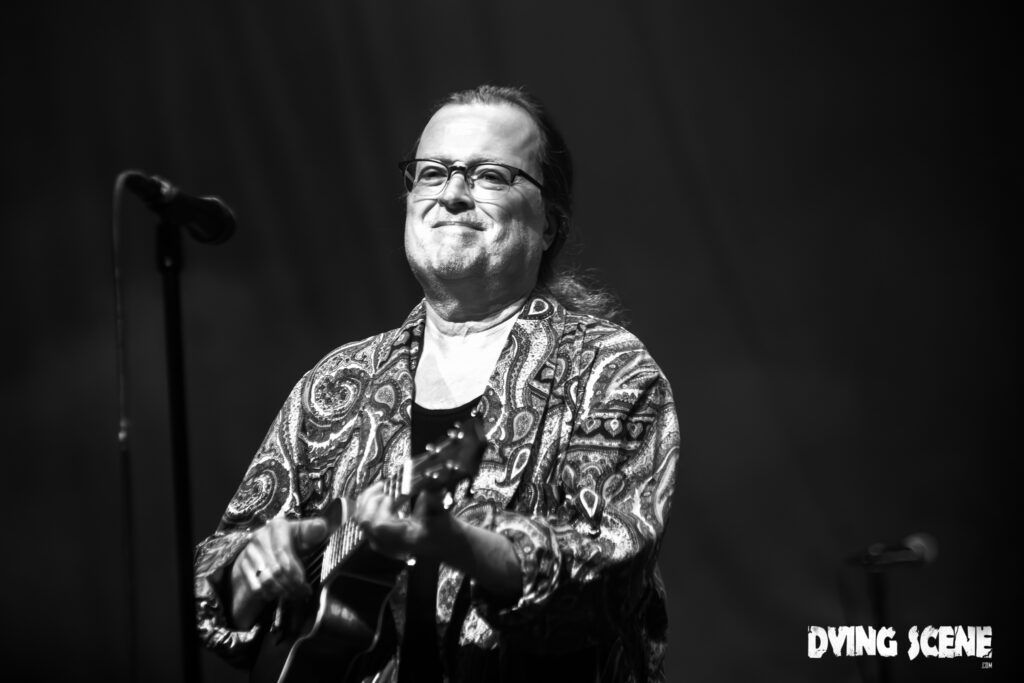
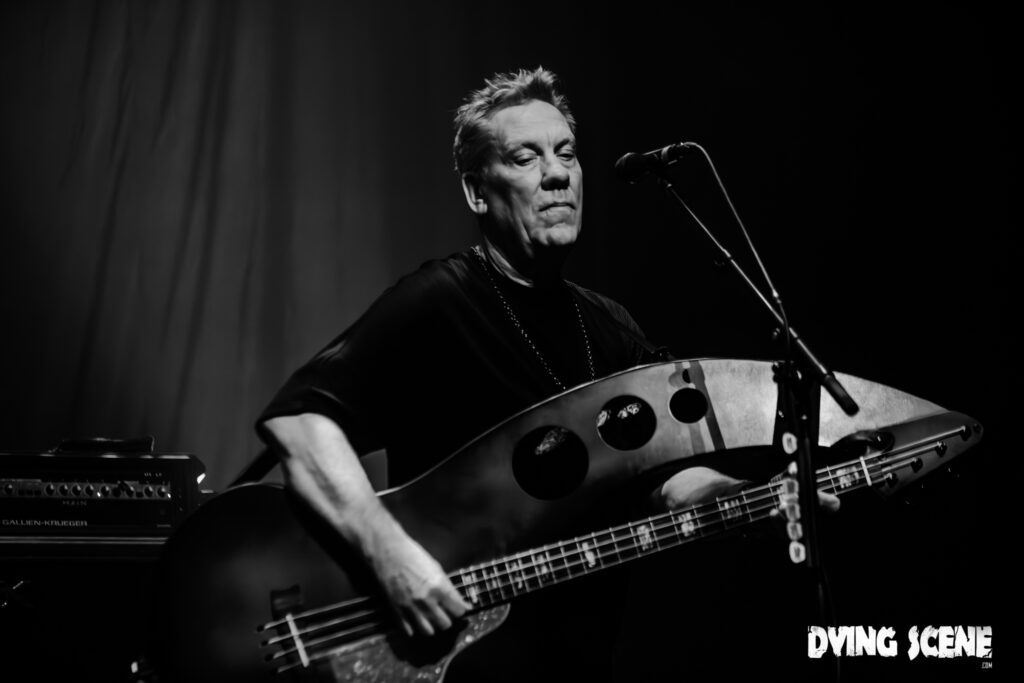
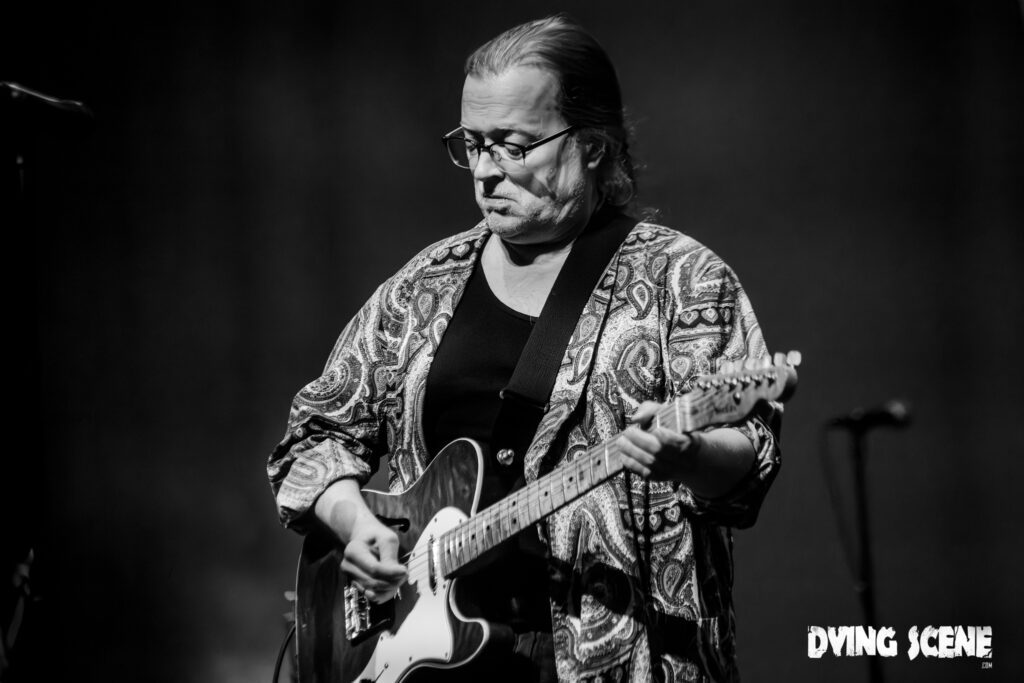
Violent Femmes had this night all to its quirky own and made quite the entrance. Singer, guitar, banjo and violin player Gordon Gano entered on stage, but his bandmates marched in from the back of the crowd. Kicking the set off with “Olinguito” set the tone for a night of the band’s trademark whimsy. If you are not familiar with the word in that song title, Olinguito is the name of an Andes-dwelling member of the raccoon family.
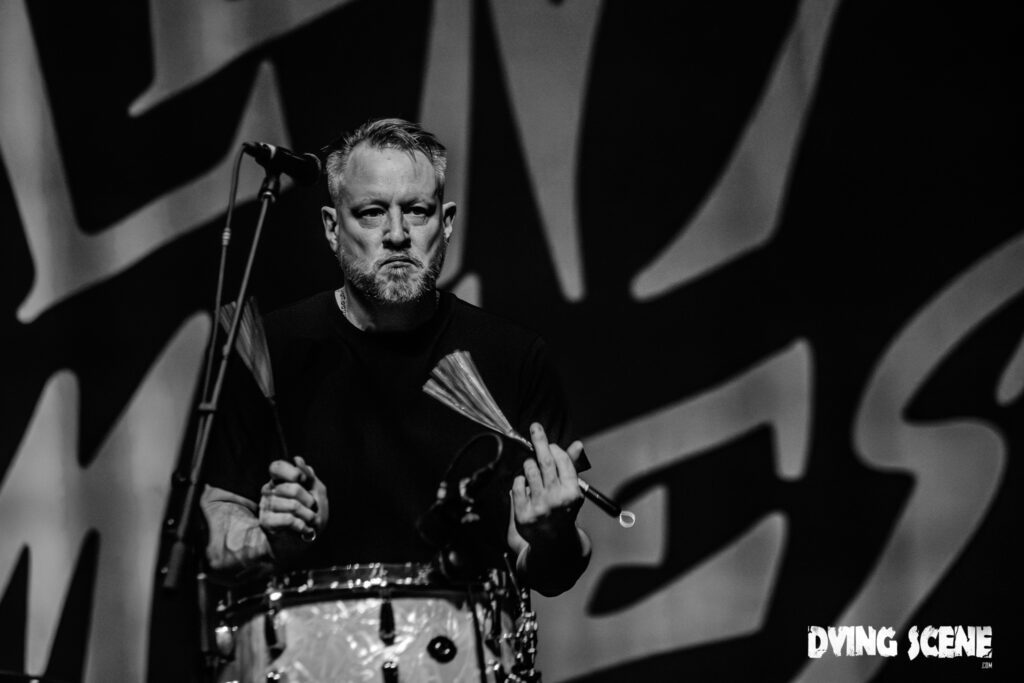
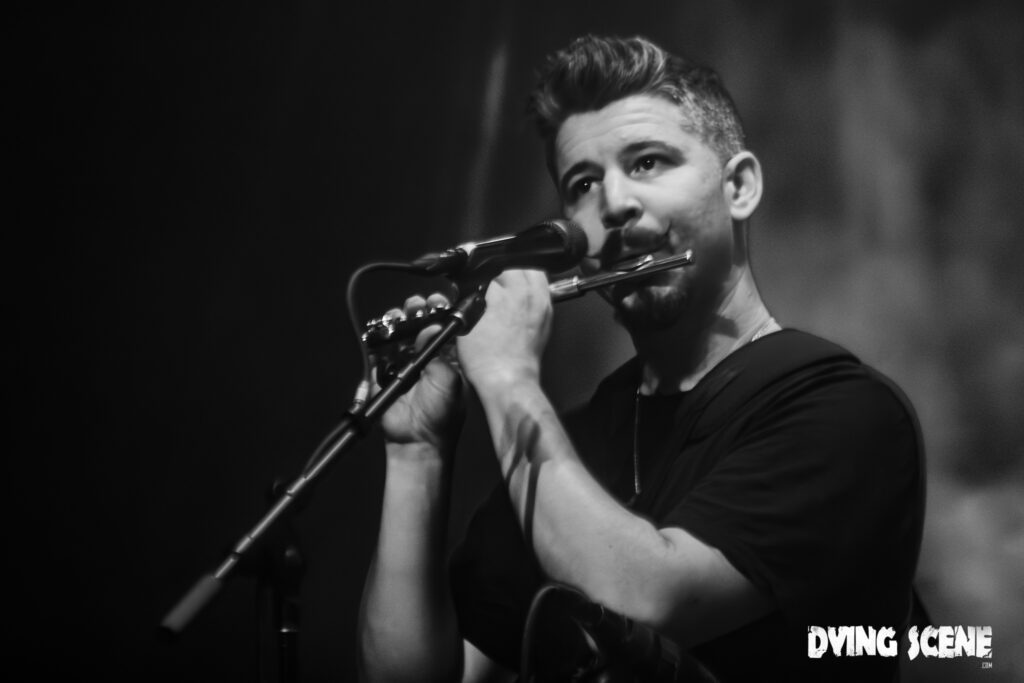
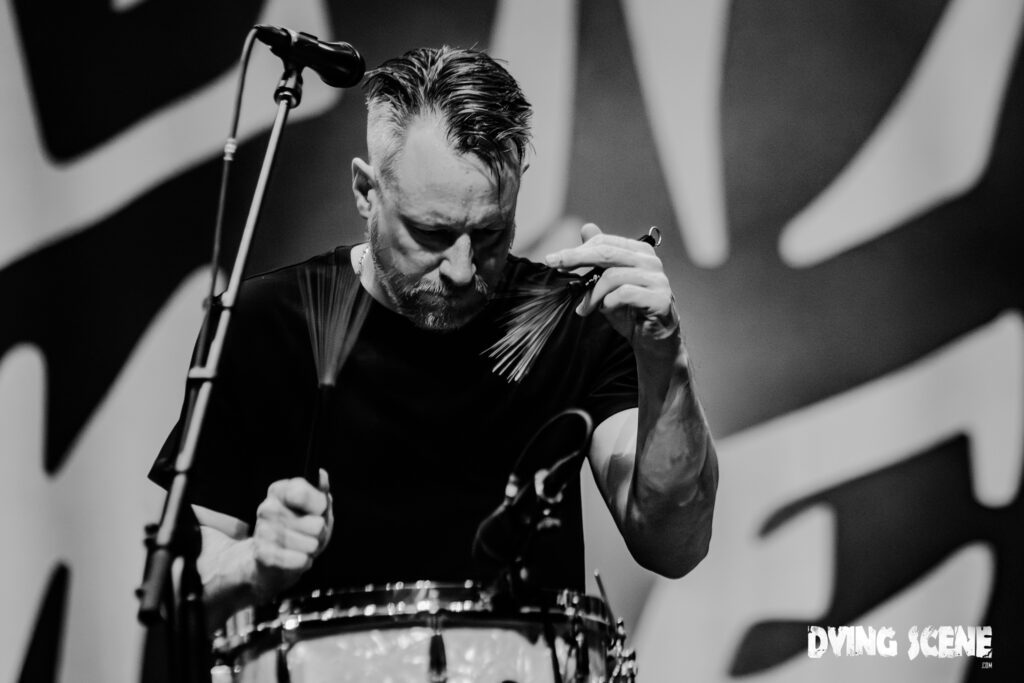
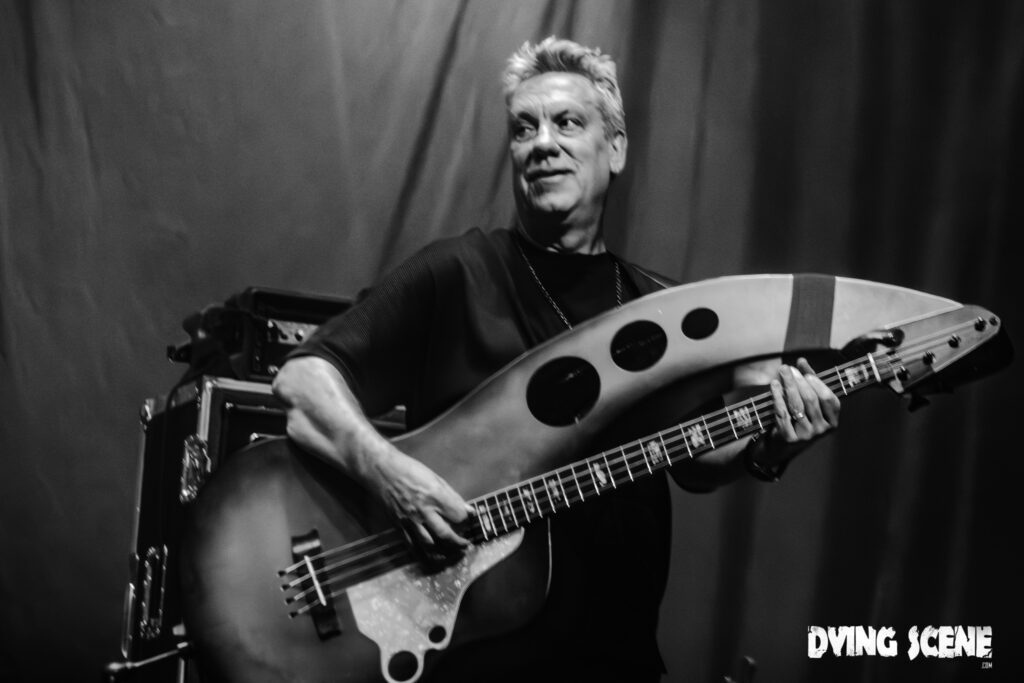
Along with Gano, Violent Femmes is composed of bass player/multi-instrumentalist Brian Ritchie, John Sparrow on drums and percussion (a Weber grill being part of his setup) and Blaise Garza on the saxophone, including the gigantic contrabass saxophone, and flute.
While the audience appeared to skew older, people who have likely followed the band from the start, there were also quite a few younger fans in the crowd. I met two sets of fans in their 20s, one from Los Angeles and one from Texas with another thing in common. These fans have followed the band across the country, catching multiple shows on this tour. The thing with fans of the Violent Femmes is they truly are the very definition of diehard fans. And on this night, per usual they were heartily rewarded for this.
The rousing 22 tune set included the biggest hits, including “Blister in the Sun,” “Kiss Off,” “Gone Daddy Gone,” “I Held Her in My Arms,” “Add It Up,” “Please Do Not Go,” and their traditional closer, “American Music.” Every one of these tunes sounded like a full venue sing-along as the crowd amplified each and every lyric.
The set list also included “Prove My Love,” “Waiting for the Bus,” “Country Death Song,” “For All Those Who Love,” “Jesus Walking on the Water,” “Good Feeling,” and “Betrayal,” among others.
Violent Femmes shows are always reliably joyful experiences. This show was no exception. It was apparent per usual, that the band was having as big a blast as its fans in the crowd were having.
The show also undoubtedly kicked off a weekend of good vibes for many in the crowd. The day after this show, the second “No Kings” march took place worldwide. An estimated 7 million people peacefully marched to oppose the encroaching authoritarianism and to declare there shall be no kings ruling the United States. I imagine quite a few of those fans rocking out to the Violent Femmes also laced up their shoes and hit the streets the next day, joining fellow citizens to push back on the fascist policies presently being instituted by carried out by the Executive Branch and its allies in Congress.
I have been fortunate enough to document several Violent Femmes shows in recent years. Hoping this continues for years to come. If you have never had a chance to catch them, I recommend you do so at your very next opportunity.
We get some interesting records in the Dying Scene inbox, but something connected with me when I listened to Zachariah Tazewell’s appropriately named record, Opening Old Wounds Through Scar Tissue. Self-described as an experimental songwriting project, Tazewell used these songs as a way to deal with mental health while living in Northern Tasmania, Australia, and […]
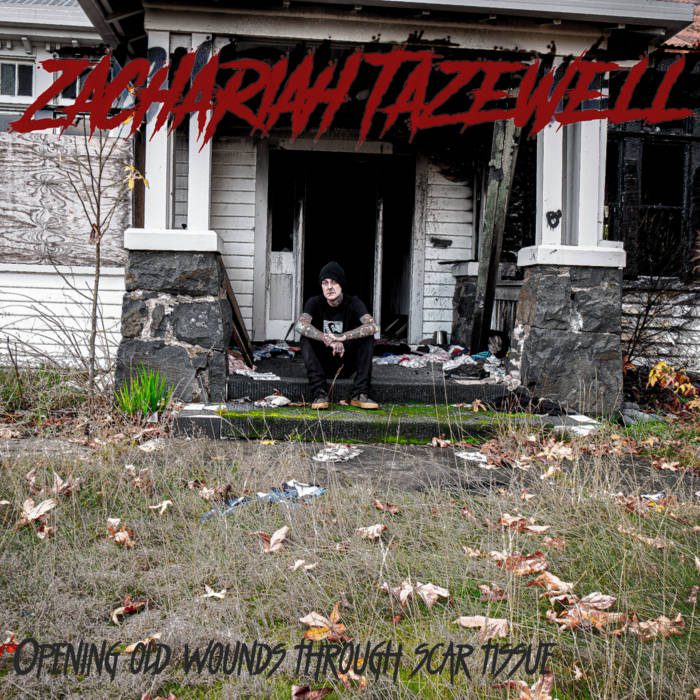
We get some interesting records in the Dying Scene inbox, but something connected with me when I listened to Zachariah Tazewell’s appropriately named record, Opening Old Wounds Through Scar Tissue. Self-described as an experimental songwriting project, Tazewell used these songs as a way to deal with mental health while living in Northern Tasmania, Australia, and takes us on a journey into his mind. Using song titles and lyrics making references to video games and popular works of sci-fi, Tazewell shares his unique perspective and charm.
While this record runs through a gamut of genres (punk, reggae, folk, hip hop), a couple of highlights for me off this album were “Driftwood in the Sea of Time” and “We Happy Few.” “We Happy Few” contains the line that stuck with me the most, but I ultimately disagree with it when it comes to describing this album: “If home is where the heart is, I guess I’m homeless.” Opening Old Wounds Through Scar Tissue is manic and heartfelt in a way that’s usually reserved for Tom Waits albums.
Zachariah was nice enough to answer some questions about his record and his process of putting it together.
How long did it take to record?
It took about seven months—I think I started structuring the songs back in March.
Do you play all the instruments and which ones did you use?
I played the guitar and handled the MIDI synth/orchestral sections, and I used Toontrack plugins for the bass, technical piano, and drums. Most purists would probably hate that, but I just see it as having virtual band members.
What is your process for arranging your songs?
I arranged each track a bit differently. Some I wrote on acoustic with lyrics first, others I built by jamming on my electric with MIDI drums, and I just keep layering once I’m happy with that, and a few I fully structured and recorded all the instrumentation before writing any lyrics.
What bands influenced these songs?
It’s probably a pretty big list of influences—I’m a huge fan of music in all its forms—but I’ve always been drawn to genre-bending punk bands like No-Cash, Get Dead, The Taxpayers, and The Clash. And even though it’s controversial because of Scott, I won’t deny that LOC and SFH were influences. More recently, I’ve been loving the Codefendants’ stuff, and my new appreciation for the Australian hip-hop artist Wombat pushed me to give that style a go.
Did I spot some Sci-fi and video game references?
Haha, I’m glad you noticed—there are a few sneaky sound clips in there. I’m a bit of a nerd. It could probably get me sued, but I think it sounds cool.
If you’ve been reading DS for a while, you’ll know that I count myself amongst those who got into the punk and ska scenes of the Boston area in the mid-1990s. Part of what drew a countless number of us to the scene was the anti-racist, anti-fascist messaging and the way kids from all walks […]
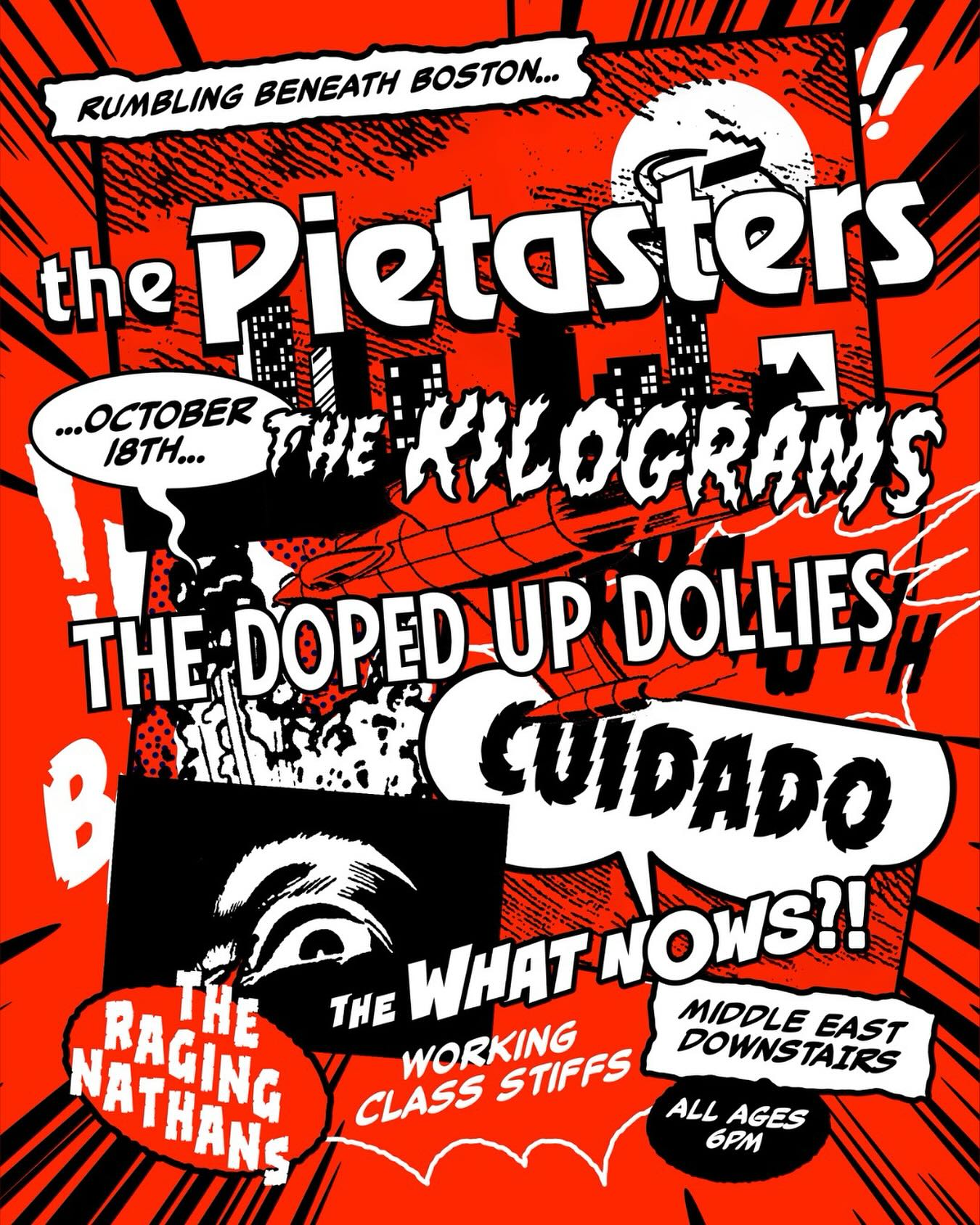
If you’ve been reading DS for a while, you’ll know that I count myself amongst those who got into the punk and ska scenes of the Boston area in the mid-1990s. Part of what drew a countless number of us to the scene was the anti-racist, anti-fascist messaging and the way kids from all walks of life could revel together in the chaos, picking each other up when we fell along the way. It’s a little bit of “old man yells at cloud” to lament that the scene has changed so much over the years, but thanks to the good folks at Riot Squad Media – the same crew who brings you the wonderful Camp Punksylvania every summer – there’s a new throwback game in town. It’s called Circuit Breaker, and it’s basically a series of jam-packed, barn-burner shows in and around the Northeast that feature a fine mix of ska and melodic punk bands that serve to give the DIY community a shot in the arm and light – or relight – the way for punks of all ages to keep coming together.
The – dare I say legendary? – downstairs at the Middle East in Cambridge, Massachusetts’s Central Square was the setting for the maiden voyage of Circuit Breaker. The Middle East – both downstairs and upstairs – is a venue that it felt like I practically lived at for a time, especially during college. I hadn’t been to the larger, downstairs venue since a few years pre-Covid, but before even hitting the bottom of the stairs, it was evident that very little had changed. The low-ceilinged, dimly-lit, no-frills venue was the site of many dozens of punk and ska shows that essentially molded my formative music-loving brain in the mid-late 90s, and seeing Big D and The Kids’ Table frontman David McWane on stage immediately brought me back to that place and time.
There were seven bands on the bill for Circuit Breaker which, for a show with set times that kicked off at around 7pm (6:55pm if we’re being totally accurate), seems bananas and seemed destined at least in my mind to go way over time. In the interest of full disclosure, life obligations and parking kept yours truly from getting to the venue until the 8 o’clock hour, which sadly meant missing sets from Niagara Falls’ Working Class Stiffs and Reading PA’s The What Nows and catching about half of McWane’s alter ego band, Cuidado.
We were there, however, for Dayton, Ohio’s The Raging Nathans. Much to the chagrin of a handful of DS staffers, yours truly had never seen the Nathans prior to this show. That was clearly a mistake on my part, I freely admit. The Nathans rule. With little time to waste in order to help the mammoth lineup keep a tight schedule, the band got right to work with a tight, high-powered set that featured a healthy dose of tracks from their latest full-length, May’s Room For One More (Rad Girlfriend Records).
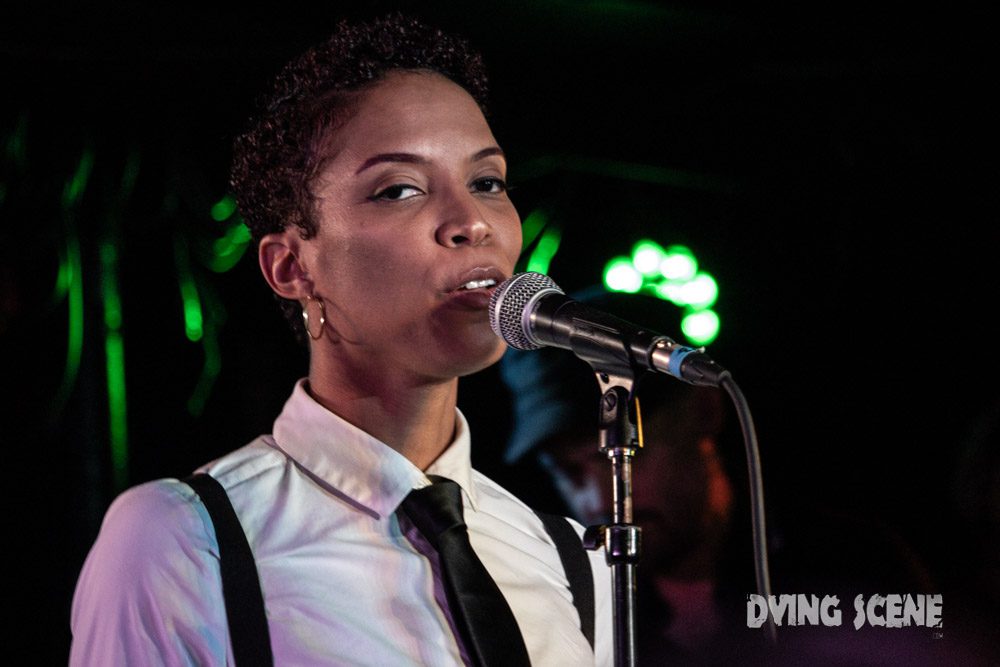
Next up were The Doped Up Dollies. The Dollies are another brainchild of Big D’s David McWane, but this one finds McWane in the background, mostly on percussion and backing vocals duties. Instead, DupD are fronted by the ultra-talented trio of Brie McWane, Sirae Richardson (pictured right) and Erin MacKenzie, who combine to bring a fun, high-energy soul to their unique double-dutch reggae sound. Their nine-song set kicked off the PMA-infused anthem “Make Your Own Sunshine,” and had the crowd dancing in the pit from the first notes. The McWane/Richardson/MacKenzi trio might be backed by – at my count – an eight-piece band, but their interplay and doo-wop harmonies are very much the engine that keeps it moving, highlighted as always by their interplay on earworms like “Be Free” and “Black Cat.”
The penultimate spot on the bill belonged to a band that is perhaps my favorite new band of the last couple of years, The Kilograms. The band kicked things off with “No Reaction,” a song that appeared on co-frontman Joe Gittleman’s 2024 solo album, Hold Up. After a quick mid-set guitar change to swap out a finicky Telecaster, KG’s co-frontman Sammy Kay took over lead vocal duties on the danceable “Every Street.” This was followed by early single “I Swear” and then a set that leaned heavily on the band’s debut full-length, Beliefs & Thieves, with a slow-burn cover of the Gittleman-penned classic “Lean On Sheena” thrown in for good measure. Guitarist J Duckworth and keyboardist Craig Gorsline serve as spark plugs, constantly rocking and dancing on stage and encouraging the audience to do the same. Extra-special props to fill-in drummer Alex Brander, who was behind the kit for the third time in four sets after also appearing in Cuidado and the Dollies. The band closed their set with a super fun rendition of another Gittleman-penned solo track, “Glimmer.”
Which brings us to the evening’s headliners, none other than The Pietasters. In a fun and playful moment, the Baltimore ska vets started their set with their own rendition of Gittleman’s “Glimmer,” much as they did on the split 7-inch they released together last year. The very first time I saw the Pietasters – nearly 29 years prior to this show – they shared the stage with Gittleman’s old band, so it was a fun full-circle moment for me to catch them sharing a legendary Boston-area venue again. As an added bonus, Gittleman’s old bandmate, Chris Rhodes, was a trombone-wielding Pietaster for the night! After “Glimmer,” the band made their way through another fun and soulful set that was heavy on tracks from their sophomore album (and my favorite one), 1995’s Oolooloo.
All in all, it was really a brilliant evening filled with connection and positivity, the kind of things that prompted so many of us to gravitate to this scene decades ago. In an increasingly dark and negative world, it’s so important to have evenings like this filled with people shining light in the darkness, standing up for the trans kids and immigrants and the working class who are continually trampled on in newer and more horrifying ways. Have a look at a bunch more pictures from the fun and festive evening down below. And make sure to follow the Riot Squad Media crew on social media to keep an eye on where you can find Circuit Breaker popping up next (like Scranton Skaliday’s throwdown in PA next month)!
For those lucky enough to have an older sibling or person in their life to act as a music mentor, it makes starting your journey in any genre of music much easier; punk rock and its adjacent genres are no exception. While some of us find our own way, others need a guide. This appears […]
For those lucky enough to have an older sibling or person in their life to act as a music mentor, it makes starting your journey in any genre of music much easier; punk rock and its adjacent genres are no exception. While some of us find our own way, others need a guide.
This appears to be the goal of John Zukowski’s book, The Only Music That Mattered: A Guide to Punk, Post-Punk, and Second Wave Ska, 1976-1983, part of the Studies in Punk series from MacFarland. Focusing on the salad days of the genres, Zukowski has compiled an A-to-Z guide, sorted by band name, of the most important albums from those particular years.
Zukowski argues why punk rock was so important and why its architects felt their voices needed to be louder and more independent than most. He chalks it up to Generation Jones, Baby Boomers born between 1954 and 1965, who were raised by the hippie culture but saw its shortcomings and decided to take it further. This disillusionment led to the emergence of politically charged punk rock and the notion of not compromising one’s principles by selling out. This probably gives us what people call the punk attitude. Punk was a way to rebel and be an outsider; Generation X’s way of playing ball with the majors softened this view.
I will say I was thrown off by this book. If you were hoping for some commentary on the music of this time, you’ve picked up the wrong book. While this book is a great extended list of important records from this time, it is just that. There are no more than a couple of paragraphs of neutral description on the LPs, EPs, and seven-inches listed here, which makes sense to me as this list is a primer to help form your own opinion on these records, if you haven’t already.
I think this is effective up to a point. At the risk of sounding old, back in my day, you had to do the legwork: buy and trade records, or even go to shows to support them, if you were able to catch any of these bands. While some of these bands have endured or reunited, a good number of these bands were definitely a time and place type of situation.
For every band I knew in this book, there was at least one I hadn’t listened to or heard of before. Since writing for Dying Scene, I’ve been thinking about what my blind spots are in my musical past; this book was a good way to put some of those in perspective. There are a good number in this book that didn’t tickle my fancy in my youth but probably deserve another chance as I’ve aged.
While the list is comprehensive, Zukowski presents what he considers essential without grasping at straws. You may feel there are some glaring omissions. The list itself features classic albums, but also rare gems that may have been missed for one reason or another. Most of the bands’ albums listed are their early works, which is odd to me as we have had time to sit with some of these bands’ later output.
However, as I have found in a lot of academic books, there are multiple mistakes in the text in regard to spelling and proper names of subjects. It is blatantly obvious there’s a disconnect somewhere in the pipeline to address bands properly. This one was nowhere near as dense as some of the others I’ve reviewed. The blurbs are mostly satisfactory in their descriptions. This book was better than most in general, but I continue to be critical of the errors I find in these books.
From punk and hardcore classics to new wave and goth, and even some novelty records, the genres The Only Music That Mattered covers are varied but poignant. It’s not youth that keeps this music relevant; it’s the older fans making sure these songs are passed on to newer fans. This should be the list you’d give to a kid in their teens to check off as they find them in a record store. More than likely, they will just look them up on a streaming service, but at least they have a map.
The Only Music That Mattered: A Guide to Punk, Post-Punk, and Second Wave Ska, 1976 – 1983 is available at McFarland books.
Compilation albums have been a staple of punk rock for years. They have always been a great way to give you a preview of a record label’s lineup and sound. Sell the Heart has released their compilation, A 7 Step Guide to Happiness, with seven non-album tracks from the label’s fantastic lineup of bands. A […]
Compilation albums have been a staple of punk rock for years. They have always been a great way to give you a preview of a record label’s lineup and sound. Sell the Heart has released their compilation,A 7 Step Guide to Happiness, with seven non-album tracks from the label’s fantastic lineup of bands.
A Seven Step Guide To Happiness kicks off with the indie and post-hardcore sounds of Her Head’s On Fire‘s song, “Bound.” The song’s steady and meditative opening matches the almost zen-like chanting of the vocals. Consisting of members from other bands such as Garrison, Saves The Day, and Small Brown Bike, Her Head’s On Fire has a lineup familiar enough to push it to new levels.
Next up is San Diego’s Hauntu and their song “Mote It Be.” Self-describing themselves as ghost punk, their haunting vocals delivering dark lyrics and fuzzy garage rock guitars elevate this song beyond what could be what separates them from being just another horror punk band. “Mote It Be” is a good taste of what’s to come on their upcoming LP.
I thoroughly enjoyed Neckscars‘s LP Unhinged when I reviewed it a couple of months back. This is the title track, but it’s not on the album itself; it serves as a great extension of those songs. Shotclock’s song, “Fucked,” is three minutes of pop-punk delight. Moderately tempoed with a hint of regret in its lyrics.
“Brackney,” contributed by Time Spent Driving, has that Midwest Emo feel. While the United Kingdom-based band, Bear Away’s “Modern Mountains” picks things up with a melodic hardcore song, Hotlung closes this comp with their song, “Fire it Up.” It’s a heavier guitar sound that feels closer to Alice in Chains than the emo and punk rock influence featured on this comp, but it works.
While each band is different there is definitely a through line when it comes to the bands’ sound, which could border on nostalgic if they weren’t so damn good at updating the genres. That’s something that could be hard to maintain when everyone is influenced by a similar sound. Sell The Heart does a great job choosing bands that vary enough in sound to not be repetitive. A 7 Step Guide to Happiness is a great example of this. Pick up Sell the Heart Records’ A 7 Step Guide to Happiness here.
Once upon a time, Brian Baker played bass in Minor Threat. He then played guitar in Minor Threat and then went back to bass again and that band broke up but not before completely changing the musical landscape for the next several generations. In the meantime, Baker went on to play guitar for Samhain for […]
Once upon a time, Brian Baker played bass in Minor Threat. He then played guitar in Minor Threat and then went back to bass again and that band broke up but not before completely changing the musical landscape for the next several generations. In the meantime, Baker went on to play guitar for Samhain for like a fortnight and was in Government Issue for a little longer and then started Dag Nasty and he went kinda metal in Junkyard and he almost went college radio with REM but instead he came back to the punk rock world by joining Bad Religion when Brett Gurewitz left. Brett of course came back, but Baker stuck around and has for three-plus decades now. (He’s also shredded for bands like Fake Names and Beach Rats and more that I’m sure I’m forgetting. Foxhall Stacks maybe?) Anyway, it’s Bad Religion that has afforded Baker the opportunity to travel the world a few times over. For the last fifteen or so of those years, Baker – like the majority of us – has been accompanied by his cell phone. In his case, it’s an iPhone. Not a fancy iPhone, mind you, but whatever one gets the job done; the job usually of sending texts and taking pictures to mark various interesting places and locations and images.
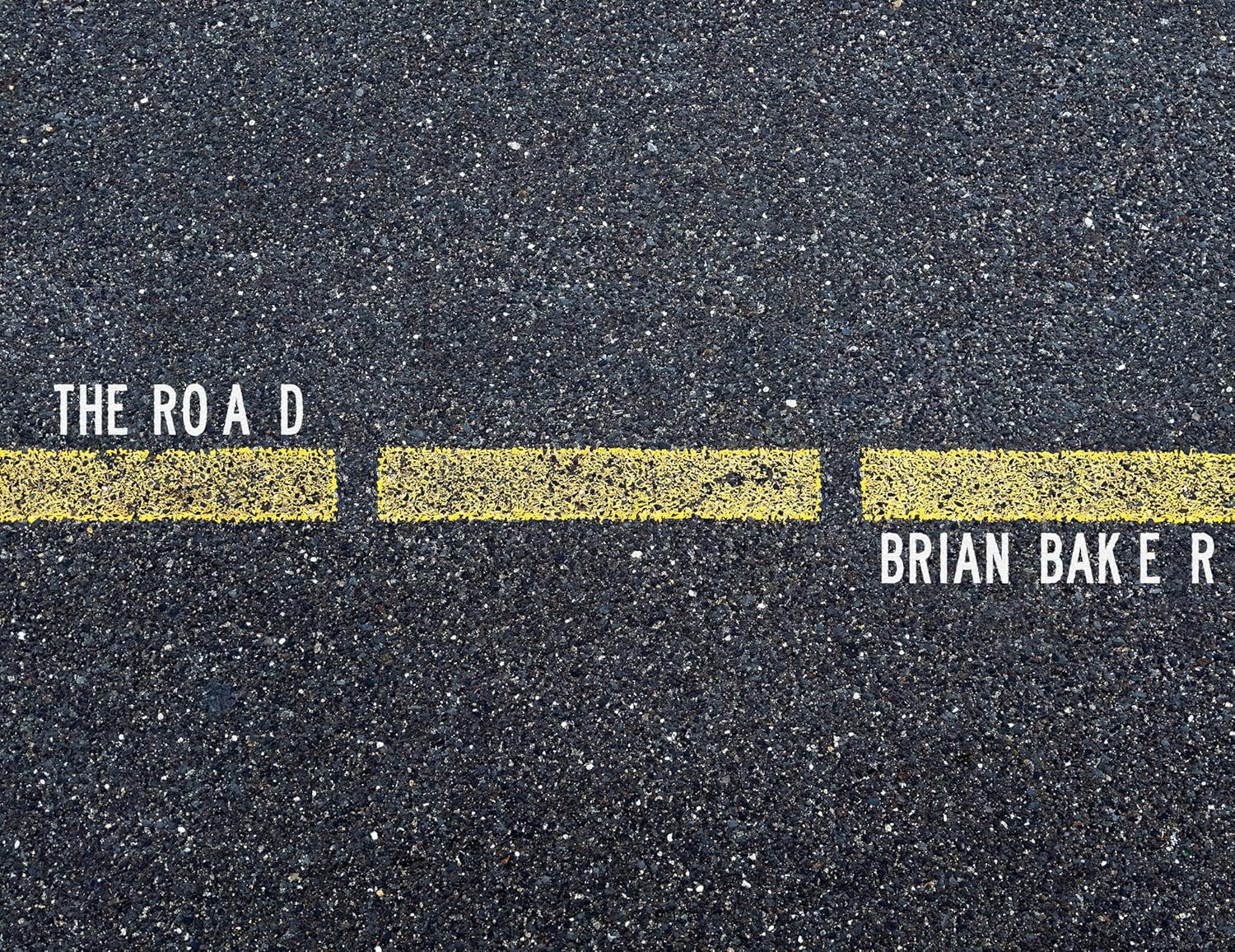
Fast-forward to November 4th of this year and we find ourselves at the release of The Road (Akashic Books). The book is a collection of a hundred or so of the iPhone images Baker has captured over the years, mostly presented without context. This creates the effect of encouraging the viewer to tell their own story as to what that particular sign was saying, or where that particular building is, or why that particular doll’s eyes look so blank and creepy. As Baker tells it, the goal was never even remotely to have a physical, tangible display of his cell phone pictures. At first, the goal wasn’t even to share them outside the small circle that was their intended recipients. “Initially, I wasn’t even ‘taking pictures,” he explains. “I was just sending a visual text basically, because it’s easier to sent a picture than a text. Half (of this book) is so completely uncontrived that it’s just pictures I was taking to text to someone to tell them where I am. “Where are you?” “Oh, I’m here at the graveyard.” Twenty years later, you go, “well that was a pretty cool picture,” when I was really just trying to tell (Bad Religion bassist Jay) Bentley where I was.”
Eventually, Baker did start to pepper some of his interesting travel pictures on his Instagram page, sprinkled in amongst the Bad Religion/Fake Names/Beach Rats promo flyers and New York Mets fanposts and his delightful “One Guitar In One Minute” series where he – you guessed it – tells the story of one of his guitars in one minute (give or take). It took the repeated insistence of his wife, Victoria, to get Baker to even consider that people might enjoy and even buy a collection of his pictures in book form. It turns out there are more than a few similarities between the way this book came together and the way the first Minor Threat foray into recorded music came to be. “I know that there would have been no Minor Threat records if we hadn’t run into a guy named Don Zientara, who had built his own studio and knew how to record music…sort of,” states Baker. Minor Threat’s Ian Mackaye and Jeff Turner had also famously already started the now iconic Dischord Records, so they already had a label and distribution in house.
And so sure, Baker’s wife was supportive, sure, but as the co-founder and director of Transformer, a long-running visual arts non-profit in Washington DC, Victoria also knows more than a thing or two about the subject matter. She also knew some people who could help make it happen. Enter Jennifer Sakai, book designer and Board President at Transformer. “My wife had said “Hey, Jennifer, you know, you should check out Brian’s Instagram page.” And Jennifer, on her own, made a mock-up just using pictures from my Instagram page and emailed it to me. And I was like, “whoa!” And this is the early stages. It’s not what you’re holding now. But it was just…I had never even thought about it in that way. And most of those pictures aren’t in the finished product, she was using them as placeholders. And I was like, “Jesus, that’s so cool.”
Photo by the author, Boston MA 2014
When it came time to actually commit to producing a physical book and distributing it to the world, Baker also didn’t have to look very far; his former Washington DC elementary schoolmate and current Fake Names bandmate/bassist Johnny Temple (Girls Against Boys, etc.) also happens to be the same Johnny Temple who founded Brooklyn-based Akashic Books in the late 1990s. “I showed it to him, and I said, “Do you think this is something you’d want to put out?” And he went, “absolutely. I’d love to put it out,” Baker explains. “And that was it. That’s the contract. It’s very, you know, it’s very punk. Akashic is kind of very Dischord-y. They just do what they feel like. There’s no contract, really. It’s just like, “we’ll split the profits 50/50 if there are any, and most of the time there aren’t.”
Once the idea to create a book had solidified, Baker et al got to work determining which photos would actually make the cut for the project. To make life easier, a couple of guardrails were put in place: they had to be cell phone pictures, and they had to be pictures that Baker himself actually took. You don’t have to extend beyond the very first image in the book to see how sometimes that meant there had to be a little creativity involved. “So the first picture in the book is a picture I took in 1975 with a Kodak camera that I’d have to look up,” (editor’s note: we think it was an Instamatic, which is not unlike yours truly’s own first camera that I snuck into the 1997 Warped Tour) he explains. “And I took that picture of my first guitar (a 1965 Epiphone Olympic if you’re keeping score at home) and amp…and then of course, I took a picture of that picture with my iPhone.”
Photo by the author, Boston MA 2019
Baker and I talked at length about the how the path from becoming a punk rock guitar player first and eventually a bona fide punk rock musician runs parallel to the path that runs between an amateur photo taker and an avid photography enthusiast (if not an actual bona fide photographer). “I have no technical knowledge. And I never really never aspired to any. It’s just, you know, it’s just kind of an accident. I have to say much like it’s punk rock,” says Baker. “It’s very punk. Like, I was accidentally in a punk band. I didn’t play bass until I joined (Minor Threat) as a bass player.” Philosophically, it’s similar to the approach he’s taken with photography.
Lest you expect that there’ll be a “One Camera In One Minute” series to come someday, Baker assures us that he is not, in fact a camera guy. “I aspired to be a camera guy,” he explains. “I remember that (first) camera and I found maybe 50 pictures that I took from ages nine through 12 with that camera, but like everything, it just didn’t stick because it was this whole “I’m going to go bring the camera with me and take pictures” thing, and that’s a whole different thing than what this book is.” This was followed by another attempt twenty-odd years later, around the time of joining Bad Religion. “Greg Graffin has been a photographer, most of his life and and is he’s a great photographer. He does a lot of landscape stuff. And he has really nice cameras. He bought me my first – and only – real camera. He bought me a Pentax of some stripe, you know, a professional or semi professional grade, 35 millimeter camera and a couple of lenses when I joined Bad Religion. I thought it was nice, because it’s the first time I’m gonna have a lot of things to take pictures of, because I’m now in this band that is traveling the world on a level that I had never been on. And again, I made a good effort. But I, you know, after about a year, I just didn’t take any more pictures.”
Something did start to change a few years ago, after Baker had gotten into the habit of taking and posting pictures on social media. A few years before the book idea was generated, Baker began the habit of not walking by things that were calling to be photographed. “Something I did up until about 2022, that I would see something cool, and I wouldn’t bother to stop walking and take my phone out of my pocket and take a picture of it. And then sometimes something would be so good, I’d walk three blocks and go, “you really have to go back and take a picture of that,” of whatever the fuck it was. And I realized that this was a healthy thing to do. And whether it’s a part of dealing with my OCD, or spending time during the day, or whatever, I started to consciously not walk by photographs. Doesn’t mean they were good. It’s just never letting opportunities go away.“
**Editor’s Note: The following transcript was edited and condensed for content and clarity’s sake. Yes, really***
Dying Scene (Jay Stone): So thank you for doing this. I have said many times here and other places and to most people that have asked ever that Bad Religion and Minor Threat were definitely my gateway drugs into the world of punk rock. And Bad Religion’s Gray Race tour was my first punk rock show as a wee little high schooler. And so…this has all been your fault.
Brian Baker: Guilty.
I have said that to you. I’ve said it to Jay (Bentley), I have said it to Greg (Graffin); like anybody that asked that Bad Religion and Minor Threat were my gateway drugs into whatever was punk rock. That is when everything in my head went, “oh, this is different. And this is my thing. This is not my dad’s music. This is not like my generation’s version of my dad’s music. This is like this is my thing. These are my people.” It’s been that way for however many years now. So I genuinely appreciate getting to talk to you guys specifically.
Well thank you! It’s been, god, 30 years now? Something like that? 31?
Yeah. My first punk rock show was the Gray Race tour in Boston. So that was April of ’96.
April ’96.
Okay, so almost 30 years ago, which is bananas. Bananas. And it’s really cool to get to talk to you about something other than guitar playing. Because this is I really enjoyed this book. I will hold it up. Not that anybody’s going to see this. I have all my notes in the book already. Like, I love it. This is really fun. It’s a really fun book.
Great. You know, like so many things, I never really set out like “I’m gonna make a book,” you know? It just kind of happened. And the way it turned out, I’m so pleased with it. I don’t really have a rap for this book, because I’m not a book person. But what I know is that there would have been no Minor Threat records if we hadn’t run into a guy named Don Zientara, who had built his own studio and knew how to record music…sort of. (*both laugh*) He had this expertise that was completely foreign to us. And in much like with this book, Jennifer Sakai, who is the woman who put it made a book out of my pictures. And she established this narrative that goes through the book. And it was her skill. I was like, “well, who would want to see this?” Because a lot of these pictures are just from my phone, or they’re so low resolution, they would never work. And it didn’t occur to me that someone who does this professionally would be like, “Oh, no, no, I can make this stuff look great! And we can do this kind of paper… She just turned it from, you know, kind of a weird file of stuff into something that’s really cool to hold and look through. And it kind of has a story. And I’m just so grateful, and I could not have done it if it were not for her.
You’ve been touring the world essentially for four or five decades. I’ve known you as a gear guy, guitar-wise and amp-wise. Were you ever like the camera guy on the road? Or did this really just start like with the iPhone?
I aspired to be a camera guy. And the first picture in the book, the first picture in the book is my first way to skirt the “I took every picture on my phone” rule. Okay, so the first picture in the book is a picture I took in 1975 with a Kodak camera that I’d have to look up. It’s not a Brownie, but it was maybe called an Instamatic? I think if your parents were getting you like a very cheap starter camera. Like I don’t even think it had a focus. I think it was just a, you know, pinhole, you know, for the for lack of a better term. And I took that picture of my first guitar and amp. And then of course, I took a picture of that picture with my iPhone…
Oh, I wondered about that.
Yeah, yeah. With my iPhone three or whatever it was. So it qualified as right from my phone. So I remember that camera and I found maybe 50 pictures that I took from ages nine through 12 with that camera, but like everything, it just didn’t stick because it was this whole “I’m going to go bring the camera with me and take pictures” thing, and that’s a whole different thing than what this book is. This book, half of it is so completely uncontrived that it’s just pictures I was taking to text to someone to tell them where I am.
Yeah, right.
“Where are you?” “Oh, I’m here at the graveyard.” And then 20 years later, you go, “well, that was a pretty cool picture.” I was just trying to tell Bentley where I was. (*both laugh*)
Right.
So, so and with the camera stuff, I had tried in, in Junkyard, I had a video camera that I thought, okay, “well, if I have a video camera, I’ll use it more” or something. And again, like now I’ve got, you know, three 90-minute cassettes of just nothing really important. Like it just became a chore to use the tool. And Greg Graffin…when I joined Bad Religion, Greg Graffin has been a photographer, most of his life and he’s a great photographer. He does a lot of landscape stuff. And he has really nice cameras. He bought me my first – and only – real camera. He bought me a Pentax of some stripe, you know, a professional or semi professional grade, 35 millimeter camera and a couple of lenses when I joined Bad Religion, and I think it was also nice, because it’s the first time I’m gonna have a lot of things to take pictures of, because I’m now in this band that is traveling the world on a level that I had never been on. And again, I made a good effort. But I, you know, after about a year, I just didn’t take any more pictures. And I think it just never became like musical equipment, where I got passionate about the equipment itself, or kept developing. It just never took. And it was only when I had a camera on me at all times, that with that convenience, I started to take pictures of things. And as I just said, like, and initially, I wasn’t even taking pictures, I was, I was just sending, it was like a, you know, a visual text, basically, because it’s easier to send a picture than a text.
So at some level, it seems like I have wrangled with this myself over the years, as somebody who’s taken 10s of 1000s of pictures at concerts, I always shy away from calling myself a photographer, because I think that a photographer means two things: A)that you know what you’re doing; and B) that it’s almost a professional thing, right? Like, like, like, you’re booking, I don’t know, it may and I’ve had people tell me, “No, you’re a photographer.” But like, I have always viewed it as a hobby. I don’t get paid to be a concert photographer, or whatever. I do it because I love it. And because I’m awkward, so I need to something to do with my hands. (*laughs*)
But the terminology is the same as the difference between saying that you’re a musician or a guitar player.
Yeah, right!
And like, I was a guitar player for a very long time. I’ve only been a musician recently. (*both laugh*) But I understand exactly. I don’t think of myself as a photographer. Pictures are great, I love good photography. It’s fun. Photography is great. But I’m yeah, I don’t know, maybe an enthusiast or practitioner. Not, you know, an actual photographer.
Yeah. And so I wondered if you had ever gotten more into it – I don’t want to say professionally – but like learning photography, learning f-stops.
No!!
I have had people try to teach me that, and I always say “you might as well be speaking Klingon. It does not resonate with me. I don’t understand.”
Yeah, I don’t have any of that. I have no technical knowledge. And I never really never aspired to any. It’s just, you know, it’s just kind of an accident. I have to say much like it’s punk rock.
I was just gonna say it’s punk rock.
Yeah, it’s very punk because it’s the same thing…like, I was accidentally in a punk band. I didn’t, you know, I didn’t play bass before in my life. Until I joined a band as a bass player. I’ve never played one before.
Right!
So, you know, why can’t I be a photographer?
Right, exactly.When did you realize that not only do I have a folder of 20,000 pictures in it, or whatever, but like, how does that morph into becoming an actual tangible thing?
Sure!
Well, it was a couple of things. My wife runs a visual arts nonprofit, and with a gallery space in DC called Transformer. And basically, she has been a curator and on the hunt for emerging artists. She has this great eye. And that’s what she does. She’s an art person. And she had told me for a long time, “you know, I think people would buy your pictures. I think that people that these are you have great photographs.” And I went from “you’re out of your mind” to “Yeah, but who cares, you know? That’s what Instagram is for.” I just never took it very seriously. But she was very encouraging. And then I think the real, the real linchpin here was the combination of things. Jennifer Sakai, who, as I said, was the book designer, she is on the board of directors at my wife’s nonprofit. So my wife, you know, had said, “Hey, Jennifer, you know, you should check out Brian’s Instagram page.” And Jennifer, on her own, made a mock-up just using pictures from my Instagram page and emailed it to me. And I was like, “whoa!” And this is the early stages. It’s not what you’re holding now. But it was just…I had never even thought about it in that way. And most of those pictures aren’t in the finished product, she was using them as placeholders. And I was like, “Jesus, that’s so cool.” At this point, this is maybe two or three years ago, where I’m like, kind of a grown-up now. (*both laugh*) I’m a man in his 50s. It’s like, “why the fuck not? Why not?” And then the convenience and the joy is that the bass player in my band Fake Names is Johnny Temple, and he is the founder of Akashic, the publishing company. And he has put out hundreds of books and he has put out books of photographs.
I showed it to him, and I said, “Do you think this is something you’d want to put out?” And he went, “absolutely. I’d love to put it out.” And that was it. That’s the contract. It’s very, you know, it’s very punk. Akashic is kind of very Dischord-y. They just do what they feel like. There’s no contract, really. It’s just like, “we’ll split the profits 50/50 if there are any, and most of the time there aren’t.” I’ve learned that a lot of times, and John doesn’t give a shit because he loves books. And it was just perfect , it just all happened like that. And I’m like, “okay, well, now I’ve gone in two weeks from not having anything to this potential project.” I just leaned into it. And I was like, “yeah, let’s do it. It’d be fun.”
I will say as a plug for Akashic, they have been wonderful to work with, for this and for a variety of other things. We have a contributor, Forrest, who’s based out in Orange County. And he’s a book guy. And so he does all sorts of book reviews and interviews, and I think he’s lined a few things up with Akashic. They’re wonderful to work with. That’s a good group.
Yeah, they’re awesome. I could I could definitely do worse.
So then does it become overwhelming to narrow down what you actually had in, let’s say, the folder on your iPhones? And like, what makes a good picture? And what makes a picture make the cut for the book?
Well, the first thing I had to do is make sure that everything was something I actually took, and wasn’t a screenshot, or forwarded to me from somebody else. All of this stuff is cell phone, but like, a lot of it didn’t have tracers on it. The older stuff in the book, I can’t just open it up and say, “see, November 2009, iPhone 3.” It doesn’t have any language on it at all, so I had to do enough research to make sure that nothing in the book is something I didn’t actually take myself. So that was the fundamental part. I thought “I have to have some guardrail here. So it has to be from when I first got a camera phone,” which happened to be that iPhone. I wasn’t brand loyal. It just was, that’s the one I had. And so once that was done, I recognized that Jennifer knew what the fuck she was doing. And there were photos in there that I may not have picked. But when I saw the way she was using them to talk, to create a narrative… I did not initially understand the flow of this entire piece, I was still looking at “oh, cool picture of me with Bruce Dickinson! Oh, wait, I didn’t take that.” I mean, all of that stuff. And so, I didn’t just nitpick. I mean, I just made some swaps after I started to really understand her vision. I swapped some things out with that in mind. And I think one of the benefits of this is because it’s stuff I took, it isn’t what what, you know, “hey, it’s the rock book from Brian Baker!”
Totally.
“It’s like, it’s not, you know, “here’s an enormous crowd in Barcelona! Here’s me and Axl Rose! Here’s me and Dave Grohl!” It’s none of that, because I didn’t do any of it. The people who do show up in it with me is because I’m holding the camera.
I was gonna say there are very few selfies, there are a few pictures of you. There’s the one on the bicycle, but there are very few other selfies. So it’s a book by Brian Baker on the road, but it’s not just a book of you.
I do recall cutting down on some of the selfies. I didn’t want them to be too many of them. But I also understood what Jennifer did. The way she used them was cool. And also, I mean, if you have a picture of yourself and Vinny Stigma, that’s as good as the picture that I have of me and Vinny Stigma…(*both laugh*) And by “good” I mean how cool Stigma looks…(*both laugh*) You put it in the book. It’s fucking Stigma!
Right! Right!
I have one of Roger (Miret) too. I can’t wait till book two because I have got a shot from that same day with Roger that’s awesome too, but I couldn’t, you know, I couldn’t go full on East Coast. I have to respect the whole country.
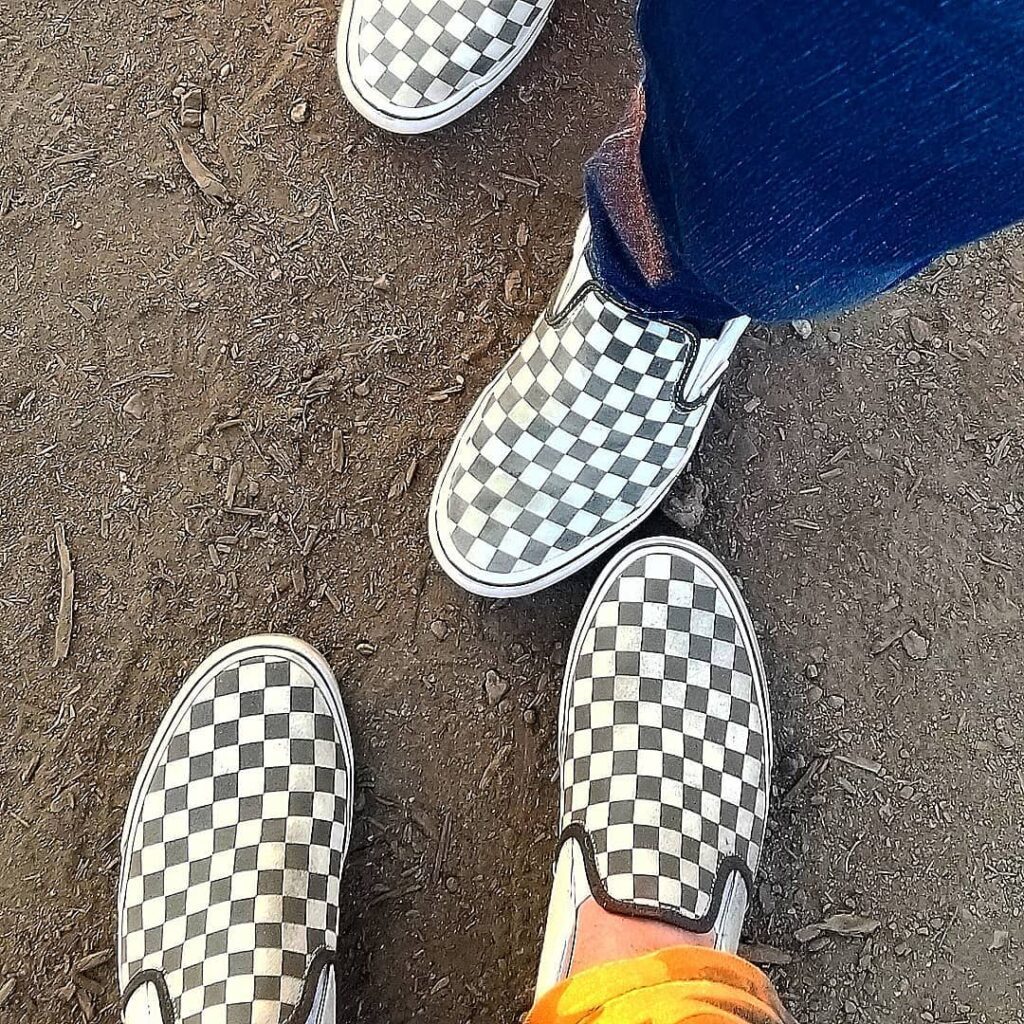
I have taken only a handful of selfies with music people over the years because I like to just be in the background or whatever. But one of my favorite pictures …and I printed it out for this occasion, and it would be in my book if I ever did a book… is you and I in Providence, Rhode Island at an outdoor festival in 2019. I say that we were wearing the same shoes and said “oh, can we take a picture?”
Photo by the author, Providence RI 2019
I remember this!
It’s one of my favorite pictures. I love it. And especially because three people know what it is, you, me and my wife (*both laugh*).
Yeah, that’s great. That would have made it into the book for sure.
And like, to me, it tells a story. And it’s a story that three people remember. I love it. Yeah, that will go in the book someday, which…
Well I know a guy with a publishing house… (*both laugh*)
Yeah, it just seems so daunting. Like trying to wrap my head around you going through pictures and figuring out “yes, no, maybe; yes, no, maybe.” It seems overwhelming to me. And to me, that would be enough to be like, “you know, I don’t want to do it.” Did you have those moments, or was it just like, full steam ahead once you did it?
Well, I think I’m not going through this because I hadn’t been taking pictures purposely, really, for a very long time. I really didn’t have to sort through 20,000 images. Let’s face it, I probably had to sort through 2000. And half of them immediately, were not going to be right, because they just weren’t. They didn’t even fit the criteria. So it wasn’t that big a deal. I also just have favorites. I don’t know. I mean, I guess that I’ve been told by people who have gotten the book who are like “Oh, I didn’t know you took pictures; you have a really good eye.” And I was like, “Well, I don’t even know what that means. But thank you.” And I think it just means that I look at a picture and go, I like that one better. And that’s it. And I just say that one’s better. I don’t know why it’s better. I don’t know what makes it better. Again, I’m just a, you know, just a kid with a phone, to oversimplify it a little. It’s just a feeling I get. It’s the same feeling when I’m writing a Dag Nasty song. It’s like you have three riffs…“does this one work? Is this good? No, but this one’s good. Well, that’s gonna be the riff, and that’s just how it is.”
Yeah. And I appreciate that. I do think that you have a good eye. And yet I’ve never necessarily known how to quantify what a good eye is. And I think that when you try to start quantifying what a good eye is, like, you lose some of the magic.
So maybe this all links to playing guitar, and maybe punk guitar specifically, because there’s so little structure involved with it. I’m sure there’s more expressive, ruleless versions of guitar than within the punk genre, because it does tend to have its own guardrails, but nevertheless, being a self-taught or not trained musician, and yet this stuff comes out. I mean, like, you think anyone told Bob Mould how to play guitar? I don’t think so. But how unbelievably beautiful and Bob Mould his guitar playing is, it’s just immediately identifiable. That’s just a thing; an intangible. And I think this is what an eye might be with a photographer. It’s just something. It just happens. You just know.
Are all of these pictures from prior to when you made the decision to put the book out? Or were any of these pictures taken let’s say since two years ago or whatever?
That’s a great question. And should actually prepare because I’m going to do a number of these conversations. The only one I’m aware of – and it’s because I’ve had to talk about it – is there is a picture of a stack of Les Paul Juniors. I know that I took that because I knew that I was doing a book. It’s a picture of Johnny Two Bags and my and Mike Dimkich’s guitars from the Bad Religion/Social Distortion tour from the summer of 2024.
I took a lot of pictures of those guitars on stage.
Right. And so I knew I had this book in in the works. I don’t remember exactly what the status was, but I know that when I when I found out that we were going to tour with Social Distortion, independent of the book, I’m like, “Oh, my God, I finally get to take a picture of all these guitars together.” Because I’m great friends with Johnny, and he has these beautiful instruments. It’s like, this is gonna be so cool. We’re gonna have all these vintage guitars together that are also punk vintage; like fucked up vintage guitars. And I must have taken 30 pictures that wound up being that. I mean, it was like the third day of the tour. And (in the picture) these guitars are all stacked up on a shipping pallet. There was a shipping pallet like by where the trucks were loading. And I’m like, “Oh, that would be really cool.” And I’m just like, “let’s go.” I found Johnny and Mike and was like, “grab your guitars and just go” and I took that picture. The inside of one of the semis was empty, because they loaded all the gear out of it, and so I kind of made it look like the guitars were just sort of thrown down in the semi. I did a lot of different setups, maybe three or four different setups, and that’s the one I wound up keeping. And I just I think it’s my favorite picture in the book. And also, because it’s so cool. It’s Johnny and Mike.
Yeah, it’s awesome. I mean, it makes me nervous as a pretend guitar aficionado, like, “Oh, that makes me nervous. That’s so much so much awesome gear.”
But they’re just tools. And also, it’s not like I threw them there. I gently put them down.
No but it looks like they’re just toothpicks that fell on the floor. But I did wonder that if knowing that there’s a book coming, I’m assuming you have still taken pictures, even though all of these pictures were submitted, but does that change what you take pictures of?
No.
And it hasn’t changed the way your brain works that way?
No, it hasn’t. But because I think that I had made a change, and this is definitely prior…for the purposes of this discussion, let’s just say that I knew that there was going to be a book out in the beginning of 2024. I don’t recall, but let’s just say that that’s when I finally started to talk about doing it. Well, I know that for a couple of years prior to that, I consciously had started making myself not walk by photographs. And this is something I did up until about 2022, that I would see something cool, and I wouldn’t bother to stop walking and take my phone out of my pocket and take a picture of it. And then sometimes something would be so good, I’d walk three blocks and go, “you really have to go back and take a picture of that,” of whatever the fuck it was. And I realized that this was a healthy thing to do. And whether it’s a part of just, you know, dealing with my OCD, or spending time during the day, or whatever, I started to consciously not walk by photographs. Doesn’t mean they were good. It’s just never letting opportunities go away. And so that was definitely happening long before Jennifer made a mock-up of my Instagram page. But it wasn’t for my Instagram page. I’ve never really thought of that as like…I’m not a social media maven. I don’t have a brand. That page has never been like, “this is my ticket out of here, man!” (*both laugh*) Like, “Hey, Graffin, man, I don’t need your fancy words!” (*both laugh*) That was always just sort of like a communication device. Again, I just never really took it seriously. So I wasn’t amassing stuff for public consumption is what I’m saying. I just took pictures anyway. But for a few years prior to deciding to do this book, I was trying to not miss anything for whatever that’s worth.
Maybe that’s where the switch flips from “somebody who takes pictures” to “somebody who’s a photographer,” right?
Possibly.
Maybe that decision is like the circuitry rewiring.
It could be. And that’s true. Maybe it’s when you’re playing guitar and then one day you start to make up your own songs.
Yeah, right.
And you’re like, “oh, I should remember that riff.” I mean, I just see so many parallels in the way I learned to be a guitar player and then a musician with this photography thing. With photography, I’m still in the stage where I’m like in the band after Minor Threat (*both laugh*). Like I’m in like Government Issue as a photographer. Like maybe I’m going to be in Samhain for two weeks right about now, you know, in my personal timeline. (*both laugh*)
This hasn’t made you want to invest in like a fancy Sony mirrorless camera to do another version of this?
I don’t know. You know, I have no desire to get another camera or another phone. And my phone, my current phone, is the iPhone 13 Mini because they’re so easy. And I know now that it’s old enough where it’s starting to like do weird things and you can’t buy them anymore. Again, I’m not a phone person, so I’ve never been like “the next phone’s out!” It’s like I get a new one when the old one, when this technology will no longer let me us it.
You and me both.
Yeah, exactly. So I know the next one I get, the camera is going to be way better. But since I don’t really manipulate, like I don’t know what that means. I’m not going out to look for a film camera or a, you know, a good digital camera. Like I can’t even… I can’t.
It’s too much, as somebody who pretends to be a photographer. It’s too much.
It’s too much. And I’d never use it, you know?
Yeah. And then it becomes a thing, and then you’re conscious about it.
Here’s how little I’m helping myself as a photographer…This is great. I went to a Mets game with Glen E. Friedman, who I’ve known forever, about just before there was a physical copy of the book. And I went to the Mets game with Glen. We watched a baseball game. It takes a long time to watch a baseball game.
Less than it used to. But yes, it does.
Right. And I was going home. I think we blew it out. We were winning and I left in probably like the eighth inning. And on the way home, I realized that not only had I not mentioned to Glen that I had made a photo book, but I had not asked Glenn about taking pictures. I was sitting next to my favorite punk photographer…(*both laugh*)…Who is insanely talented. I didn’t ask him one question. (*both laugh*) I mean, next time I hang out with Glenn, I’m going to pepper him with shit.. But that’s how detached I am from being like a quote photographer is I had this incredible opportunity. It’s like going to dinner with Eddie Van Halen. “And what strings do you use?” Like, I just didn’t. I was so dumb. Not going to miss that again.
I was going to say, I wonder if he appreciates that, because I’m sure everybody talks to him about being a photographer.
Yeah, but he’s cool.
I think if you’re buddies…
Yeah. Yeah. I think he’d be cool. I wish I told him that I had a book. I haven’t even sent him one, actually. I should probably.
So there are a couple of pictures in the book that I wanted to talk about. One of my favorites, because I have almost an identical picture, is Bruce’s ’52 Nocaster or whatever.
Yeah. Yeah.
In Freehold. I love that. And I didn’t know it was there the time that I saw it. And as a person who historically has gone to Asbury Park for music and like whose parents are still dyed-in-the-wool Springsteen fans, I didn’t know that guitar was there. And I was like, oh, my God.
And I didn’t know it was there. And I’d lived here for probably four years. And then I found out that it’s on 10th Avenue.
Yeah.
And it’s like “oh, of course it is. The Freeze Out.”
Right. Yeah.
Because I’m not really very versed in Springsteen. But of course, now that I’ve lived in…well, I live in Neptune, but we just call Asbury Park.
Right, it’s close enough.
It’s kind of like you being in Boston, you know?
Exactly.
So being in Asbury Park for eight years, of course, I feel that I am very remiss in my duties; my Springsteen knowledge. But I just haven’t, you know…saxophones, you know? (*both laugh*) I like punk.
I get it. I get it. To me, it was the synthesizer, the keys, like in the Born In The USA era. I did this podcast recently where they have you pick four records from essentially each quarter of your life. What was the defining record from that quarter? And for me, the first quarter of my life, the first I called it the first 11 years, was Born In The USA, because that album was on all the time in my house. My parents went to Giant Stadium to see Springsteen on that tour. It was huge. And I have tried to listen to it in years since and I don’t really like it at all. I don’t like production on it, I don’t like the keyboard. “Born In The USA” would be such a good song if it didn’t have that ham-fisted (*hums synth line*) in it. Like, it’s so I can’t listen to it.
Good lyrics.
Sure.
You know, I mean, I just look at it that way. Like, I can’t really listen to it either. But I get why it’s good. And I’m glad it’s out there. It’s like Dylan for me, or probably Geddy Lee for people, except for, you know, maybe I wouldn’t relate. (*both laugh*)
I love Geddy Lee myself.
Yeah, you know what I mean? But (Bruce) is a very nice man, and he does great stuff for the community. And, you know, he’s not taking any shit. I like that, too.
I love it. Yeah, I love it. There are a lot of pictures in here of busts of…
Right! I collect busts.
Oh, really?
I collect busts, but I didn’t realize I collected busts until I just happened to have a lot of them. And now I know I collect them. And that means that, you know, with like the cutoff is like 100 bucks. I just think they’re cool. I don’t know. Maybe it’s because of DC, growing up in DC, that kind of, you know, retro Greco thing. I mean, looking at right now talking to you, I have a bust of Teddy Roosevelt.
Oh, funny.
Sitting right next to my computer. And I mean, you could do worse for presidents.
Yeah, absolutely.
He had something going on, but he’s like many of them, a product of their time. (*both laugh*) But yeah, and so there are a lot of pictures of graveyards and busts and stuff. I just my eyes just love it. I just love them.
Yeah, there’s something compelling about a lot of them. And there’s one, I didn’t put a sticky on that one, but it almost looks like somebody’s death mask, right? That had been painted some and I forget, I feel like it’s towards the beginning. So I’ll flip and talk and stall…but I don’t think it was a death mask, but it’s sort of like that. I’ve always been sort of drawn to that sort of imagery myself.
That mask that you’re talking about is made of plaster. I have had that piece, probably 30 or 40 years. I bought it at a thrift store or yard sale. And I don’t know what its purpose was, you know, like theater kids practice or something. It was just some… I don’t know what it was. Obviously amateur. I don’t think it’s supposed to be artwork. I think it might have been from some kind of production.
It’s like vaguely John Waters looking.
Yeah! I just found it and I’ve just kind of carted around, you know? It used to be in like my room at the group house and eventually made it all the way to my grown-up house in the garage. Does it have glasses on it? Because …
I don’t feel like it does. No, it is not wearing glasses.
Okay, in real life it does, because the glasses that are on it are my old glasses from Minor Threat.
Oh, funny! So the glasses aren’t supposed to go with it.
No.
That’s funny. Yeah, I like that. I like, I like your eye. And I like that all these pictures were taken just as a means of capturing images that were cool to you without the point of a book behind it. Because it really seems like authentic and punk rock that way. This is it’s really fun to go back and look at. Yeah, I don’t always say that about photography books.
Yeah, well, great. I’m really glad. And I kind of agree with you. It’s like, I just don’t. I don’t know if I’m allowed to say it. But it is authentic in punk rock. Because it’s just completely not contrived. And it was for no purpose other than to exist. Yeah it’s just cool, and I’m so grateful that I had some friends who could help me and make it into something because, again, there’d be none of these early punk records if there weren’t people who were like, “hey, I’m interested in recording music.” You know, where would people be?
Right! Thank you for doing this.
My pleasure. My pleasure.
I have seen the list of people that you’re chatting with. Walt and Ian and Damian and Brett Gurewitz, and to pretend I’m even tangentially in that class is good for my ego.
So you’re not just tangentially in that class, you’re in that class!
Well folks, the world is going to hell. Every day is a little more apocalyptic than the last and it’s hard to even remember the last time we went 24 hours without a constitutional crisis. In times like these it’s tempting to throw your hands in the air and drink yourself into oblivion. But fear […]
Well folks, the world is going to hell. Every day is a little more apocalyptic than the last and it’s hard to even remember the last time we went 24 hours without a constitutional crisis. In times like these it’s tempting to throw your hands in the air and drink yourself into oblivion. But fear not, my friends! If you find yourself fighting those feelings of anxiety and despair with a pint glass of hope, boy have I got the record for you.
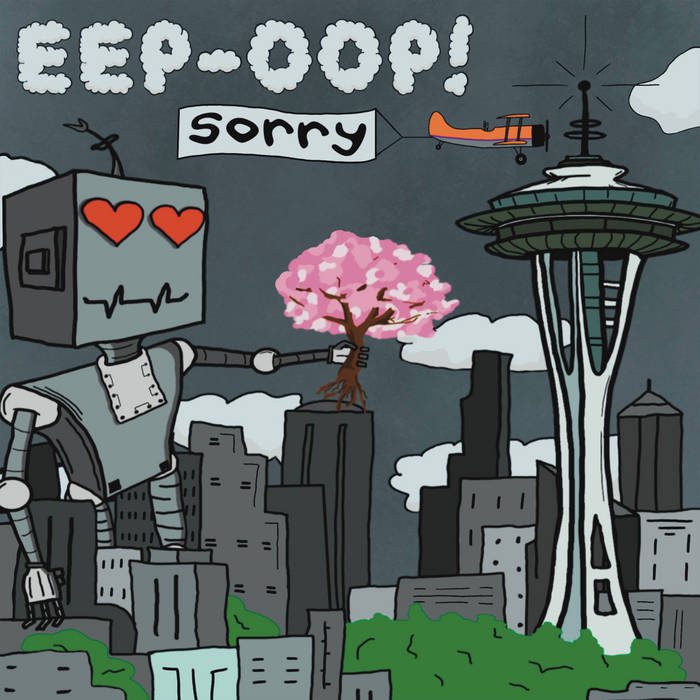
Seattle’s Eep-Oop! are here to turn all your bad feelings into good feelings…or at least supply the soundtrack to a night of binge drinking with your pals. Just like a good mix drink, Sorry, the debut album from this five headed pop punk hydra, is a little bitter, a little sweet and guaranteed to lift your mood and help you forget that we are living in a global dumpster fire.
Punchy bass and big chugging guitars are balanced expertly with tight drum work and hooky synth lines to create a bouncy backdrop for the these 8 tales of depression, isolation, self loathing and angst that somehow come across as triumphant rather than lachrymose. The voices of dual singers Steve and Aimee fit together well, balancing one’s gruff and snotty timbre with the other’s more direct and melodic sensibility to create an effervescent mixture that helps the melancholy storytelling in the lyrics feel almost hopeful. If there is a common thread in these songs it is the desire to drink away the negative feelings that itch at the back of your brain, and party through the pain of post adolescent disillusionment.
The opening track “Blackout” sets the tone right out of the gate with the cracking of a beer and the rallying cry of the alcoholic, “Let’s get blackout drunk in the parking lot”. It’s a fun little rager to kick things off with a grin. “Don’t Waste Away With Me” is a synth driven tale of a relationship on it’s last legs, with each singer playing the parts of the respective aggrieved parties begging one another to walk away. The alternating perspectives make for a playful trading of self inflicted jabs, rather than a bitter feud. “R2Steve2” is the self deprecating declaration of a guy who can’t seem to get his shit together, and barely seems to care. I’m sure we all know some version of this guy, or maybe we are this guy deep down.
The album continues with more tales of self medication and voluntary alcohol fueled amnesia in the face of the struggles of life and love. Other standouts include “Crashing And Crawling” which has a lovely half time pre chorus dropout that adds a nice dynamic change to an otherwise full force charge, and an ode to corporate frustration and isolation called “Inbox” that finds Aimee taking the lead.
Overall, this is a solid first effort from a band that has a lot going for them. If you enjoy fellow Seattle punk poppers like Dead Bars and The Subjunctives or Bay Area drunk punks The Hammerbombs, this might be just what you’ve been looking for. The album drops November 21st, but you can stream the first two singles and preorder the album now via Bandcamp.
Welcome to Four Records! Happy Halloween! This week Forrest speaks with Steven Gorrissey, singer for the Mismiths, the best Misfits/Smiths tribute band you didn’t know you needed. This year they released the Dead To ME.P., five songs mashing the sounds of two polar opposite singers, Glenn Danzig and Morrissey. The Mismiths are coming to your […]
Welcome to Four Records! Happy Halloween! This week Forrest speaks with Steven Gorrissey, singer for the Mismiths, the best Misfits/Smiths tribute band you didn’t know you needed. This year they released the Dead To ME.P., five songs mashing the sounds of two polar opposite singers, Glenn Danzig and Morrissey. The Mismiths are coming to your town:
Oct 24th – Jerry’s Pizza – Bakersfield, CA
Oct 25th – OC Fairgrounds – Costa Mess, CA
Oct 26th – Cheznanigans – Santa Maria, CA
Oct 30th – The Barn – Riverside, CA
Oct 31st – Yucca Taproom – Tempe, AZ
Nov 1st – Harvard and Stone – Hollywood, CA
Nov 8th – Kilowatt Brewing – San Diego, CA
Nov 15th – The Hideout – La Habra, CA
Nov 28th – Summer Fox Tower – Fresno, CA
Nov 29th – Ivy Room – Albany, CA
Nov 30th – Humdinger Brewery – San Luis Obispo, CA
Dec 11th – Dave and Busters – Hollywood, CA
Dec 12th – Mi Vida Loca – Fullerton, CA
Feb 19th – Star Bar – Atlanta, GA
Feb 20th – The Handlebar – Pensacola, FL
Feb 22nd – Pensacon – Pensacola, FL
For more information about shows and to buy merch, click here.