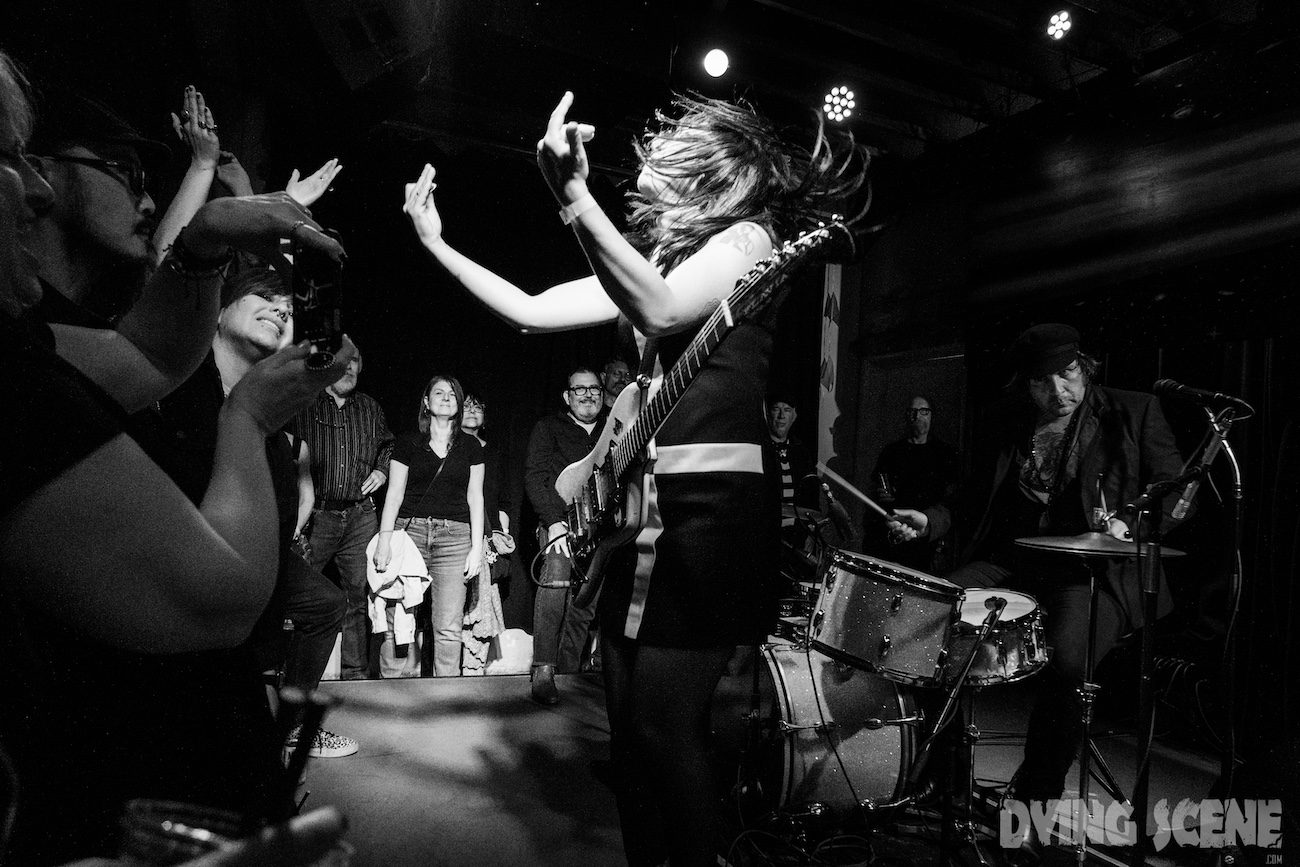
On Wednesday, 17 September 2025, Denmark-based Danish-Brazilian garage rock duo, the Courettes, played a sold-out show to a packed crowd at Comet Ping Pong in Washington, DC, with local band Jake Starr and the Czars as the opening act.
Comprised of Brazliian singer/guitarist Flavia and Danish drummer/vocalist Martin Couri, the Courettes is a married couple that really packs a punk rock and roll punch with their take on garage rock. They started their set with The Boy I Love, which let Martin lead with the drums and allow Flavia to take the stage delivering some wild riffage before launching into her raw and beautiful vocals. The crowd rocked out stomping, clapping, and singing through the show.
The band endured a 30-hour flight before driving straight from the airport to the venue with only some of their equipment, which made for a special night. Usually accompanied by backing bass and synth tracks, the Courettes were forced to deliver their songs in their rawest form with vocals, guitar, and drums. They also shared that their working visa cost a whopping $7,000.00 and implored the crowd to buy some merch and make the best of this rought first night of their North American tour.

Despite their jet lag, misplaced equipment, and daunting business expenses, the Courettes delivered a classy set of garage rock with all the pop elements of Phil Spector style 1960’s rock and all the energy of 1970’s punk. Be sure to check out their new album, The Soul Of… The Fabulous Courettes, on Damaged Goods Records, and go see them for yourselves here.
The Courettes’ setlist follows:
The Boy I Love
R.I.N.G.O.
Until You’re Mine
Trash Can Honey
Want You! Like a Cigarette
Night Time (The Boy of Mine)
Tough Like That
Better Without You
Boom! Dynamite!
Won’t Let You Go
Hop the Twig
Encore
Keep Dancing
SHAKE!

Jake Starr and the Czars got the night started the night off with their take on 60’s garage rock. Starr, the vocalist, informed the crowd that he had just returned from a trip to Iowa and was much in need of this night of rock and roll. Starr explained that he and the band had just recorded an album in Europe and that most of the night’s songs would be available on that forthcoming record.

The band is comprised of Jake Starr (vox/tambourine/maracas), formerly of Adam West as well as Jake Starr & The Delicious Fullness, along with Peter Greenberg (guitar), Sean Crowley (guitar/vox), Nathaniel Osbood (drums), and Mike Lewis (bass) of legendary Boston-based garage band DMZ. Jake Starr and the Czars’ set included a powerful cover of Every Minute of Every Day by the Primitives. Be on the lookout for their It’s the Bad Times album release on 17 October (digital) and vinyl LP release on 21 November 2025. Go see them here.
Starr and the Czars’ setlist follows:
Flashes
Deborah Deevine
Falling Back on Me
Dream of June
Baby, Cry
Body Between Us
There’ll Be No Squopping
Am I Alive? Or Am I Dead?
Every Minute of Every Day
Keep Me Underground
Licking the Frog
It’s the Bad Times
